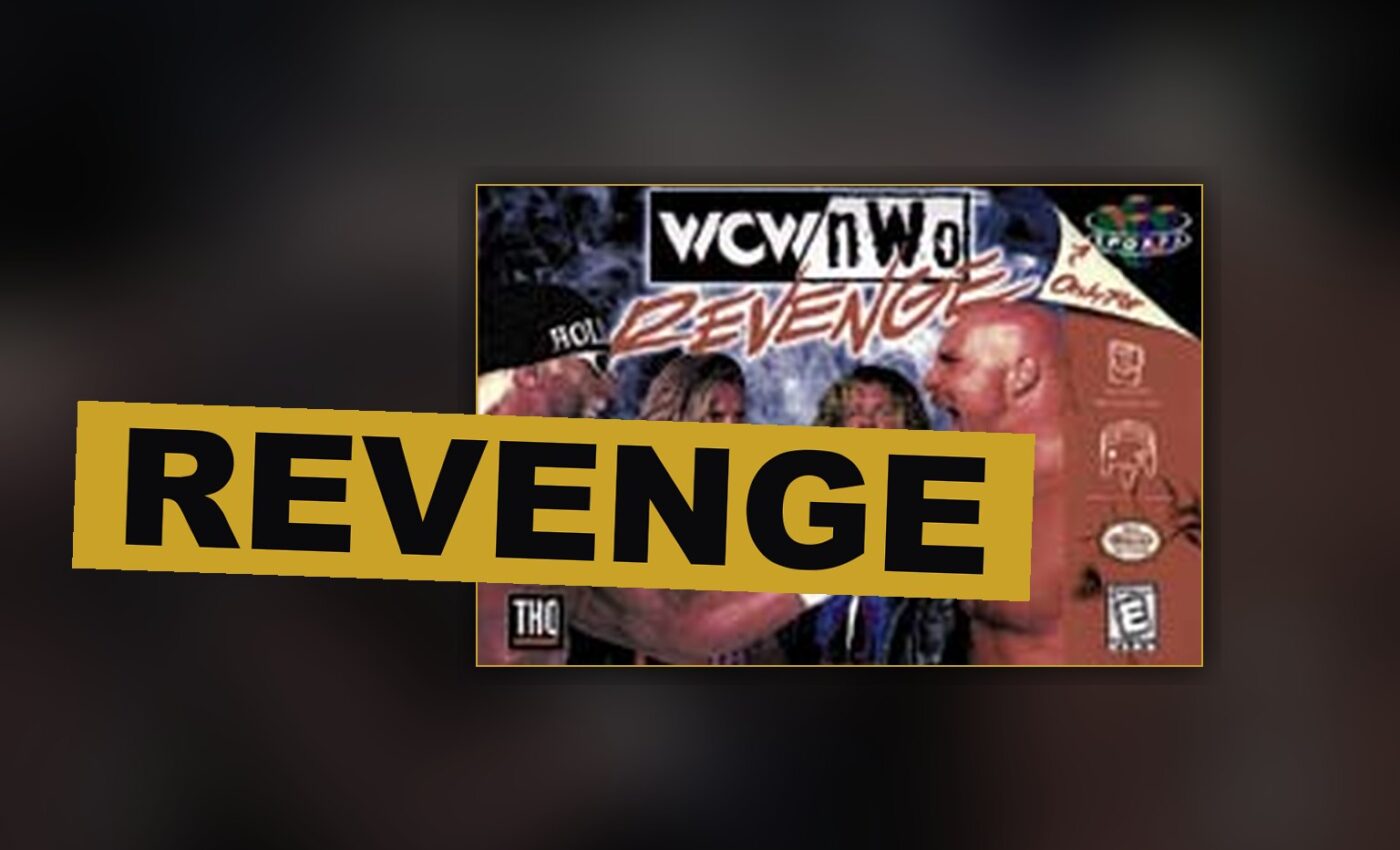
WCW/nWo Revenge arrived on the Nintendo 64 in 1998 with more than 60 wrestlers and a promise: this was the wrestling game that would finally feel like the real thing. THQ released it, Asmik Ace Entertainment and AKI Corporation built it, and it followed 1997’s WCW vs. nWo: World Tour. It is the best wrestling game on the console, and the margin is not close.
AKI’s Grappling System Returns
Revenge keeps AKI’s proprietary grappling system, the mechanic that separated World Tour from the pack, and builds around it. The graphics are heavily improved over the predecessor. A championship mode gives the roster somewhere to go beyond exhibition matches.
The roster is the headline. More than 60 wrestlers, real and fictional, covering the top WCW and nWo names. Every real WCW belt is in. Wrestler entrances are in. Hidden weapons, instant replay, a costume editing feature and complete user stats with arcade-style scores round out the package.
Real pay-per-view arenas replace generic rings. The 40-man Battle Royale mode is the strangest and best addition — a match type that turns the grappling system into a survival exercise.
What the Grappling Gets Right
The grappling system rewards patience. It is not a button-masher, and it does not pretend to be. AKI built a game where positioning matters, and Revenge refines that foundation rather than replacing it.
The mode list is the strongest argument for the cartridge:
- Championship mode, which gives the roster a season structure.
- 40-man Battle Royale, the mode that best uses the full roster.
- Split-screen multiplayer, for two players in the same room.
- Single-player, for anyone who wants the belts without a second controller.
That ordering is not arbitrary. Championship mode is the reason to keep playing alone. Battle Royale is the reason to call someone over. The rest is furniture, useful furniture, but furniture.
The costume editing feature is thinner than the mode list suggests, but it is there, and it works.
A Roster That Carries the Cartridge
More than 60 wrestlers is a number that sounds like marketing until you play it. Revenge uses the roster. The nWo and WCW split gives the championship mode its structure, and the fictional wrestlers fill out a card that would otherwise run dry.
The entrances matter more than they should. They are not a technical showpiece. They are the part of a wrestling broadcast that sells the match before the bell, and Revenge is the first N64 wrestling game that understood this.
The pay-per-view arenas do the same work. A match in a real arena feels like a match. A match in a generic ring feels like practice.
The Last AKI WCW Game
Revenge was the last AKI-developed WCW game for the Nintendo 64. The next AKI wrestling game on the console, WWF WrestleMania 2000, carried THQ’s newly acquired World Wrestling Federation license. That is the end of an era, and Revenge is a good place to end it.
The commercial record backs up the critical one. A 1999 IGN article called Revenge the best-selling wrestling game for the N64, and at the time, the top-selling third-party Nintendo game ever.
That figure is a snapshot from 1999, not a lifetime total, and it should be read that way. It still tells you what the game was.
Where Revenge Falls Short
WCW/nWo Revenge is not a perfect game. The costume editor is shallow, and the single-player loop leans hard on championship mode to stay interesting.
Those are small complaints against a game that nailed the thing that matters most: the grappling. The roster is the selling point. The grappling system is the reason it holds up. AKI built a wrestling game that respects the sport’s pacing, and THQ shipped it with enough modes to keep a cartridge in the console for a year.
Get the Notebook.
The day's best stories and every fresh verdict, in plain English, in your inbox by seven. One email a day, no more.