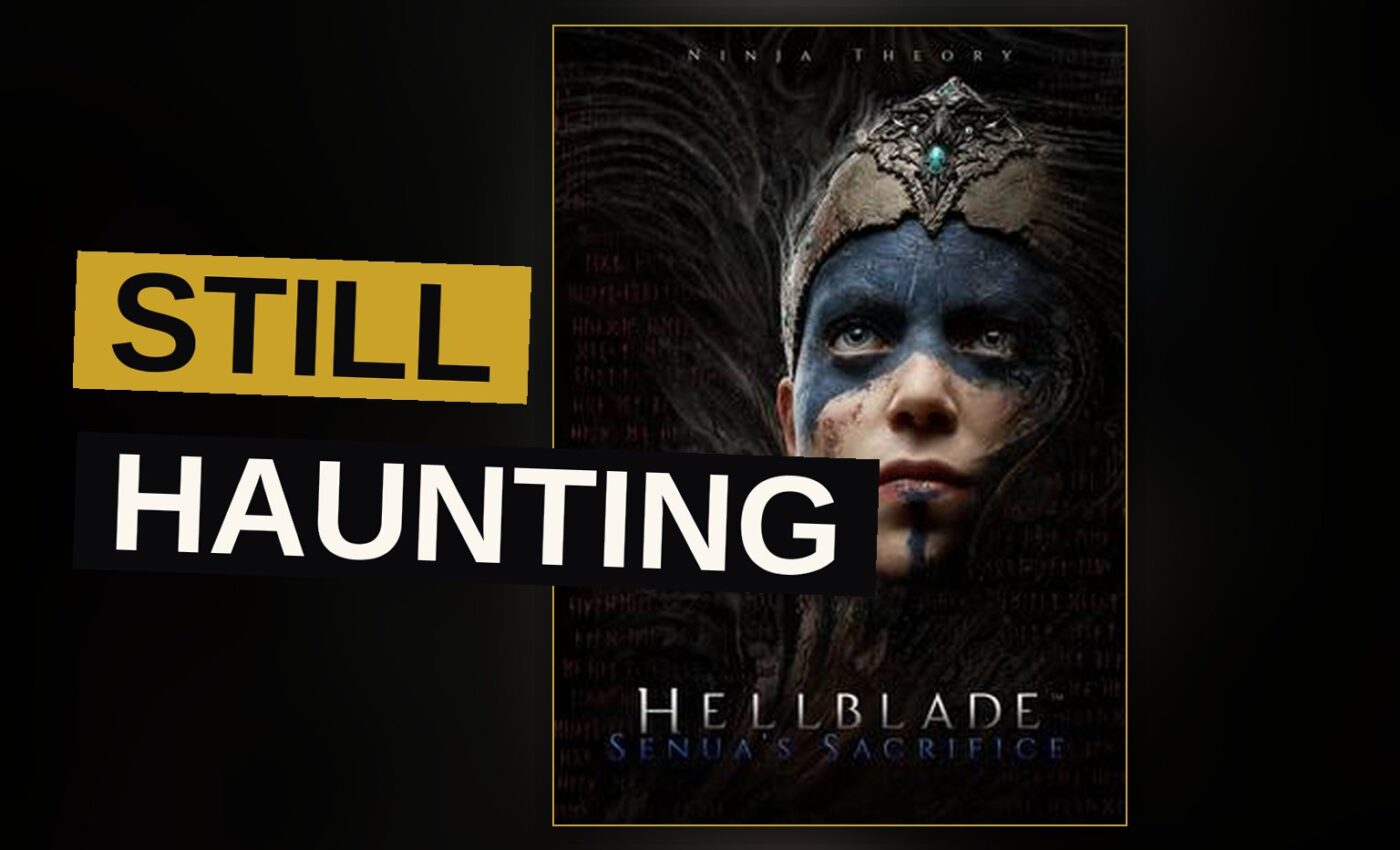
Hellblade: Senua’s Sacrifice is not a game you play so much as one you endure. Ninja Theory’s 2017 action-adventure drops you into the fractured mind of Senua, a Pict warrior who walks into Helheim to rescue the soul of her dead lover. The game runs on PS4, PC, Xbox One, and Switch, and it has lost none of its power in the years since release. It is a brutal, beautiful, and deeply uncomfortable experience that earns its reputation. The published critical score sits at 8.1 out of 10, and that number feels exactly right.
Trailer, via Ninja Theory.
Senua’s Journey Into Helheim
The setup is simple. Senua’s lover, Dillion, was killed by the Northmen, and she believes his soul is trapped in the Norse underworld. She sets out alone, carrying his severed head in a pouch at her belt. The story follows her through flooded ruins, burning villages, and impossible landscapes as she fights her way toward the goddess Hela.
The narrative is told almost entirely through Senua’s perspective. Other characters appear only in memory or in the voices that live inside her head. You are never allowed to see the world as it might actually be. You only see what Senua sees, and what Senua sees is filtered through psychosis, grief, and terror.
Ninja Theory worked with neuroscientists and people who live with psychosis to shape Senua’s experience. The result is not a cheap horror gimmick. The voices she hears are not whispers in the dark meant to scare you. They are constant, overlapping, and often contradictory. Some encourage her. Some mock her. Some simply talk over each other in a way that feels real and exhausting.
The Voices in Her Head
The audio design is the heart of the game. Senua’s voices are delivered through binaural audio, which means they appear to come from specific points in space around you. Put on headphones and the voices move behind you, to your left, above your head. They respond to what you do. They comment on puzzles. They warn you about enemies. They argue with each other about whether Senua is strong enough to finish the journey.
This is not a passive soundscape. The voices are a mechanic. During combat, they tell you when an attack is coming from behind. During exploration, they point you toward hidden paths. But they also lie. They tell you that you are failing. They tell you that you are already dead. They tell you that Dillion’s death was your fault.
The performance from Melina Juergens, who plays Senua, is the anchor. She spent years working on the motion capture and the voice work, and it shows. Her face carries every shift in belief, every crack in her resolve. She is not a stoic hero. She is a woman in pain who keeps moving because stopping means giving up.
Combat and Puzzles
The combat is functional but not the main draw. Senua carries a sword and can block, dodge, and parry. Light and heavy attacks chain together in simple combos. A focus ability slows time, but it runs on a meter that fills as you fight. Enemies come in a few varieties: shielded warriors, fast attackers, and large brutes. The fights are tense because the camera stays close and the animations are heavy.
The real challenge is not the mechanics. It is the permadeath system. If Senua dies too many times, the rot on her arm spreads to her head, and the game deletes your save. Ninja Theory later admitted that the system is a bluff. The rot never actually reaches her head, and the save is never deleted. But the game does not tell you that.
The puzzles are mostly environmental. You look for shapes in the world — runes carved into rocks, patterns in the architecture — and match them to the symbols floating in your view. The camera shifts perspective to line up the shapes. It is a clever way to make the world feel like it is rearranging itself around Senua’s perception.
A World Built From Fear
The visual design is extraordinary. Senua’s world is a mix of Norse mythology and her own distorted memories. The ruins are vast and silent. The seas are black and still. The sky is often a bruised purple or a sickly green. The game uses photogrammetry, scanning real locations and people to build its assets, which gives everything a grounded weight.
The enemies are drawn from the same well. The Northmen are not just warriors. They are manifestations of Senua’s trauma, their faces twisted and their movements jerky. The final confrontation with Hela is less a boss fight and more a slow, crushing walk toward an inevitability. The game does not give you a victory lap.
The Switch version, released in 2019, is a technical marvel. The game runs on hardware far weaker than the PS4 or Xbox One, and it holds together. The resolution drops and the frame rate dips, but the core experience survives.
| Version | Release Year | Performance | Best For |
|---|---|---|---|
| PS4 / PC / Xbox One | 2017 | Full resolution, stable frame rate | The definitive experience |
| Switch | 2019 | Lower resolution, occasional dips | Portability and convenience |
The Weight of the Story
The game takes about eight hours to finish. That length is a strength. It does not drag. It does not pad itself with busywork. Every section pushes the story forward, and every section builds on the one before it. The game knows when to give you a quiet moment, and it knows when to throw you into the next nightmare.
The themes are handled with care. Senua’s psychosis is not a superpower and it is not a weakness. It is simply part of who she is. The game does not cure her. It does not offer a tidy resolution where she learns to ignore the voices. It offers something harder: a moment where she accepts that the voices are part of her and keeps walking anyway.
The game also has a documentary mode, unlocked after you finish the story. It shows the making of the game, the research behind it, and the work of the cast and crew. It is worth watching. It makes the finished product feel even more deliberate, more considered, more human.