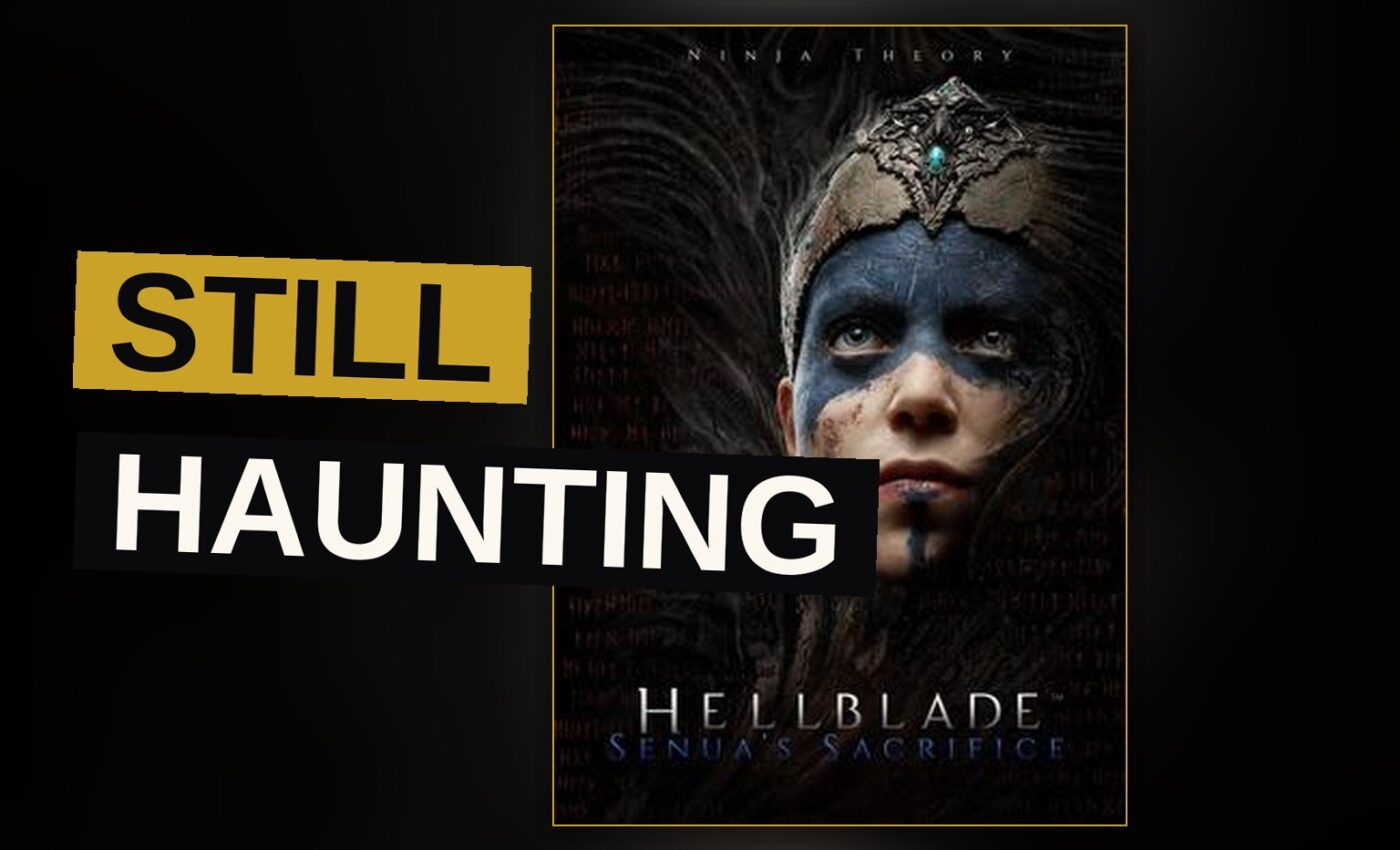
Ninja Theory built Hellblade: Senua’s Sacrifice with roughly twenty people and no on-screen interface of any kind. The result, released in August 2017 for PlayStation 4 and Windows, is an action-adventure game that trusts its own audio to do the work most games hand to a minimap.
Trailer, via Ninja Theory.
Senua Walks Into Helheim
Senua is a Pict warrior from Orkney, voiced and motion-captured by Melina Juergens. She enters the Norse underworld carrying the severed head of her dead lover, Dillion (Oliver Walker), as a vessel for his soul. Her goal is to reach the goddess Hela and win him back.
She hears voices. Senua calls them “Furies,” and the most prominent is the Narrator (Chipo Chung), who knows the player is there and speaks to them directly. A dark entity called the Darkness (Steven Hartley) follows her the whole way down.
Senua believes her psychosis is a curse. The game treats it as something else: a condition that shapes every room she enters. Ninja Theory built that portrayal with neuroscientists and people who live with the condition, and it shows in the writing rather than in a disclaimer screen.
Voices Instead of a Health Bar
There are no tutorials and no on-screen readouts. Audio cues from the Furies tell you when to block, when to dodge, when an enemy is winding up behind you. It is a bold design choice that mostly holds.
Combat is melee, third-person, camera locked to whichever enemy Senua faces. Quick attacks, heavy attacks, kicks to break guards, parries, dodges. Parry or dodge enough and she can spend her “focus” ability to move faster than her enemies or burn away the shadows some of them are made of, shadows that make them immune to normal hits.
The rest of the game is walking and puzzles. Focus triggers puzzle events and reveals memories tied to forty-four hidden totems, each one a voiceover of her dead friend Druth (Nicholas Boulton) telling Norse legends. Find all forty-four and a bonus cutscene plays shortly before the climax, filling in Druth’s backstory.
Some areas run their own rules, like reaching a safe zone before Senua dies. The variety is real, though the puzzle logic leans on the same trick more than once.
Surtr, Valravn, and Gramr
The boss fights give the structure its spine. Senua defeats the fire giant Surtr and the god of illusions Valravn before she even crosses the bridge to Helheim. Hela meets her there and drops her with a single blow, shattering her sword.
Senua survives, cauterizes a gash on her head, and follows visions of Druth and a man-shaped light she thinks is Dillion to a great tree. Four trials test her body, spirit and mind. The reward is Gramr, a sword powerful enough to kill Hela, which also lets her charge heavy attacks for extra damage and parry more efficiently.
The backstory arrives out of order through hallucinations, including the fate of her mother, the healer Galena (Ellie Piercy). Nonlinear is the right call here. Senua’s memory works the way the game is built.
What Twenty People Made
Hellblade: Senua’s Sacrifice calls itself an “independent AAA game,” a phrase that usually means compromise. This one mostly doesn’t. Writer and director Tameem Antoniades led a team of about twenty, and the cutscenes blend Juergens’ motion capture with live-action performances from other actors. Virtual reality support arrived in a 2018 update.
The game has since traveled. Xbox One got it in April 2018, Nintendo Switch in April 2019, Xbox Series X/S in August 2021, and PlayStation 5 in August 2025.
| Platform | Release |
|---|---|
| PlayStation 4, Windows | August 2017 |
| Xbox One | April 2018 |
| Nintendo Switch | April 2019 |
| Xbox Series X/S | August 2021 |
| PlayStation 5 | August 2025 |
That spread matters. A game this small, this strange, and this dependent on headphones kept finding new audiences for eight years, which is not how most single-player action games behave.
Where the Voices Lead
The audio-first design is the whole bet, and it pays off more often than it frustrates. When the Furies whisper a warning a half-second before an attack lands, Hellblade does something no health bar can: it makes you trust a voice you are not sure you should trust. That tension is the game.
Where it stumbles is repetition. The puzzle vocabulary is narrow, and the combat, while weighty, runs out of new ideas before the credits. The Darkness is a thinner antagonist than the Furies, more a mood than a character. And the fourth-wall breaks from the Narrator will divide people — clever for some, a step too cute for others.
None of that undoes the achievement. Hellblade: Senua’s Sacrifice treats psychosis as a way of seeing rather than a monster to defeat, and it does so without a single explanatory cutscene telling you what to feel. Ninja Theory spent its budget on voices instead of vistas, and the voices are the reason this one stays with you.
For a twenty-person team working against the grain of blockbuster design, that is close to a best case.
Get the Notebook.
The day's best stories and every fresh verdict, in plain English, in your inbox by seven. One email a day, no more.