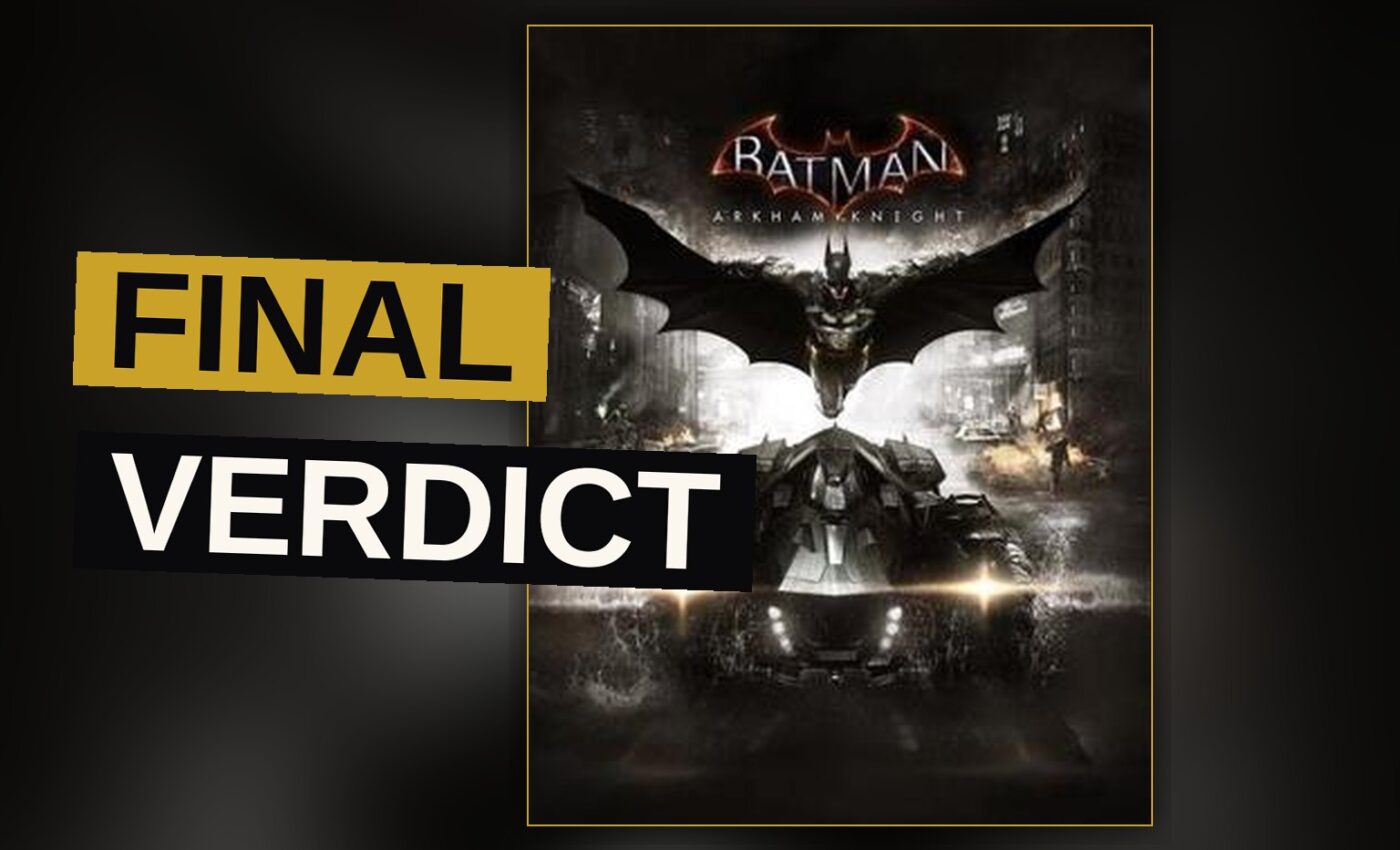
Batman: Arkham Knight closes the Arkham trilogy with a city on the brink, a broken Batmobile, and a villain who has been waiting in the wings since the beginning. This is a game about endings, and it rarely lets you forget it. The result is a massive, confident, and occasionally exhausting finale that earns its place among the best superhero games ever made.
Developer Rocksteady Studios has built a Gotham that feels alive, dense, and hostile. The rain never stops. The neon never dims. And the Scarecrow, the game’s chief architect of terror, has flooded the streets with fear gas and a militia that answers to no one. Batman: Arkham Knight is not a quiet game, and it does not want you to feel safe.
Trailer, via Batman Arkham Videos.
Driving the Tank Through Gotham
The biggest change in Batman: Arkham Knight is the Batmobile. It is not an optional toy. It is a core tool, a weapon, and a puzzle solver. You drive it through the streets, you use it to winch walls down, and you fight in it. The vehicle transforms into a battle tank, and those sequences are frequent.
The driving feels heavy, almost like a battering ram on wheels. It is fast when you want it to be, but it is not a precision machine. The combat, however, is a different story. The tank battles are simple on the surface: dodge, aim, fire. But the game layers in enemy types, drone swarms, and stealth sections that require you to fire from behind cover while moving.
The Batmobile sections are divisive, and it is easy to see why. They break up the rhythm of the hand-to-hand combat and the predator stealth that defined the earlier games. But they also give the game a scale it could not have achieved otherwise. When you are chasing down a convoy or tearing through a militia checkpoint, the power fantasy is real.
Riddler Trophies and the Long Grind
The Riddler returns, and he has outdone himself. His side quests are everywhere. There are hundreds of trophies, races, and puzzle rooms scattered across the map. Some are clever. Some are tedious. All of them are optional, but the game ties them to the main story’s ending. If you want the true final act, you have to collect them all.
That is a bold choice, and it is one that will frustrate many players. The Riddler’s content is extensive, but it is also repetitive. The payoff, a final confrontation with the villain, is worth seeing, but the road to it is long. For completionists, this is a marathon. For everyone else, it is a nagging reminder that the game wants you to stay in Gotham longer than you might want to.
The voice acting carries the weight of the script. Mark Hamill returns as the Joker, and his performance is a highlight. The Joker is dead in the story, but he lives in Batman’s mind, a constant taunt and a psychological weapon. Hamill delivers lines that are chilling, funny, and sad, often in the same breath.
Scarecrow’s Plan and the Knight’s Secret
The plot of Batman: Arkham Knight centers on the Scarecrow’s plan to destroy Gotham and unmask Batman. He is joined by the Arkham Knight, a new character who knows Batman’s methods and movements intimately. The Knight’s identity is a mystery the game holds close, and the reveal is a nod to long-time fans of the comics.
The narrative is dense, and it leans heavily on the history of the previous games. If you have not played Batman: Arkham Asylum and Batman: Arkham City, you will miss a lot of context. The game assumes you know who these people are and what they have done. That is a fair assumption for a trilogy finale, but it makes the story less welcoming for newcomers.
The pacing is uneven. The middle of the game drags, with several missions that feel like padding. But the final hours are a relentless push toward a conclusion that is both bleak and hopeful. The game ends with a question, not an answer, and it leaves the door open for a future that may never come.
“I am vengeance. I am the night. I am Batman.”
Rain-Slick Streets and Free-Flow Fights
Gotham City in Batman: Arkham Knight is the largest and most detailed version of the city ever put in a game. The streets are wide enough for the Batmobile, the buildings are tall enough for gliding, and the districts each have a distinct character. The rain and the lighting create a mood that is oppressive and beautiful at the same time.
The combat system remains the best in the genre. The free-flow fighting is smooth, responsive, and deep. You can chain combos, use gadgets, counter attacks, and take down groups of enemies with style. The game adds new moves and variations, but the core is the same as it has always been. It works, and it works well.
The predator sections, where you take out enemies from the shadows, are also strong. Each room is a puzzle, and you can approach it in multiple ways. The game rewards patience and creativity. You can hang from a gargoyle, hide in a vent, or use the Batmobile to blow a hole in the wall. The choice is yours.
Ports, Patches, and Performance
Batman: Arkham Knight had a troubled launch on PC, with performance issues and bugs that were severe enough for the game to be pulled from sale. On PS4 and Xbox One, the game runs better, but it is not flawless. The frame rate can dip in busy moments, and the loading times are noticeable. The game looks stunning, but it pushes the hardware to its limits.
The version on Switch, released later, is a remarkable technical achievement. It is a portable Arkham Knight, and it mostly holds together. The visual fidelity is lower, and the frame rate is less stable, but the game is playable and complete. For players who want the game on the go, it is a solid option.
The sound design is excellent. The rain, the thunder, the roar of the Batmobile engine, and the crunch of a punch all land with weight. The score is moody and cinematic, and it knows when to pull back and let the silence do the work.
The Cost of Being Batman
Batman: Arkham Knight is a game about fear, obsession, and the cost of being a hero. It is not a light story. The game asks you to spend a lot of time in the dark, and it does not always offer a reward for your patience. But when it works, it works on a level that few games reach.
The side missions are a mixed bag. Some, like the ones involving the other members of the Bat-family, are excellent. Others, like the tank patrols, feel like busywork. The game is packed with content, and it is easy to spend fifty hours in Gotham without seeing everything.
The voice cast is strong across the board. Kevin Conroy returns as Batman, and he brings the same gravitas he has always had. The supporting cast, including Nightwing, Robin, and Oracle, all get moments to shine. The Scarecrow, voiced by John Noble, is a menacing presence, but he is often overshadowed by the Joker.
Closing the Case on Arkham Knight
Batman: Arkham Knight is a fitting end to a great trilogy. It is ambitious, sometimes to a fault, and it stumbles in a few places. The Batmobile is overused, the Riddler content is bloated, and the pacing sags in the middle. But the core of the game is strong. The combat, the stealth, the world, and the story all come together to create an experience that is memorable and impactful.
It is a game that respects its source material and its players. It trusts you to follow a complex story, and it rewards you for exploring its world. It is not perfect, but it is close.
Get the Notebook.
The day's best stories and every fresh verdict, in plain English, in your inbox by seven. One email a day, no more.