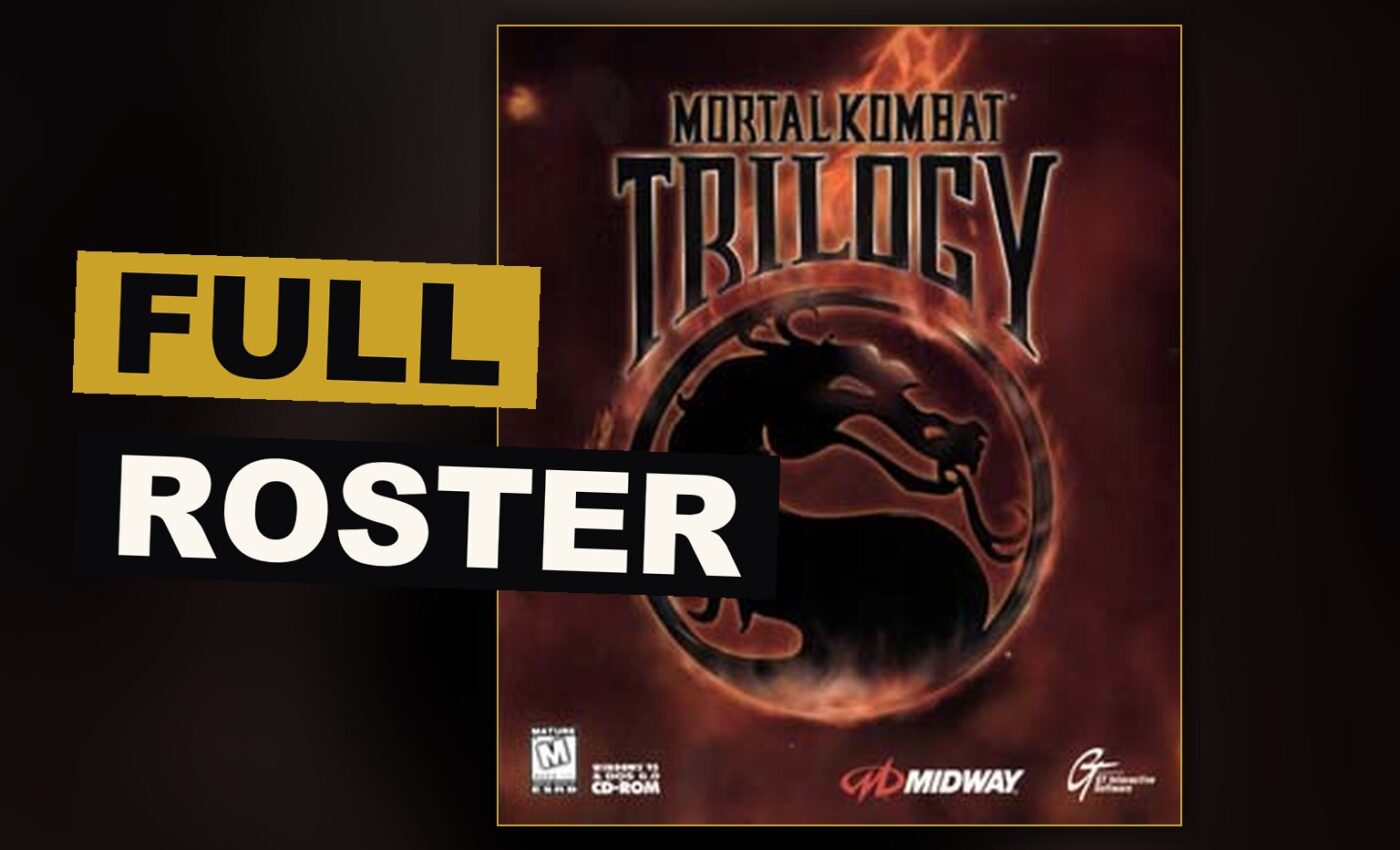
Mortal Kombat Trilogy is not a new game. It is the second and final update to Mortal Kombat 3, following Ultimate Mortal Kombat 3, and it arrived in 1996 on the PlayStation, Nintendo 64, Sega Saturn and PC. It runs on the same basic fighting system as Ultimate Mortal Kombat 3 and tells the same story. What it adds is a roster and a set of arenas pulled back from Mortal Kombat and Mortal Kombat II, plus two mechanics that change how a match plays out. On the Nintendo 64 it is a compromised but still potent package, and it earns an 8.4/10.
The Aggressor Bar Fills Twice as Fast on Block
The Aggressor bar fills as the two fighters trade blows. It fills twice as fast when the opponent is blocking. Once it is full, the character gets fast movement and greater attack damage for a short period.
That is a small addition with a large effect. It rewards a player who keeps pressure on, and it punishes a player who turtles behind a guard. The bar turns a defensive stalemate into a decision: hold the block and hand your opponent a faster, harder-hitting character, or break out and fight.
Brutality Ends With the Opponent Exploding
Trilogy introduces the Brutality, a finishing move built from a long combination of attacks that ends with the opponent exploding. It is the kind of finisher the series had been circling for years, and it lands here as a mechanic rather than a novelty.
The Brutality was also folded into the Mega Drive/Genesis and SNES ports of Ultimate Mortal Kombat 3, which shipped the same month as Trilogy.
Not every finishing move survived intact. Sub-Zero’s “Spine Rip” Fatality returns, but it is completely censored. The screen blacks out with only the “Fatality” text visible. The reason given is to avoid having to re-animate the fatality for this game.
That is the trade this collection makes in several places. The move is present in name, absent in effect.
Raiden and Baraka Return as They Looked in Mortal Kombat II
Alongside the Ultimate Mortal Kombat 3 roster, Trilogy adds Raiden and Baraka exactly as they appeared in Mortal Kombat II, with running animations created specifically for this game. Carlos Pesina played Raiden, except for one sprite portrayed by Sal Divita, who also portrayed Sektor, Cyrax, Cyborg Smoke and Nightwolf. Richard Divizio played Baraka, and also Kano and Kabal, including Noob Saibot in MK3 only.
Johnny Cage joins as well, portrayed by Chris Alexander, replacing Daniel Pesina, who was legally at odds with Midway. Cage is the only non-secret character exclusive to this version. He keeps his Mortal Kombat II moves except for the Split Punch, which was cut because none of the Mortal Kombat 3 and Ultimate Mortal Kombat 3 characters had graphics for getting hit in the groin.
Bosses Goro, Kintaro, Motaro and Shao Kahn are playable from the start on most versions. The Nintendo 64 version is the exception.
- Goro, Kintaro, Motaro and Shao Kahn are playable from the start on the PC, PlayStation and Saturn.
- The Nintendo 64 version includes only Motaro and Shao Kahn, and both must be unlocked before a match, in a fashion similar to Human Smoke on selected stage backgrounds.
- The PC, PlayStation and Saturn versions also carry alternate versions of Jax, Kung Lao, Kano and Raiden as they appeared in the first two titles.
Those alternate fighters come with a catch. MK1 Raiden, MK1 Kano, MK2 Jax and MK2 Kung Lao did not get proper running animations. They use a sped-up version of their walk animation when they run.
Stryker Throws Two Grenades Instead of One
Many characters gained additional special moves. Some are simple edits of existing moves, such as Stryker throwing two grenades instead of one. Others are unused animations never implemented in their intended previous games.
Those include MK1 Kano’s Knife Spin, MKII Kung Lao’s Air Torpedo, Goro’s Spinning Punch, Raiden’s Lightning that shoots from behind the opponent, and Baraka’s Blade Spin. Shao Kahn gained a throw and a grab-and-punch move. Motaro gained a proper throw.
This is the strongest argument for Trilogy as a package. These are not palette swaps or stat tweaks. They are finished moves that had been sitting unused, and they give longtime players something genuinely new to learn on characters they already know.
The Pit II Loses Its Stage Fatality
All the arenas that featured a Stage Fatality appear in Trilogy except the one in the Pit II, cut for reasons similar to the “Spine Rip” Fatality. Every battle arena from Mortal Kombat II, Mortal Kombat 3 and Ultimate Mortal Kombat 3 is available. Only four backgrounds from the original Mortal Kombat make it in: the Courtyard, Goro’s Lair, the Pit, and the Pit Bottom.
The versions diverge further. The PC, PlayStation and Sega Saturn versions lack the Hidden Portal and Noob’s Dorfen stages from Mortal Kombat 3. The Nintendo 64 version lacks Kahn’s Arena.
Two new secret characters appear depending on the version. Most versions have Chameleon, a semi-transparent ninja who rapidly switches between characters.
The Nintendo 64 Cartridge Drops Kahn’s Arena
The Nintendo 64 release is the one to weigh carefully, because it gives up the most. It loses Kahn’s Arena. It cuts Goro and Kintaro from the starting roster and locks Motaro and Shao Kahn behind an unlock. The PC, PlayStation and Saturn versions keep all four bosses available from the start.
What the cartridge keeps is the core. The Aggressor bar works. The Brutality works. The restored fighters and the unused special moves are all here. The fighting underneath is the same system that carried Ultimate Mortal Kombat 3, and it holds up.
The question is whether the missing arena and the reduced boss roster matter more than the convenience of a cartridge. For a player who wants the complete version, they do. For a player who wants the fastest-loading version of a 1996 fighting game, the trade is easier to accept.
What Trilogy Gets Right and What It Gives Up
Trilogy was met with mixed to positive reviews on release, and that range is fair. This is an update, not a sequel. It does not reinvent the fighting system, and it does not try to. It restores characters and stages, adds two mechanics, and cleans up a roster that had been scattered across three arcade games and several consoles.
The Aggressor bar is the real addition. It gives every match a second clock, and it makes blocking a cost rather than a refuge. The Brutality is a fine finisher, though the censored “Spine Rip” shows how much of this package is assembled rather than made.
The unused special moves are the part worth celebrating. Kano’s Knife Spin, Kung Lao’s Air Torpedo, Goro’s Spinning Punch, Raiden’s Lightning from behind, Baraka’s Blade Spin — these are moves that existed as animation and never reached players. Trilogy is where they finally land, and they are the reason to pick this up over Ultimate Mortal Kombat 3.
The Nintendo 64 version is the weakest of the main releases. Losing Kahn’s Arena and starting without Goro and Kintaro is a real cut, and the unlock requirement for Motaro and Shao Kahn adds friction to a game that should be about immediate access. The PlayStation, Saturn and PC versions are the ones to seek out.
Still, the fighting is intact, the roster is the deepest the series had assembled to that point, and the two new mechanics earn their place. Mortal Kombat Trilogy is a collection that knows what it is, and on the right platform it is the definitive version of Mortal Kombat 3’s era.
Get the Notebook.
The day's best stories and every fresh verdict, in plain English, in your inbox by seven. One email a day, no more.