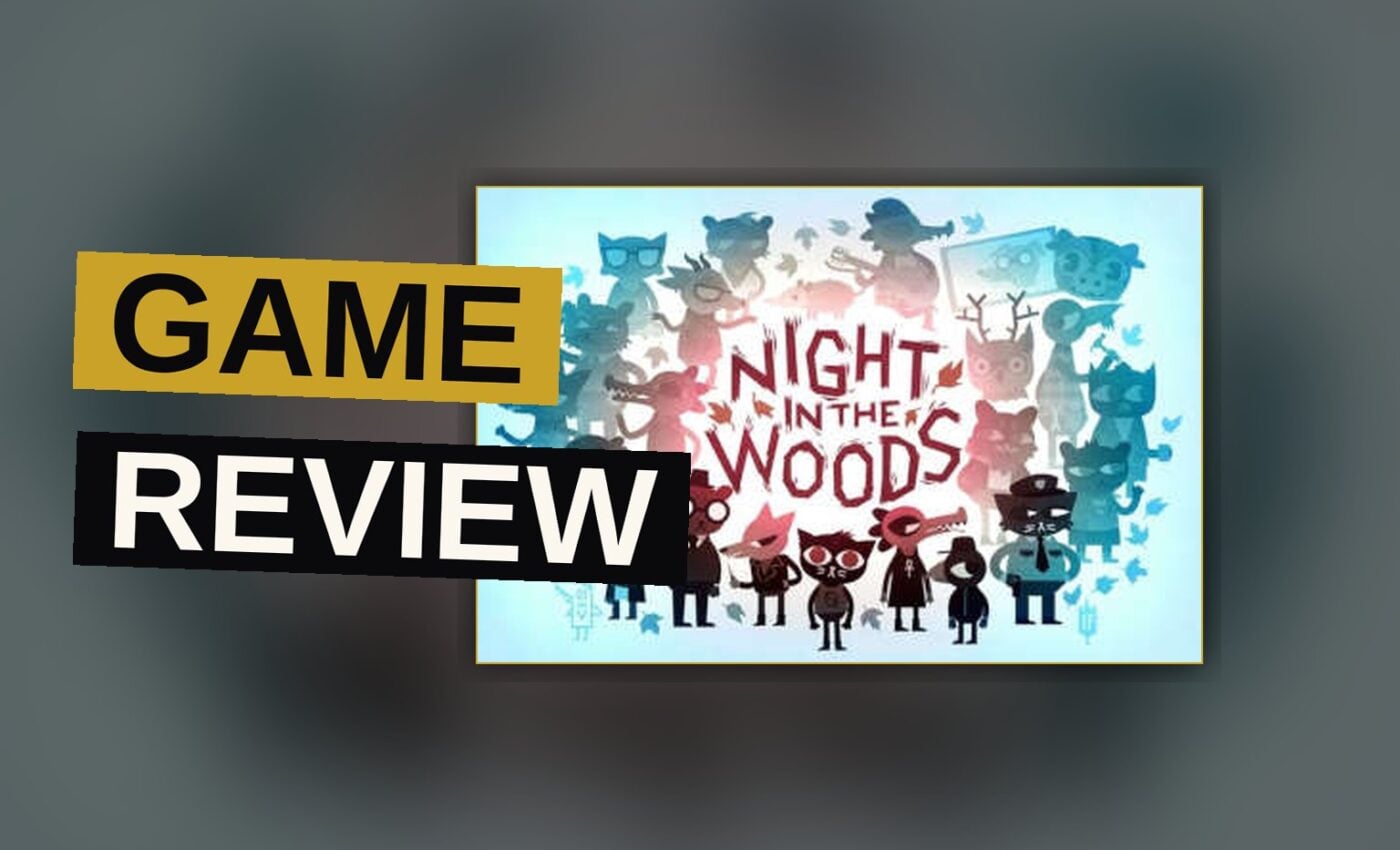
Night in the Woods dropped Mae Borowski back into Possum Springs, and the town had already moved on without her. Infinite Fall’s adventure game, released February 21, 2017, for PC, Mac, Linux and PlayStation 4, follows a 20-year-old college dropout who comes home to a Rust Belt town hollowed out by the closure of its coal mines. She wanted to run around with her friends, break things, and hold onto what the game’s own summary calls “a life of aggressive aimlessness.” What she finds instead is a place where nothing is the same, her old friends have grown in their own directions, and something is waiting in the woods.
Trailer, via Night In The Woods.
Possum Springs After the Mines
The setting does the heavy lifting. Possum Springs is populated by zoomorphic humans, and its economic stagnation is visible everywhere — the mines shut down years before the game starts, and the town never recovered. Mae lives in her parents’ attic. She reconnects with Bea Santello, a cigarette-smoking crocodile and childhood friend; Gregg Lee, a hyperactive fox; and Gregg’s boyfriend Angus Delaney, a quiet, sensible bear. She also learns that Casey Hartley, another old friend, has disappeared.
That disappearance is not background noise. It pulls Mae and her friends toward a secret the town has hidden for decades, one that involves the mine and Casey both.
Two Weeks, Late October to Early November
The game covers roughly two weeks, and it spends them on conversation rather than combat. Scott Benson described the player’s core actions as “explore, converse, see and touch.” Alec Holowka called the approach “narrative-focused” rather than “gameplay-first.” Mae is a cat, so roofs, ledges and powerlines are her playground, and the platforming exists mainly to move her around town.
Choices shape the story, but not in the usual branching way. Benson put it plainly: “it’s more like ‘do you hang out with this person?’ Okay, cool. That person might not know you as well by the end of the game, but this person you hung out with, you’re going to get to see their storyline.”
Paste magazine described the game’s themes as:
- Mental illness and depression
- The stagnancy of the middle and lower classes
- The slow death of small town America
Mae’s Dreams and the Harfest Kidnapping
Mae starts having strange, vivid dreams, and her mental health declines with each one. At the town’s autumn Harfest festival, she watches a teenager get kidnapped by a mysterious figure she takes for a ghost. Her friends are skeptical. The group — Mae, Bea, Gregg, Angus, and Germ — investigates anyway, and the trail leads to cloaked figures in the woods. They give chase. Mae falls down a cliff and lapses into a coma. Her friends escape. Churchgoers rescue her.
When she wakes, she tells her friends why she really left college: an increasing dissociation from people and the world, seeing everything as shapes. Her journal, where she draws pictures for in-game events, came from the town doctor, who gave it to her to record her emotions after she bludgeoned a student with a softball bat during a dissociative episode six years earlier. That incident made the townsfolk wary of her.
Why the Quiet Parts Land Hardest
Night in the Woods earns its reputation on the writing, not the platforming. The jumping is thin. The town is not. Infinite Fall built a place where the economic damage is legible in every conversation, and then refused to let Mae fix it. She cannot bring the mines back. She cannot make Bea less tired or Gregg less restless. The game’s own framing says as much: “The world is changing, things are ending, and the future is uncertain.”
That refusal is the point. Night in the Woods treats depression and dissociation as conditions Mae lives inside, not puzzles she solves, and it lets the horror stay small and local until it doesn’t. The Kickstarter campaign earned over four times its initial US$50,000 funding goal, which tells you the audience was already there for exactly this. The Weird Autumn edition later added new content and the supplemental games — Longest Night and Lost Constellation. It launched on Windows, Mac, Linux, PlayStation 4, and Xbox One on December 13, 2017, and reached Nintendo Switch on February 1, 2018.
The weakest stretch is the investigation itself. The cloaked figures resolve faster than the two weeks of hanging out that precede them, and the climax trades the game’s best asset — ordinary people talking — for a chase and a coma. The friendship scenes carry more weight than the conspiracy.
Still, this is one of the sharper games of its decade about what it costs to go home. Night in the Woods is available on PlayStation 4, Linux, PC, iOS, PlayStation 5, Mac, Xbox One, and Nintendo Switch.
Get the Notebook.
The day's best stories and every fresh verdict, in plain English, in your inbox by seven. One email a day, no more.