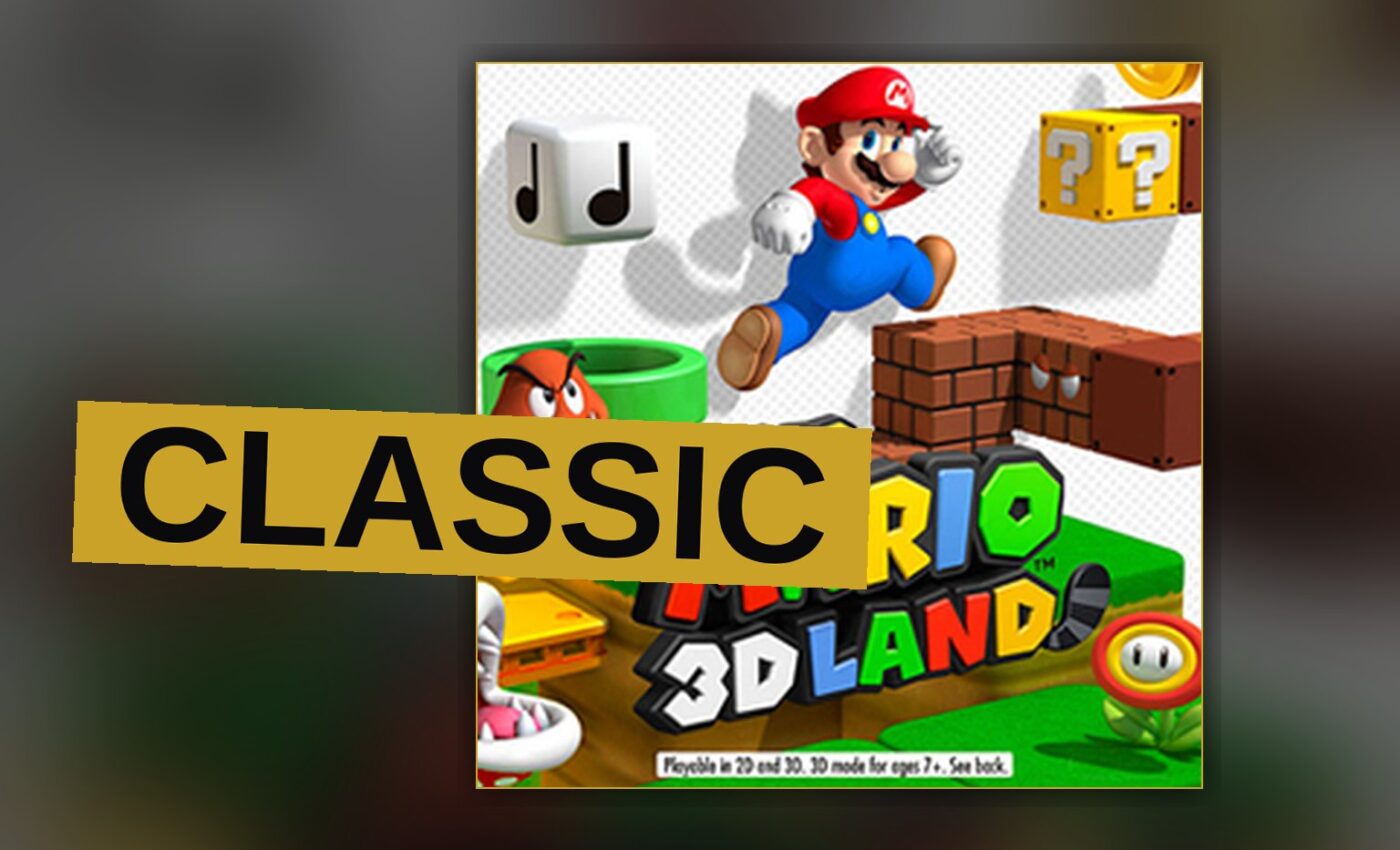
Super Mario 3D Land arrived on the Nintendo 3DS in November 2011 and did something deceptively hard: it made a 3D Mario that plays like a 2D one. Shigeru Miyamoto, the game’s designer, described it as a “3D Mario that plays as a 2D Mario game.” That idea carries the whole project.
Trailer, via Nintendo of America.
A Tail Tree and a Missing Princess
The story opens on the Tail Tree, a mysterious tree on Princess Peach’s castle grounds with a branch shaped like a tail. A storm strips its leaves. Peach goes to check on it and does not return. Mario and the Toads find the bare tree and an envelope holding a photograph of Peach in Bowser’s grasp.
Bowser took the leaves — they are Super Leaves — and is using them to give his minions tanooki tails and limited flight. Mario sets off to rescue her.
A 2D Mario in 3D Clothes
Super Mario 3D Land is the second 3D Super Mario platformer for a handheld and the successor to Super Mario Galaxy 2. It borrows the linear level structure of the side-scrollers and the free movement of the modern 3D titles.
The health system is old-school. Mario shrinks when he takes damage, and a hit as Small Mario costs a life. There is a dedicated Dash button rather than analog speed control. Each level ends at a Goal Pole, under a time limit.
The Tanooki Suit Comes Back
The power-ups give the game its texture. The Super Leaf returns from Super Mario Bros. 3, giving Mario the Tanooki suit: float in the air, attack with the tail, and with a later variant turn into a statue on a ground pound. The Boomerang Flower is new.
Mario also learns a barrel roll and a roll jump — the first to break blocks, the second to cross horizontal ground in one leap. Players can bank an extra power-up and tap it on the touchscreen.
The Camera Finally Cooperates
The stereoscopic 3D is not decoration. Judging a jump in three dimensions has always been the genre’s quiet problem, and the 3DS screen solves it. Depth reads cleanly.
Bowser’s Boss Fights Fall Short
The criticism that lands is the boss fights. They are the weakest material here, familiar and short on the invention the rest of the package shows. The knock about creativity is fair at the margins, not as a summary.
What 3D Land Built
The numbers settled the argument. As of March 31, 2024, Super Mario 3D Land had sold 12.88 million copies worldwide, the seventh best-selling game on the 3DS and the first 3DS title to pass five million. Nintendo released it as a download via the Nintendo eShop in 2012. A sequel, Super Mario 3D World, followed on the Wii U in November 2013 and on the Nintendo Switch in February 2021.
The sequel is the tell. 3D Land was not a one-off experiment; it set the template 3D World inherited. The boss fights are noise. The structure — 2D discipline, 3D space, and a camera that lets you trust your own eyes — is the part that mattered, and it still does.
Key facts
– Release: November 2011, worldwide
– Platform: Nintendo 3DS
– Developer/Publisher: Nintendo
– Director’s description: a “3D Mario that plays as a 2D Mario game”
– Sales: 12.88 million copies as of March 31, 2024
– Score: 9.0/10
Get the Notebook.
The day's best stories and every fresh verdict, in plain English, in your inbox by seven. One email a day, no more.