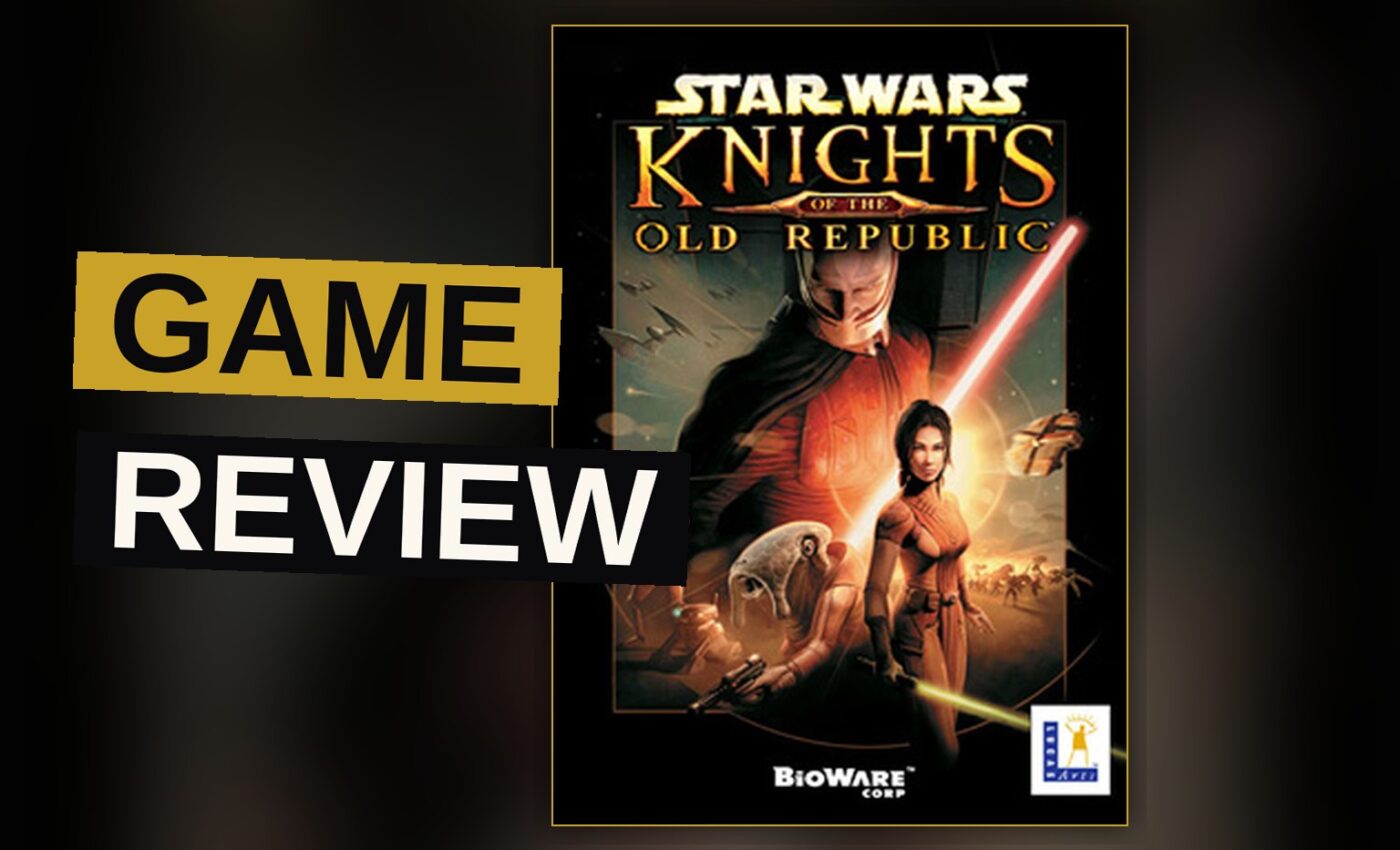
Star Wars: Knights of the Old Republic opens with your character waking aboard the Endar Spire as Malak’s forces tear the Republic ship apart. You have no name yet, no memory worth trusting, and one order: get out alive. BioWare built a role-playing game from that panic, and two decades on it remains the best thing ever done with the Star Wars license.
Three Classes on Taris
Knights of the Old Republic came out for Xbox on July 16, 2003, with a Windows version following on November 19, 2003. Aspyr later ported it to Mac OS X, iOS and Android, and a Nintendo Switch version arrived on November 11, 2021. It also runs on Xbox 360, Xbox One and Xbox Series X and Series S through backward compatibility.
You start as a Scout, a Soldier or a Scoundrel. Later you pick a Jedi subclass — Guardian, Sentinel or Consular — and the game opens up. Skills take points at every level. Feats and Force powers unlock as you go.
No two characters come out the same. That claim gets thrown around loosely. Here it holds.
Casey Hudson and the d20 Under the Hood
Casey Hudson directed the game. James Ohlen designed it. Drew Karpyshyn wrote it. Those three names explain why the thing works.
Combat runs on Dungeons & Dragons rules, specifically the d20 System. Time splits into discrete rounds. Combatants attack and react at once, though the screen shows those actions one after another. Each round is a fixed short interval of real time.
You can set the game to pause at specific events, at the end of every round, or never. Turn the pauses off and it feels like real-time combat. It isn’t.
The full breakdown for every action — die rolls, modifiers, all of it — sits in a menu. The math stays hidden until you ask for it. That is the right call.
Companions Who Talk Back
For most of the game you carry up to two companions. They fight in your party. You can control them directly or let them act on their own.
Outside combat they start conversations with you and with each other. Those exchanges sometimes unlock extra quests. They also sit in on your conversations with other characters.
The dialogue menu system handles everything that isn’t fighting. Every statement branches. Every branch costs something.
This is where Knights of the Old Republic separates itself from its peers. The talking is not a break from the game. It is the game.
Revan, Malak and the Mandalorian Wars
The story sits roughly 4,000 years before the rise of the Galactic Empire, in the years after the Tales of the Jedi comics. The Mandalorian warrior society invades the Republic. The Jedi hesitate.
Two renegade Jedi Knights, Revan and Malak, insist on leading a Republic force to war. They win. Then they vanish into the Unknown Regions and return a year later with a Sith armada, invading the Republic they just saved.
Revan is seemingly killed in a Jedi ambush. Malak takes his former master’s place as Dark Lord of the Sith. Malak’s armada has left the Jedi scattered and vulnerable. Many Jedi Knights have fallen. Others have sworn allegiance to him.
You gather companions. You piece together your past. You try to stop Malak.
Planets Worth the Loading Screen
The playable locations: Tatooine, Dantooine, Kashyyyk, Korriban, Manaan, Rakata Prime and Taris. Also the Republic cruiser Endar Spire, Saul Karath’s ship Leviathan, and the Star Forge space station.
A space station near Yavin is open to players on PC, Mac OS X and mobile. Xbox players get it through an Xbox Live download.
You travel between all of it on the freighter Ebon Hawk. The ship becomes home. That matters more than it sounds like it should.
Light Side, Dark Side, and What It Costs
Interacting with characters and making plot decisions earns Light Side and Dark Side Points. Those points decide whether your character aligns with the light or dark side of the Force. The alignment gates which abilities you can use.
The game asks whether you master the Force to save the Republic or fall to the dark side and take ultimate power. Hero, villain, peacekeeper, chaos-bringer. You and your party decide the fate of the galaxy.
Here is the ranking that matters, and it is not close:
- The dialogue system, which makes every other choice in the game feel like it has weight.
- The companion writing, which turns a party into a cast.
- The d20 combat, which is smart but opaque until you dig into the menus.
- The planet-hopping structure, which drags in the middle stretch.
The combat is the weakest link, and it is still better than most of what shipped around it. New players will bounce off the round-based pacing. Stick with it. The pauses are the point.
What holds up after all these years is the writing. Karpyshyn’s script treats the player as an adult who can handle a story about a Jedi who might be a monster. Malak is a blunt instrument of a villain, but the question underneath him — what Revan was, and what you are — carries the whole thing.
The ports are uneven. The Switch version arrived in 2021 and plays like a game from 2003, which is either the appeal or the problem. On mobile, Aspyr’s touch controls work but the interface was built for a controller and a television.
None of that touches the core. Knights of the Old Republic is a role-playing game that trusts its players to make choices and then lives with them. Very few games since have matched that confidence.
Get the Notebook.
The day's best stories and every fresh verdict, in plain English, in your inbox by seven. One email a day, no more.