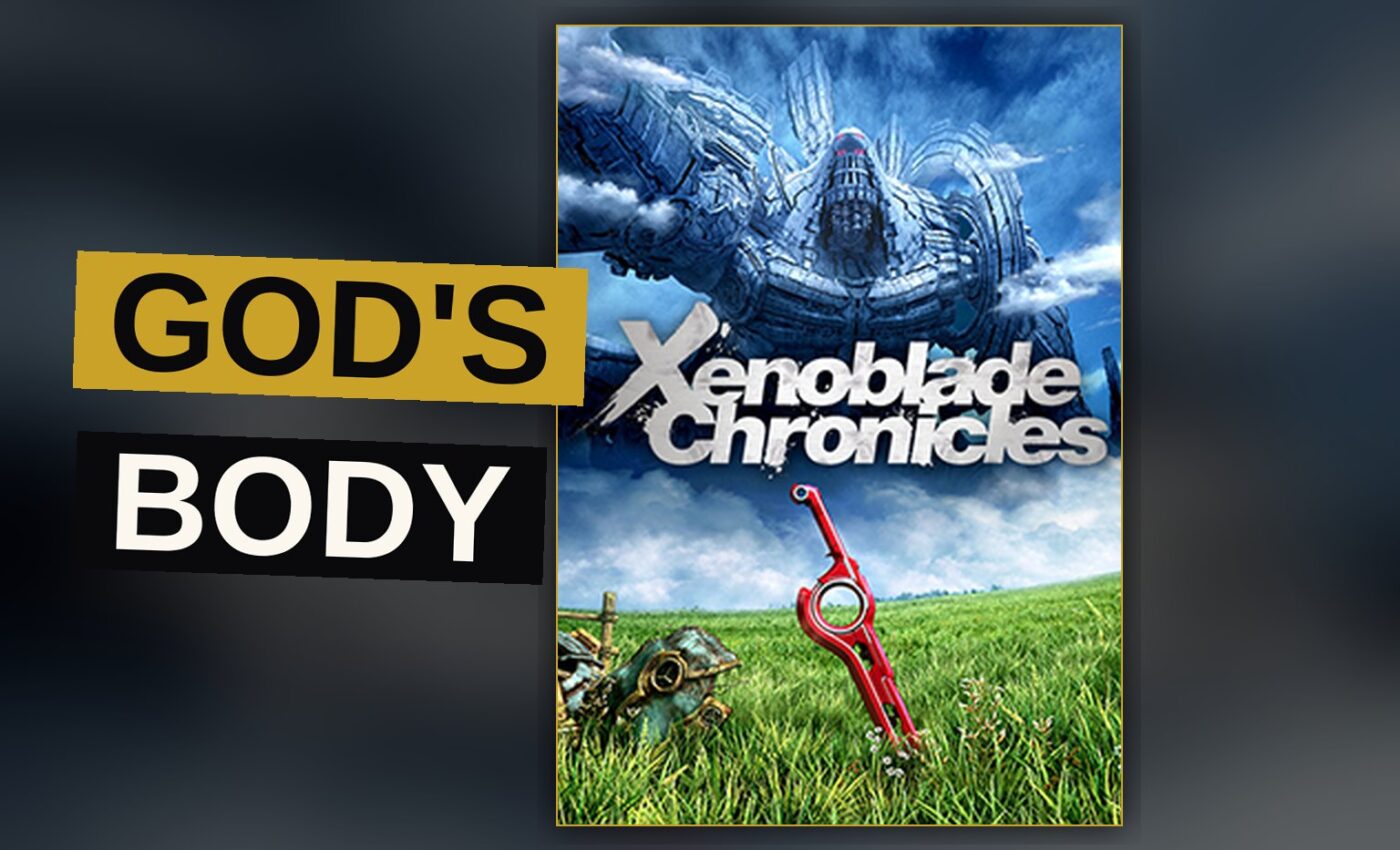
Xenoblade Chronicles arrived in Japan in 2010, in PAL regions in 2011, and in North America only in 2012. A New Nintendo 3DS port followed in 2015, a Switch remaster called Xenoblade Chronicles: Definitive Edition in May 2020, and a Nintendo Switch 2 Edition in 2026. The Wii role-playing game was developed by Monolith Soft and published by Nintendo.
Trailer, via IGN.
Two Dead Gods and a Sword Called Monado
The premise is one of the strangest in the genre. An endless ocean held nothing until two titans, the Bionis and the Mechonis, rose and fought until only their frozen bodies remained. Life evolved on those corpses. The Bionis carries organic peoples: the human-like Homs, the small furry Nopon, and the avian High Entia, whose lives span centuries. The Mechonis carries the mechanical Machina, whose lifespans run for millennia.
Shulk is a young Homs mechanic in Colony 9. When Machina war machines called Mechon attack the colony, he becomes the new wielder of the Monado, the ether-controlling sword said to have once belonged to the Bionis. The Monado grants him brief visions of the future. That single idea — a hero who sees what is coming and still has to earn the right to change it — does more work than most RPG hooks manage in forty hours.
A Party Built From Colony 9 Outward
Shulk does not travel alone. Reyn, a headstrong childhood friend in the Defence Force, joins him. So does Fiora, his childhood friend and love interest, and her brother Dunban, the Monado’s previous wielder. Sharla, a medic and sniper from Colony 6, signs on. Melia Antiqua, a High Entia-Homs hybrid and a princess of her people, joins the party. Riki, a Nopon chosen as his village’s hero, rounds out the group.
Zanza is the god of the Bionis and the game’s main antagonist. Lady Meyneth, goddess of the Mechonis, sits on the other side. Dickson is Shulk’s mentor. Mumkhar is a cowardly soldier who once fought beside Dunban. A year before the story proper, Dickson, Dunban and Mumkhar faced a Mechon army, and Mumkhar deserted. The Monado paralyzed Dunban’s right arm.
| Release | Platform | Date |
|---|---|---|
| Original | Wii (Japan) | 2010 |
| Original | Wii (PAL) | 2011 |
| Original | Wii (North America) | 2012 |
| Port | New Nintendo 3DS | 2015 |
| Remaster | Nintendo Switch | May 2020 |
| Remaster | Nintendo Switch 2 | 2026 |
An Open World That Rewards Looking Up
Xenoblade Chronicles is an action RPG played with the Wii Remote and Nunchuk or the Classic Controller. The player steers one character out of a party of three. The world is open and seamlessly interconnected, and the design pushes exploration hard. The player is encouraged to explore the large environments, which generally allow them to visit whatever can be seen on the horizon.
Time matters. A day-and-night cycle runs automatically, repeating roughly every ten minutes, and players can wind the in-game clock forward at will. Stronger enemy types appear at night. Quests, events and item availability shift with the hour. Landmarks act as warp points, letting players return instantly to anywhere they have already reached. There is a save-anywhere feature outside battle and a New Game+ mode that carries progress into later playthroughs.
Side Quests and the Collectopaedia
Side quests come from non-player characters and usually ask for certain items or a set number of kills. Some complete themselves once the requirements are met, sparing the walk back to the quest giver. The Collectopaedia is the game’s item log. Scattered across the world are glowing blue orbs. Side quests are tied to party members’ affinity, which is the system that quietly ties the whole game together.
Where the Ambition Shows Its Seams
The scale is the point. Xenoblade Chronicles asks a lot of a Wii, and the environments are enormous. That reach over polish is the right call, and critics cited the game as a great example of innovation and improvement in Japanese role-playing video games.
What holds up best is the structure of the thing. The visions give every fight a shape beyond trading damage. The Landmarks respect a player’s time in a way that open worlds a decade later still struggle with. The party is large enough to matter and specific enough to remember, and the Monado gives the combat a spine.
The game’s real argument is that Japanese role-playing games did not need to shrink to survive. They needed to grow, and to trust players to walk toward whatever they could see. Xenoblade Chronicles spawned a sub-series inside the larger Xeno metaseries, including Xenoblade Chronicles X and Xenoblade Chronicles 2, and that lineage starts here.
It has rough edges, and the platform it was born on never did it any favors. It is still one of the most generous RPGs Nintendo has ever put its name on.
Score: 8.5 of 10, from the IGDB critic aggregate across 15 outlets.
Get the Notebook.
The day's best stories and every fresh verdict, in plain English, in your inbox by seven. One email a day, no more.