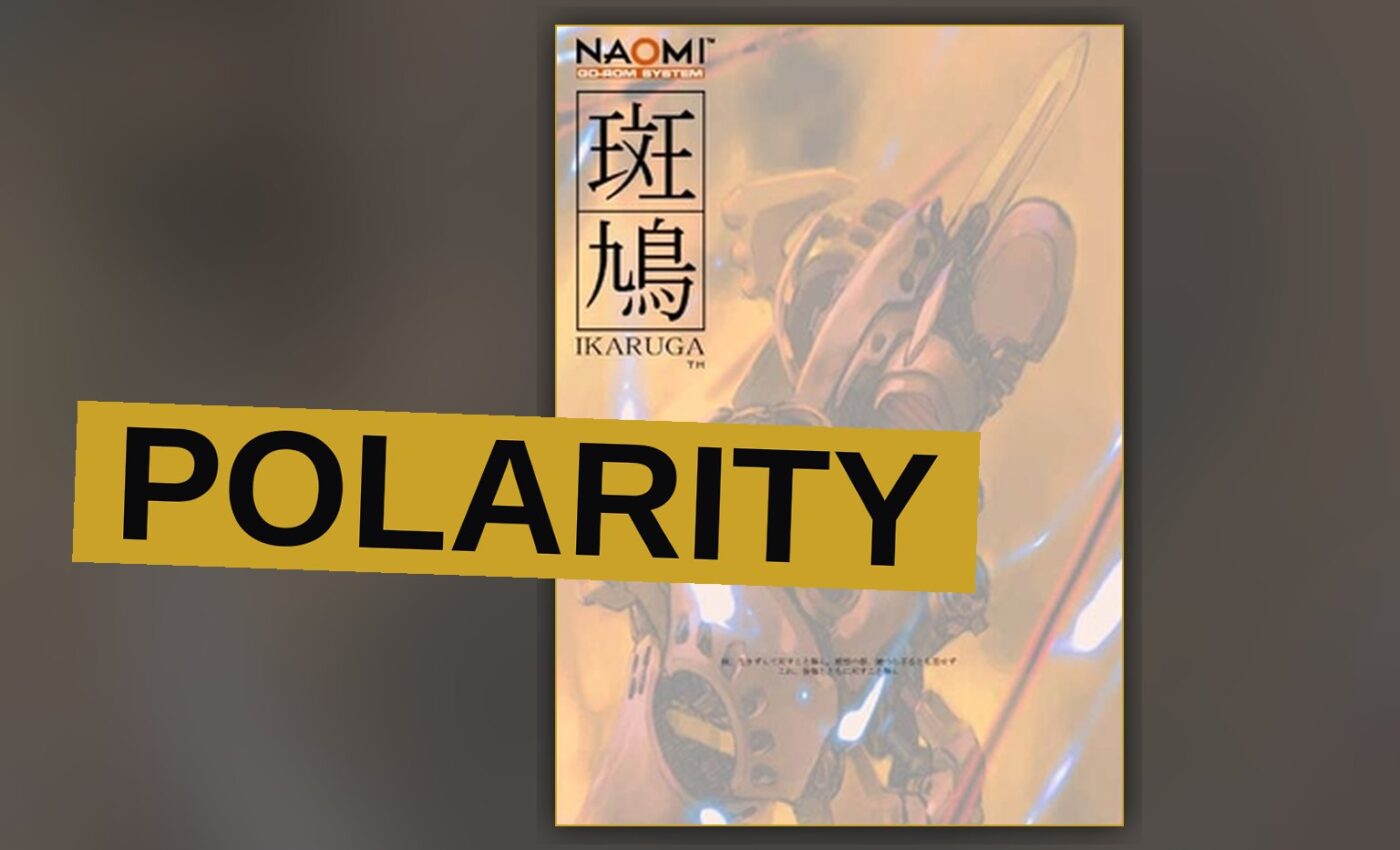
Ikaruga is a shooting game that asks you to think before you shoot. It arrived in arcades in 2001, then reached home consoles later, and it has never really left the conversation about what the genre can do. The core idea is simple: your ship can switch between black and white polarity, and bullets of the same color pass through you without harm. Bullets of the opposite color kill you. Enemies carry one of the two colors, and your own shots deal double damage when they hit the opposite polarity.
That single mechanic turns every screen into a puzzle. You are not just dodging; you are reading the field, deciding when to flip, and calculating which color to feed your own fire. The game rewards aggression because absorbing same-colored bullets charges your special weapon. So the best players fly into danger on purpose, soaking up fire to unleash a screen-clearing blast. It is a risk-and-reward loop that feels sharp even decades later.
The Two-Color Engine
The polarity system is the whole game. You press a button to switch your ship from white to black, and the world flips with you. White bullets pass through white ships, black bullets pass through black ships. Enemy ships of the opposite color take double damage from your shots. Destroying an enemy with the opposite polarity causes it to release revenge bullets — a spread of fire you must dodge or absorb.
That last detail matters more than it sounds. Ikaruga is a game about score as much as survival. Chaining kills works in sets of three: destroy three enemies of the same color in a row and your chain multiplier grows. The multiplier resets if you break the chain by hitting the other color. So a player who just shoots whatever appears will finish the level, but a player who plans the order of kills will finish with a score many times higher. The game does not force you to chase score, but it makes the option obvious and tempting.
The result is a shooter that rewards patience and study over raw reflexes. You can play it blind and survive a few minutes. You can play it well and feel like you are solving a dense logic puzzle in real time. That depth is why Ikaruga still gets mentioned alongside the best of the genre.
Chapter 1 and Chapter 2
The first level, called Chapter 1, introduces the polarity idea gently. Enemy formations arrive in waves, mostly white, and the game gives you room to experiment. The boss teaches you to read the color of incoming fire before you move. It is a fair opening.
Chapter 2 shifts the pace. The enemies come faster, and the color mixes become more chaotic. You will find yourself flipping polarity constantly, sometimes just to survive a wall of bullets that changes color mid-stream. The boss here splits its attacks between both colors, forcing you to switch at the right moment or eat a hit.
Chapter 3 and Chapter 4
Chapter 3 is where the game turns serious. The enemy density climbs, and the patterns demand that you track two colors at once. This is the level where casual players start to hit a wall.
Chapter 4 introduces a new twist: the stage is built around obstacle-maze navigation rather than pure bullet patterns. You weave through tight corridors while managing your polarity, and the field shifts under you. This level is often cited as the hardest in the game, and the claim holds up. The boss fills the screen with alternating color waves.
Chapter 5 and the Final Fight
Chapter 5 is the finale. It recycles elements from earlier levels but speeds everything up. The final boss is a multi-stage fight that tests everything you have learned. It is long, demanding, and fair. When you clear it, you feel like you have actually mastered something.
Reading the Bullet Field
Ikaruga is not a game you play once. It is a game you play a hundred times, and each run teaches you something new. The level designs are fixed, so every death is a lesson. In order, you learn:
- Where the safe spots are.
- When to flip.
- Which enemies to kill first.
The score system gives you a reason to replay beyond survival.
The graphics are clean and readable. The black-and-white palette is not a gimmick; it is functional. You can always tell what color a bullet is, even in the middle of a dense pattern. The backgrounds are detailed but never clutter the action. The sound design is sharp, with distinct audio cues for hits and near-misses.
The game does not hold your hand. There is no tutorial, no difficulty slider, no checkpoint system. You start at the beginning, and you either survive or you restart. That is a hard design choice, but it fits the game’s purity. Ikaruga is not trying to be accessible; it is trying to be excellent.
Ports and Lasting Influence
The arcade original is the reference point, but the home versions matter too. The game has appeared on multiple platforms over the years, and the core experience holds up everywhere. The controls are precise, the frame rate is steady, and the polarity switch feels responsive. If you have never played Ikaruga, any version is a good place to start.
The game has a reputation as a “bullet hell” shooter, but that label undersells it. Ikaruga is not about dodging impossible walls of fire. It is about understanding the rules and using them to your advantage. The bullets are dense, yes, but they are also readable. The game gives you the tools to survive if you take the time to learn them.
That learning process is the real content. Ikaruga is short in terms of levels, but it is long in terms of mastery. A skilled player can clear it in under an hour, but a new player will spend many hours just reaching the later chapters. The score chase adds another layer entirely.
Why It Still Matters
Ikaruga was not the first game to use a polarity mechanic, but it refined the idea into something near-perfect. The design is tight, the challenge is fair, and the payoff for skill is real. It is a game that respects your time and your intelligence.
The shooter genre has evolved since 2001, but Ikaruga remains a touchstone. Its influence shows up in later games that borrow the color-switching idea, but few have matched its clarity. The game never feels arbitrary. Every bullet, every enemy, every pattern exists for a reason.
Ikaruga is also a game you can watch. The visual clarity means that even a spectator who has never played can follow the action. The score counter and the chain multiplier give you a way to measure skill at a glance. It is a game that rewards both playing and watching.
The score is 8.9 out of 10.
Ikaruga is a masterpiece of design. It takes a simple idea and explores it fully, without padding or compromise. The difficulty is high, but the game never feels unfair. Every death is your own fault, and every success is earned.