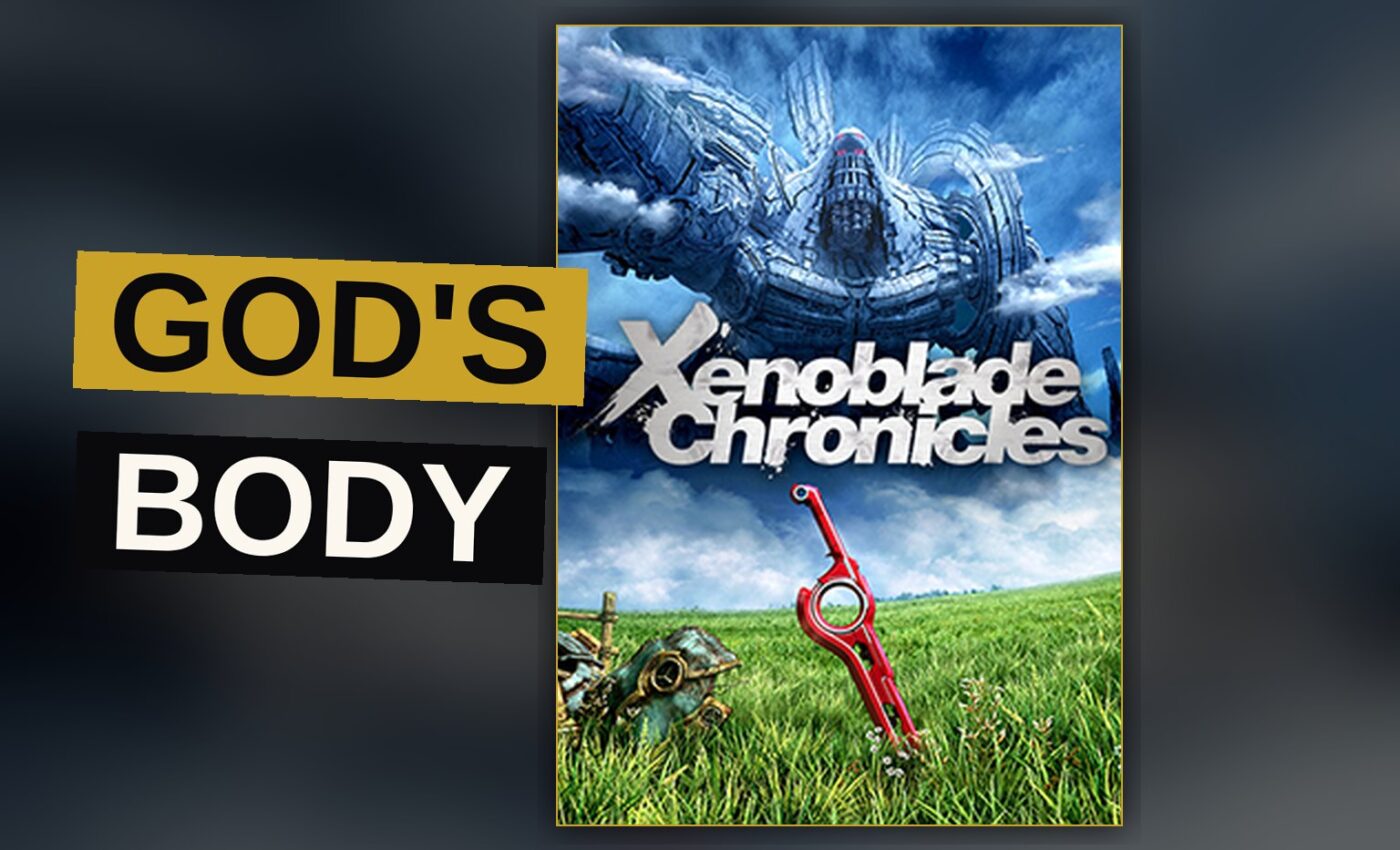
Xenoblade Chronicles is a game about standing on the shoulder of a dead god and looking at the infinite. The Wii original, released in 2010, asks you to take that view seriously. It is a role-playing game with a world built on the corpse of a titan, a combat system that rewards forward motion, and a story that runs for dozens of hours without losing its footing. The Wii U re-release brings the whole thing to a sharper screen, and the game remains a landmark of its genre.
The premise is simple and enormous. Two gods, Bionis and Mechonis, fought a war and killed each other. Their frozen bodies became the world. The Bionis is a continent of flesh and bone, home to the Homs, the Nopon, and the High Entia. The Mechonis is a mechanical wasteland, home to the Mechon, machines that descend on the living world to devour it. You play as Shulk, a young man who finds a blade called the Monado, a weapon that can cut through Mechon armor and show glimpses of the future. When his home colony is destroyed, he sets out to find answers.
That premise drives everything. The world of Xenoblade Chronicles is not a backdrop; it is the argument of the game. You walk across the Bionis’ thigh, through a knee-high forest of grass, and the scale is constant. You are small, and the world is not. The game makes that plain in its opening hour, when you step out of a cave onto Gaur Plain and see the Mechonis looming over the horizon, a giant of rusted steel that fills the sky. It is a sight that has not dulled in 16 years.
Trailer, via IGN.
Walking Across a God’s Body
The geography of Xenoblade Chronicles is its best character. Each region is distinct and memorable. Colony 9, the starting area, is a quiet military settlement with a beach and a view of the Mechonis’ sword sticking out of the sea. Tephra Cave is a damp, dark labyrinth under a mountain. Satorl Marsh turns from a foggy swamp into a field of glowing blue lights at night. Makna Forest is a canopy of giant leaves and rivers. Eryth Sea is an archipelago of floating islands.
The game rewards exploration with more than scenery. There are secret areas, treasure chests, and named monsters that tower over common wildlife. The map is large, but landmarks keep you oriented. The day-night cycle changes what monsters appear and what the world looks like, and resting at inns grants bonus experience while showing how party members feel about recent events.
The music carries the mood. The composers wrote a score that shifts from pastoral strings to pounding rock. The Gaur Plain field theme is a guitar-driven anthem that makes running across the grass feel heroic. The battle theme is fast and energetic. The nighttime Satorl Marsh and Eryth Sea themes are quieter, more reflective. The soundtrack is one of the best in the genre, and it does emotional work the story sometimes leaves unsaid.
Combat That Keeps You Moving
The battle system of Xenoblade Chronicles is real-time, and one rule defines it: position matters. You control one character while party members act on their own. Each character has arts, skills with cooldowns. Some arts deal more damage from the side. Some work better from behind. Some are stronger when the enemy is toppled or dazed. The game asks you to keep moving, to circle enemies, to break guards, and to chain arts with allies.
The result is an active combat loop. You are not waiting for a turn; you are watching the battlefield. The Monado has its own arts, including one that lets you see the future. When a boss is about to land a killing blow, the screen flashes, and you see a vision of what will happen. You then have seconds to act. You can warn allies, use a shield art, or change the flow of battle. It turns every major fight into a puzzle and a panic.
The system has friction. Party AI is mostly competent but sometimes wastes arts or stands in the wrong spot. The camera can be a problem in tight spaces, and targeting gets finicky when surrounded. The game also layers on many systems: gems, skills, affinity, and skill trees. Tutorials are frequent and sometimes overwhelming. Once the systems click, though, combat is a joy.
Shulk, the Monado, and the Long Road
The plot of Xenoblade Chronicles is a slow burn that turns into a fast fire. Early chapters are about survival and revenge. Shulk wants to understand the Monado and stop the Mechon. Middle chapters introduce a conspiracy involving the High Entia and Emperor Sorean. Final chapters pull the rug out, revealing that the Monado and the gods share a connection that changes the meaning of the journey.
The cast is strong. Shulk is a protagonist who thinks before he fights, which is rare in the genre. His friend Reyn is a loud, loyal soldier. Fiora, the third starting party member, has a fate that drives the early story. Later characters — the mysterious Seven, the playful Riki, the stoic Melia — each have their own arcs. The game takes time to let them talk, argue, and grow. Voice acting is mostly good, with a few wobbly accents, but performances carry the emotional beats.
The game does not shy away from heavy themes. It is about the cost of war, the danger of relying on prophecy, and whether a person can change their fate. The ending is a long sequence of revelations and battles, and it lands with real weight. It respects the player’s time and intelligence.
What the Wii U Version Changes
The Wii U re-release of Xenoblade Chronicles is not a ground-up remake, but it is a careful one. Resolution is higher, textures are cleaner, and draw distance is better. The game runs at a smoother frame rate, which helps combat feel more responsive. The interface is clearer, and the map is easier to read.
The re-release does not change the core game, but it makes it easier to appreciate. The original Wii version was a technical marvel that pushed the hardware hard, and the Wii U version smooths out the rough edges without altering what made the game special. The core experience remains intact.
The Grind and the Hours
Xenoblade Chronicles is a long game. The main story takes about sixty hours at a steady pace. Completing all side quests can easily push that past a hundred. The quests are numerous. Some are simple fetch tasks. Others involve finding a specific item or defeating a specific monster. Many tie into the affinity system, which tracks how much party members like each other and how much residents trust you.
The grind can be real. Some quests require rare monster drops, and drop rates are not generous. The game does not always tell you where to find items, so you may have to search. The level curve is strict in places. Underleveled, a boss will tear you apart. Overleveled, the fight is trivial. The game wants you to engage with its systems, and it punishes you if you skip them.
But the grind is not all bad. Combat is fun enough that fighting for experience is not a chore. The world is beautiful enough that crossing it again is a pleasure. Resting at inns lets you turn in bonus experience, which helps manage the grind. The balance is not perfect, but it is fair.
A Giant’s Legacy
Xenoblade Chronicles was a niche title at launch. It released in Europe before North America and only reached North America after a fan campaign. It sold well enough to become a franchise and now stands alongside major Japanese role-playing games. Its influence shows in later Monolith Soft games and the broader genre.
The game has flaws. Combat can be chaotic. Side quests can be tedious. Voice acting has rough edges. The story has contrivances. But the whole is greater than the parts. Xenoblade Chronicles believes in its world, and it asks you to believe too. It is about looking at something vast and deciding to walk toward it.
| Aspect | Xenoblade Chronicles (Wii U) | Typical JRPG of the Era |
|---|---|---|
| World Design | Single continuous titan, fully explorable | Separate overworld and dungeon maps |
| Combat | Real-time, positional arts, vision mechanic | Turn-based or simple real-time |
| Story Length | 60+ hours main, 100+ with side content | 40-50 hours typical |
| Music | Genre-spanning score from a full composing team | Often synthesized, less varied |
| Side Content | Hundreds of quests, affinity system | Fewer, often repetitive |
- The Monado lets Shulk see the future and counter it.
- The Bionis and Mechonis are the corpses of gods.
- The day-night cycle changes monsters and scenery.
Xenoblade Chronicles earns its reputation. It asks for a lot and gives back more. It is a journey across the body of a god, and it is worth every step.