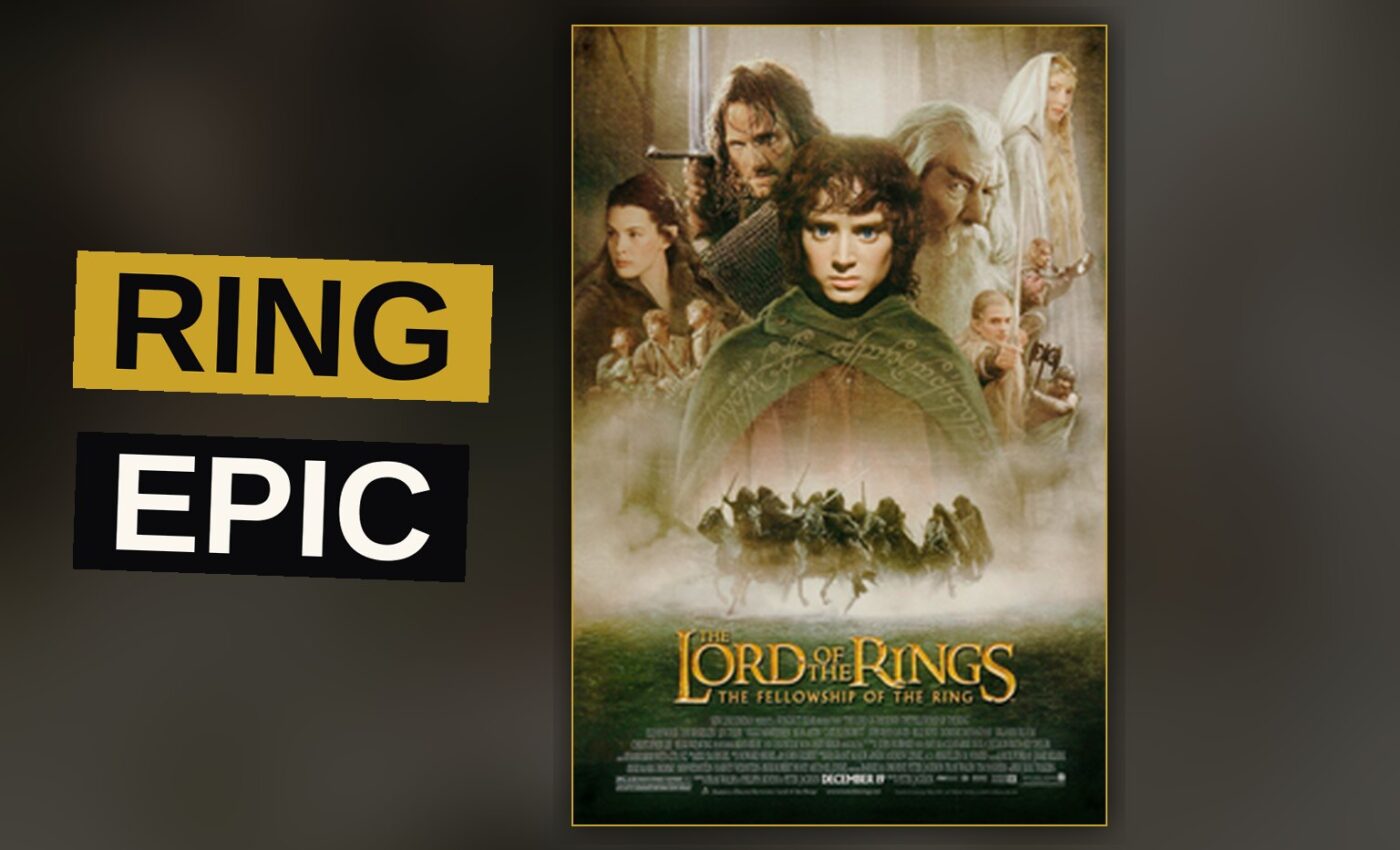
In 2001, Peter Jackson took one of the most beloved books in the English language and turned it into a movie that should not have worked. The Lord of the Rings: The Fellowship of the Ring is a three-hour fantasy epic with a cast of thousands and a plot that hinges on a piece of jewelry. It should have been a mess.
It is not a mess. It is a landmark.
The film opens with a history lesson delivered by Galadriel, voiced by Cate Blanchett. We learn of the Dark Lord Sauron, who forged a ring to rule them all. We learn of the Last Alliance of Elves and Men, and we learn that the ring was not destroyed, only lost. This prologue is brisk, clear, and sets the stakes in minutes. Many modern blockbusters spend an entire film fumbling this kind of exposition. The Lord of the Rings: The Fellowship of the Ring does it before the title card.
Trailer, via Warner Bros. Entertainment.
Hobbits of the Shire
The story proper begins in the Shire, a pastoral idyll of rolling hills, small houses, and large appetites. We meet Frodo Baggins, played by Elijah Wood, a young hobbit who inherits the ring from his uncle Bilbo, played by Ian Holm. Bilbo is leaving for one last adventure, and his parting is tinged with a strange reluctance. The ring has already begun to work on him.
Frodo is joined by his gardener Samwise Gamgee, played by Sean Astin, and his friends Merry and Pippin, played by Dominic Monaghan and Billy Boyd. These four are the heart of the film. Jackson and his screenwriters, Fran Walsh, Philippa Boyens, and Peter Jackson himself, understand that the story is not about the ring. It is about the people who carry it and the people who carry them.
The Shire sequences are warm and funny. The hobbits eat, drink, sing, and complain about the journey ahead. This warmth is essential. It gives the darkness that follows a real weight. When the Black Riders appear, their arrival is genuinely terrifying because we have seen what they threaten.
Forging the Company
The hobbits do not travel alone for long. They are joined by Gandalf the Grey, played by Ian McKellen, and later by Aragorn, played by Viggo Mortensen, an heir to a lost throne; Boromir, played by Sean Bean, a man of Gondor; Legolas, played by Orlando Bloom, an elf; and Gimli, played by John Rhys-Davies, a dwarf.
This fellowship is the engine of the film. Each member brings a different voice and a different fear. Boromir is tempted by the ring’s power. Aragorn doubts his own right to lead. Gimli is comic relief with a sharp axe. Legolas is cool and precise. The film takes its time to establish these characters before the action starts.
The journey takes the company through the mines of Moria, a vast underground city of the dwarves. This sequence is the film’s centerpiece. It is dark, claustrophobic, and filled with dread. The encounter with the Balrog, a creature of shadow and flame, is a masterclass in tension and release. Gandalf’s fall is the film’s emotional turning point. He tells the company, “Fly, you fools,” and then he is gone.
Breaking at the Falls of Rauros
The film does not end with a victory. It ends with a failure. The fellowship is broken at the Falls of Rauros. Boromir falls to the ring’s temptation and tries to take it from Frodo. Frodo flees, and decides to go to Mordor alone. Sam refuses to let him go alone, and the two hobbits set off into the unknown.
Sam’s refusal is the film’s quiet climax. He has promised to look after Frodo, and he will not break that promise. His key moment is not a speech about stories. It is a simple act of loyalty. He says he made a promise, and he keeps it.
Boromir is killed defending Merry and Pippin from Uruk-hai. His death is a quiet, sad moment. He confesses his failure to Aragorn, who tells him, “No, Boromir. You fought bravely. You have kept your honor.” Boromir says, “I would have followed you, my brother, my captain, my king.” It is a small scene, and it is one of the best in the film.
The film ends with Aragorn, Legolas, and Gimli setting off to rescue Merry and Pippin, while Frodo and Sam walk toward Mordor. The quest is not over. It has barely begun. This is only the first part.
Actors Who Carry the Ring
The cast is uniformly excellent. Ian McKellen is the anchor. His Gandalf is wise, impatient, and deeply human. He is not a distant wizard. He is a man who is tired and afraid, but who does his duty anyway. His scenes with Elijah Wood are the emotional core of the film.
Elijah Wood gives Frodo a quiet strength. He is not a warrior. He is a boy who is asked to do an impossible thing, and he does it because no one else can. Sean Astin is the film’s secret weapon. His Sam is loyal, brave, and funny. His promise to Frodo is the film’s thesis statement.
Viggo Mortensen is a revelation as Aragorn. He is a king who does not want to be one, and Mortensen plays the weight of that. Sean Bean brings a tragic nobility to Boromir. He is the most human member of the fellowship, and his fall is the film’s greatest tragedy.
Tolkien on Screen
The Lord of the Rings: The Fellowship of the Ring is based on the 1954 novel by J.R.R. Tolkien. The book is dense, slow, and full of songs and genealogies. The film is fast, clear, and streamlined. This is a translation, not a transcription. Jackson and his team cut characters, combined scenes, and moved events around. This is not a betrayal. It is an adaptation.
The film understands what Tolkien was doing. It is about the small and the ordinary defeating the large and the powerful. It is about friendship and sacrifice. It is about the idea that even the smallest person can change the course of the future. These themes are not buried in the action. They are the action.
The film also understands the darkness of the book. Tolkien’s Middle-earth is a place of loss and decay. The elves are leaving. The age of men is coming. The film does not shy away from this melancholy. The scenes in Lothlórien are beautiful, but they are also sad. Galadriel knows that her time is ending.
How It Stacks Up
The Lord of the Rings: The Fellowship of the Ring is often compared to other fantasy films, both before and after it. The comparison is usually to its own sequels, but it also stands against the wider genre.
| Film | Release Year | Runtime | Audience Score | Tone |
|---|---|---|---|---|
| The Lord of the Rings: The Fellowship of the Ring | 2001 | 178 minutes | 8.4/10 | Epic, heroic, melancholic |
| The Two Towers | 2002 | 179 minutes | — | Darker, more action-heavy |
| The Return of the King | 2003 | 201 minutes | — | Grand, conclusive |
The Fellowship of the Ring is the most intimate of the three. It has the smallest battles and the most character work. The Two Towers is bigger and darker. The Return of the King is the grand finale. But The Fellowship of the Ring is the foundation. Without it, the other two would not work.
The film also compares favorably to other fantasy adaptations. It is more grounded than the Harry Potter films, which are more whimsical. It is more serious than The Chronicles of Narnia, which is more childlike. It is the rare fantasy film that treats its material with complete sincerity. There is no irony. There is no winking at the audience. The film believes in its world, and so does the audience.
Lasting Impact
The Lord of the Rings: The Fellowship of the Ring changed what a blockbuster could be. It proved that a film could be long, serious, and literary and still make a fortune. It proved that fantasy was not a niche genre.
The film won four Academy Awards, including Best Cinematography, Best Visual Effects, Best Makeup, and Best Original Score. It was nominated for Best Picture and Best Director. It lost Best Picture to A Beautiful Mind. This is often cited as one of the worst decisions in Oscar history. The film’s reputation has only grown since then.
The film also launched a franchise. It spawned two sequels, a prequel trilogy, and a streaming series. None of these have matched the original. The sequels are very good. The prequels are uneven. The series is a different thing entirely. But The Fellowship of the Ring remains the standard.
Small Faults
The film is not perfect. The pacing drags in the middle. The scenes in Lothlórien are beautiful but slow. The Council of Elrond is a lot of talking. The film also cuts some of the book’s best moments. Tom Bombadil is absent. The Scouring of the Shire is absent. These are understandable cuts, but they are still losses.
The film also has some dated effects. The CGI is good for 2001, but it is not perfect. Some of the wide shots of the fellowship walking through the mountains look a little fake. The prologue is a little rushed.
These are minor complaints. The film is not a flawless object. It is a human work, made by people who were tired and under pressure. The fact that it is as good as it is, is a miracle.
The Lord of the Rings: The Fellowship of the Ring is a film about hope. It is about the idea that the world is worth saving, even when it seems dark. It is about the idea that ordinary people can do extraordinary things. It is about the idea that stories matter.
The film ends with Frodo and Sam walking toward Mordor. They are alone. They are afraid. They do not know if they will survive. But they keep walking.
That is the whole film in one image.
The Lord of the Rings: The Fellowship of the Ring is a masterpiece. It is a film that rewards repeated viewing. It is a film that gets better with age. It is a film that will be watched for decades. It is a film that matters.