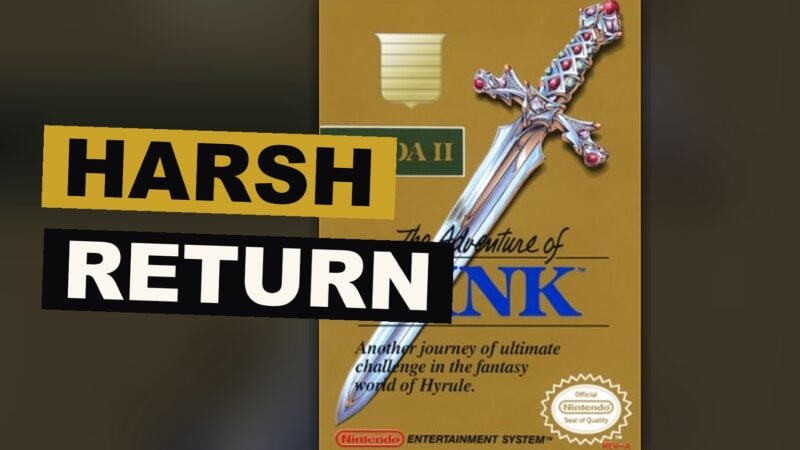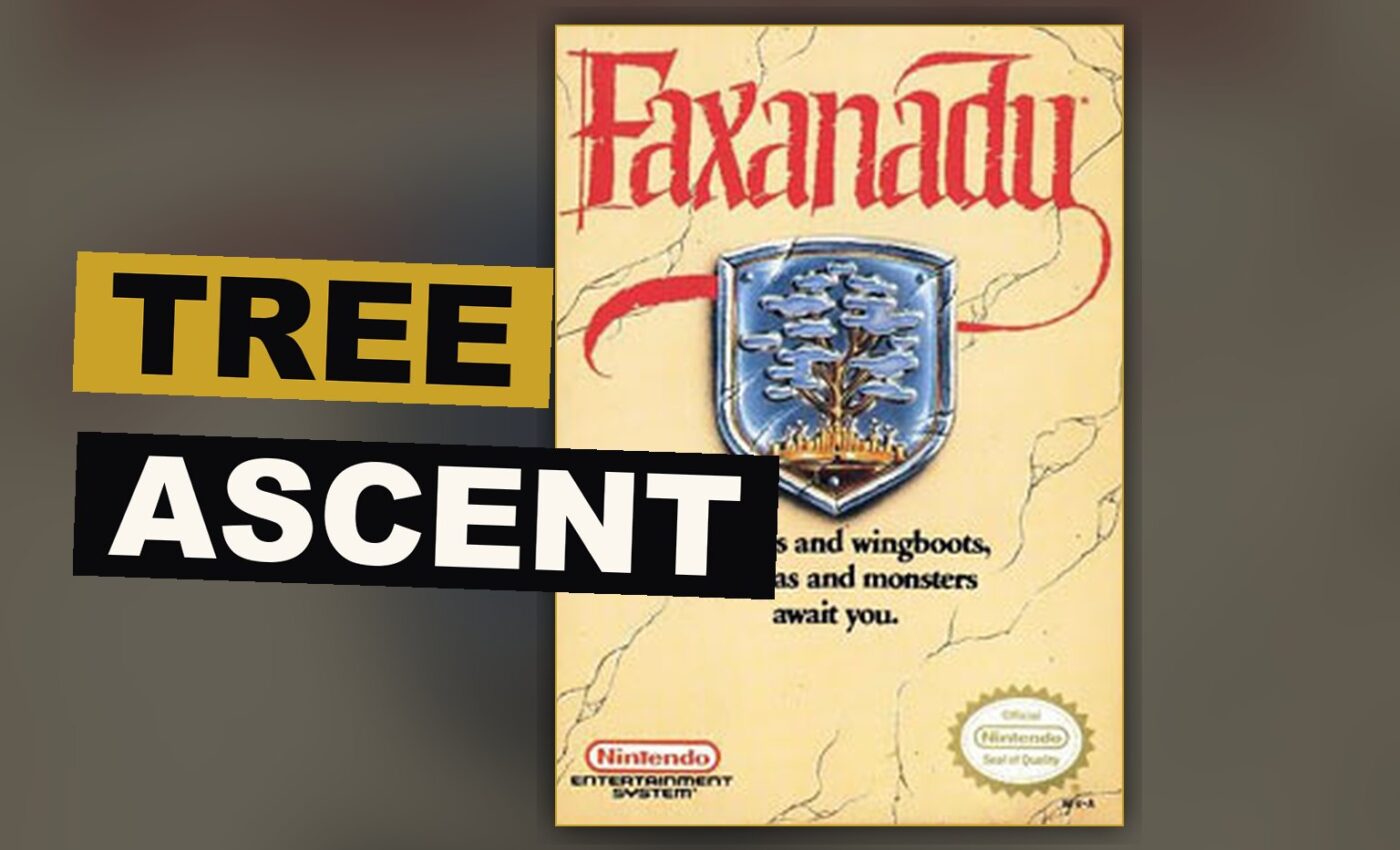
Faxanadu arrived in the West in 1990 as a first-party Nintendo release, three years after Hudson Soft put it out in Japan on the Famicom. The name is a portmanteau — Famicom plus Xanadu — and the game itself is a side-story of Xanadu, the second entry in Falcom’s Dragon Slayer series. That lineage matters less than what Faxanadu does on its own: it drops a nameless wanderer at the gates of a ruined town and asks him to climb a tree.
The tree is the World Tree, and the climb is the whole game.
Eolis Is Already Lost When You Arrive
Faxanadu opens with the hero returning to Eolis, his hometown, after an absence. He finds it in disrepair and virtually abandoned. It is also under attack by Dwarves. The Elven king tells him the Elves’ fountain water — their life source — has stopped, and that all other remaining water has been poisoned. He hands over 1500 gold, the game’s currency, and sends the wanderer out to find the cause.
In the Japanese version the player names the protagonist. Everywhere else he is Nello. That small change says something about how Nintendo sold this game abroad: the blank wanderer became a character, however thin.
The story, once it unfolds, is a decent one. Elves and Dwarves lived in harmony among the World Tree until The Evil One emerged from a fallen meteorite. The Evil One transformed the Dwarves into monsters against their will and made them hostile toward the Elves. The Dwarf King, Grieve, swallowed his magical sword before the transformation took him, hiding it inside his own body so The Evil One could not claim it. That sword is the only thing that can destroy The Evil One.
Grieve’s gambit is the best idea in Faxanadu. A king who swallows his own weapon to keep it from the enemy is a real piece of fantasy writing, and it gives the game a destination rather than a premise.
Four Overworld Areas, One Long Climb
The journey runs through four overworld areas:
- The tree’s buttress
- The inside of the trunk
- The tree’s branches
- The Dwarves’ mountain stronghold
That structure is the game’s spine, and it is a good one. You start at the roots of something enormous and end inside the mountain of the people who were turned against you. Faxanadu is a side-scrolling action role-playing game, sometimes classified as a metroidvania, and it moves the hero screen by screen through fields, towns and dungeons.
The platforming is standard for its era and standard in the good sense. Nello walks, jumps and climbs ladders. He buys usable items with gold, equips and swings bladed weapons, wears armor, and casts magic projectiles. He talks to townsfolk for information about what is happening, or consults other sources when the townsfolk run dry.
The life bar tracks physical damage. The magic bar tracks magical power. Both sit at the top of the screen alongside total experience, gold, a timer for items with a timed duration, and the currently held item.
When the hero defeats an enemy, it usually leaves behind gold or life-giving bread.
Enemies also drop items. Some activate specific effects on touch. Others can be stored for later. Killing things gives a set amount of experience, and experience raises the hero’s rank.
Mantras, Gurus, and the Password Problem
Faxanadu saves progress with passwords. In the game they are called mantras, and you get them from church-dwelling Gurus. The same Gurus bestow ranks when the hero hits certain experience totals. Those ranks decide how much experience and gold you keep when you resume from a mantra.
This is the part of Faxanadu that has aged worst. A password system was a compromise, not a design choice, and the game leans on it hard. Ranks tied to experience thresholds mean your save state is doing double duty as a progression gate. It works. It is also the least interesting thing in the cartridge.
The rest holds up better than its reputation suggests. Faxanadu sits in the same conversation as the NES games that blended platforming with role-playing systems, and it does so with a medieval setting and an expansive story rather than a straight action run. The tone is grim in a way Nintendo’s own 1990 lineup mostly was not. Your hometown is already broken when you get there. The king who can save you is dead or worse. The water is poison.
What Faxanadu Gets Right, and What It Does Not
The four-area structure gives the climb a shape. The Grieve reveal gives it a reason. The combat and shopping loop gives it enough texture to hold a player through the trunk and into the branches. The metroidvania label fits loosely — the game is more linear than that term implies — but the screen-by-screen exploration and the item economy earn some of it.
What Faxanadu does not have is a protagonist. Nello is a wanderer with a name in the West and no name in Japan, and neither version gives him much to say. The Elven king delivers the setup. The Gurus deliver the save system. Grieve delivers the twist from inside his own stomach. Nello delivers nothing but forward motion.
That is not fatal. Plenty of games from 1987 ask you to be the engine rather than the character. But Faxanadu’s story is doing real work — a meteorite, a coerced army, a king who ate his sword — and the hero walking through it is a blank.
The other complaint is the pacing. Four overworld areas is a clean design on paper. In practice the middle stretch, inside the trunk, is where the game’s platforming and its role-playing systems pull against each other. You want to explore. You also want to grind enough gold to afford the next weapon. Faxanadu makes you do both at once, and it does not always make that pleasant.
None of this sinks the game. Faxanadu is a strange, grim, ambitious cartridge that Nintendo brought West as a first-party title under license from Hudson Soft, and it earns its place in the NES library on the strength of its setting and its central twist. The sword in Grieve’s belly is worth the climb.
7.5 of 10.
Get the Notebook.
The day's best stories and every fresh verdict, in plain English, in your inbox by seven. One email a day, no more.