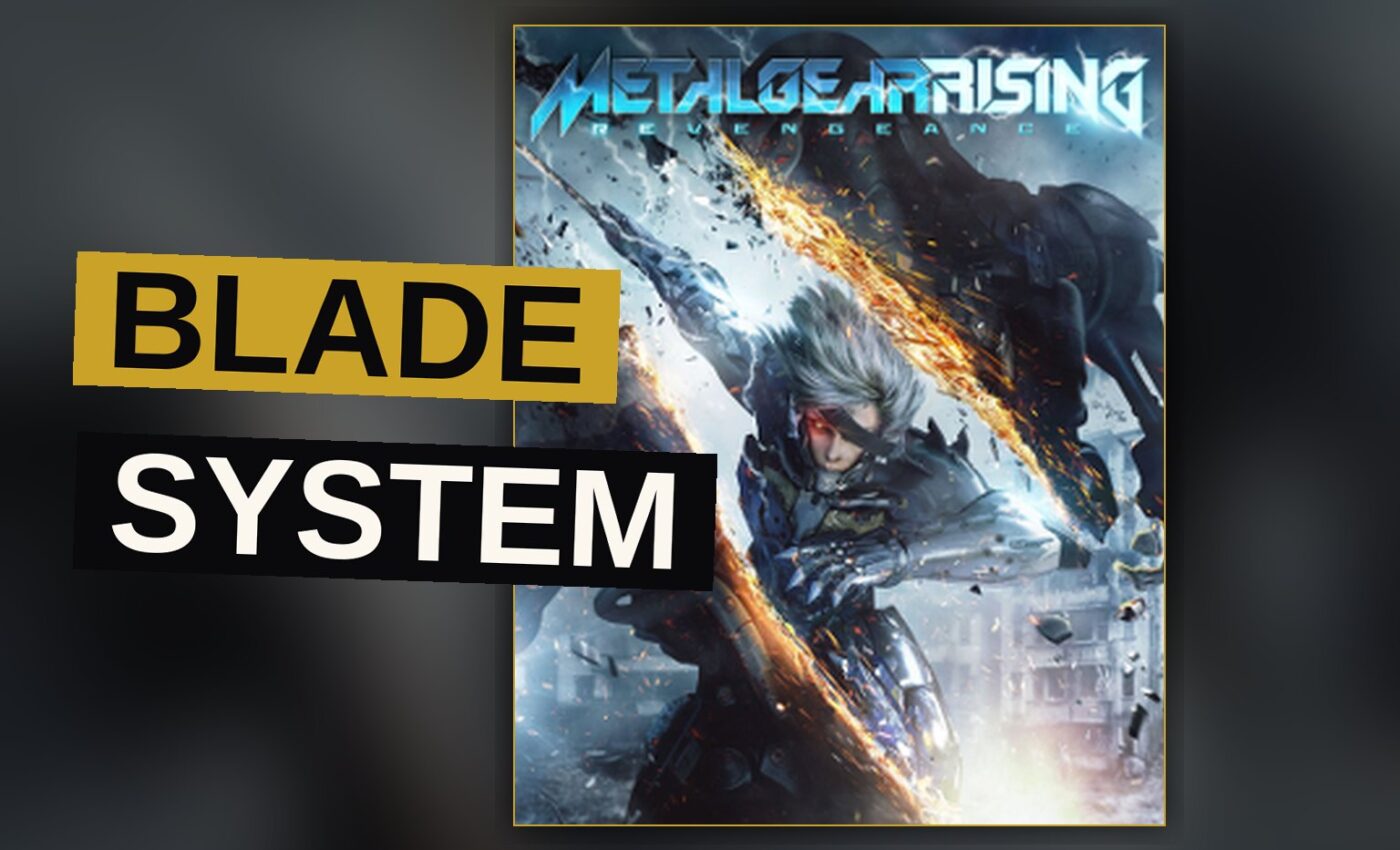
Metal Gear Rising: Revengeance is a game about a man with a sword, and it never once apologizes for that. PlatinumGames took a Metal Gear spin-off that Kojima Productions had stalled out and turned it into a pure action game — one that treats Raiden, the child soldier turned cyborg, as a blade first and a character second.
That trade works better than it has any right to.
Trailer, via GameSpot.
Raiden Loses an Arm to Jetstream Sam
The premise is simple. Raiden is a cyborg armed with a high-frequency blade, strong enough to slice a giant unmanned combat gear in two with a single stroke. He works for Maverick Security Consulting, Inc., taking contracts for VIP protection and military training in a developing country.
His assignment puts him in the path of Desperado Enforcement LLC. While Raiden is protecting Prime Minister N’Mani, Desperado attacks. N’Mani is kidnapped and assassinated by Sundowner, and Raiden loses his left eye and arm in a duel with Jetstream Sam.
Set in 2018, four years after Metal Gear Solid 4: Guns of the Patriots, the game picks up in a world where the Patriots are gone and private military companies have splintered into competing factions. Desperado is the main antagonist, a PMC that wants to destabilize peaceful nations and keep conflict alive so it can profit from the war economy.
Raiden’s support crew at Maverick includes Russian pointman Boris Popov, military advisor Kevin Washington, computer specialist Courtney Collins, and cybernetics expert Wilhelm “Doktor” Voigt. Sunny Emmerich, the child prodigy from Guns of the Patriots, returns as a friend of Raiden working at Solis Space and Aeronautics.
Blade Mode Is the Whole Argument
The gameplay is where Revengeance earns its keep. Players control Raiden, a katana-wielding cyborg, and the focus is sword fighting rather than the stealth the series built its name on.
The cutting system is the centerpiece. Blade Mode lets players slash enemies and objects along a geometric plane. Entering it produces a targeting reticle in the form of a transparent blue plane that can be moved and rotated freely, tracing holographic orange lines across surfaces to show exactly where a cut will land. It can also drop into a bullet time state, letting players slice an airborne target multiple times before it hits the ground.
Virtually any object can be cut, including vehicles and enemies. Environmental destruction was deliberately limited to structures like pillars and walls, which keeps the cutting from turning into a physics demo. Raiden can also dismember enemies in slow motion and steal health items from their bodies.
His main weapon is the high-frequency blade, but he can carry replacement blades, sub-weapons and secondary weapons. That includes two kinds of rocket launchers, four kinds of grenades, and tools like the cardboard box, an empty oil drum, and a 3D photo frame. Additional melee weapons come from defeating bosses.
Stealth still exists, but as an option — a way to avoid a fight rather than the point of one.
Sundowner and the Winds of Destruction
The boss fights carry the game. Raiden’s rival is Samuel Rodrigues, known as Jetstream Sam, a Desperado operative voiced by Philip Anthony-Rodriguez. A conversation between the two early on shapes Raiden’s path through the story.
Sam runs with an elite Desperado cyborg team called the Winds of Destruction. Sundowner, Desperado’s de facto leader, fights with machetes that combine into a large pair of pincers and wears reactive armor shields connected to his body.
The cast is rounded out by Quinton Flynn as Raiden, JB Blanc as Boris Popov, Phil LaMarr as Kevin Washington, Kari Wahlgren as Courtney Collins, Jim Ward as Doktor, and Cristina Pucelli as Sunny Emmerich.
A Spin-Off That Survived a Halt
Revengeance had a rough road to release. Kojima Productions announced it in 2009 as Metal Gear Solid: Rising. The team struggled to build a game around swordplay, and supervising director Hideo Kojima halted development until a solution could be found.
The project came back in late 2011 under its final title, with PlatinumGames as the new developer. Gameplay mechanics and storyline changed significantly in that handoff. The source material does not say the game was cancelled during that pause — it says development stopped until the team found a way forward, and the finished game reflects that restart.
It released for PlayStation 3 and Xbox 360 in February 2013. Later ports followed: Windows and OS X in January and September 2014, and Nvidia Shield TV in January 2016. Two downloadable content chapters were also released, set before the main campaign and centered on Raiden’s enemies. The PC version bundles those chapters alongside a third mission, VR Missions, which is why the counts differ between the console release and the port.
The PC Version Adds Everything
The PC release is the version to play if you have the choice. It runs the same moves and action in an HD environment, and it bundles content that was sold as separate add-ons elsewhere.
It includes all three DLC missions — Blade Wolf, Jetstream, and VR Missions — plus every customized body upgrade for Raiden: White Armor, Inferno Armor, Commando Armor, Raiden’s MGS4 body, and the Cyborg Ninja skin.
The menu additions are the reason to single out this port. A cutscenes option in the main menu lets players watch any cutscene. A codecs option does the same for codec conversations. The Chapter menu adds a way to play only the boss battles. The Options menu adds graphic settings for resolution and anti-aliasing, plus a zangeki option that adjusts how many cuts you can make.
That last one matters more than it sounds. The cut count is the game’s signature, and letting players tune it is the rare settings toggle that changes how the game feels rather than how it looks.
Where the Game Stumbles
The story is the weak half. Raiden’s arc — child soldier, cyborg, contractor — is thinner than the premise deserves, and the Desperado plot about destabilizing nations for profit is a familiar Metal Gear refrain delivered with less patience than usual.
The game also commits hard to its own bit. Cutscenes run long, and the tone swings between grim military thriller and something close to parody without always landing the transition. Players who want the stealth of the mainline series will find it demoted to a suggestion.
The camera and the cutting system occasionally fight each other when the action gets crowded. Blade Mode asks for precision while the fight around you is chaotic, and that tension is deliberate but not always fun.
None of this sinks the game. It just marks the ceiling.
Why Revengeance Still Holds Up
Here is the thing worth saying plainly: Revengeance is the clearest case in the Metal Gear catalog that the series’ swordplay could carry a full game on its own. It made that case by dropping the stealth scaffolding to an optional setting and building everything around Blade Mode.
The combat is precise, fast, and legible. Blade Mode is not a gimmick bolted onto a standard action game — it is the reason the game exists, and every enemy, boss, and weapon is built to feed it. The Winds of Destruction give the campaign a spine of memorable fights, and Jetstream Sam is the rare rival who earns his place in the franchise’s memory.
The PC port’s bundled DLC and menu options turn a good console game into a better one. If you are coming to Revengeance now, that is the version to take.
The ranking of what matters here, from strongest to weakest:
- Blade Mode and the cutting system — the core, and still unmatched.
- The boss roster, led by Jetstream Sam and the Winds of Destruction.
- The PC version’s DLC bundle and quality-of-life menu options.
- The combat sandbox of sub-weapons, grenades, and replacement blades.
- The story and its handling of Raiden’s past.
- The optional stealth, which is present but never essential.
That ordering is the review in miniature. Everything the game does with a sword is excellent. Everything it does with a script is serviceable.
Metal Gear Rising: Revengeance is not a Metal Gear game in the way the series trained players to expect. It is a PlatinumGames action game wearing Metal Gear’s clothes, and it wears them well. The boss fights remain the reason to play it, the PC version is the one to take, and the combat holds up because it was built around a single idea rather than a checklist.
It is a spin-off that outgrew its own origin story.
Get the Notebook.
The day's best stories and every fresh verdict, in plain English, in your inbox by seven. One email a day, no more.