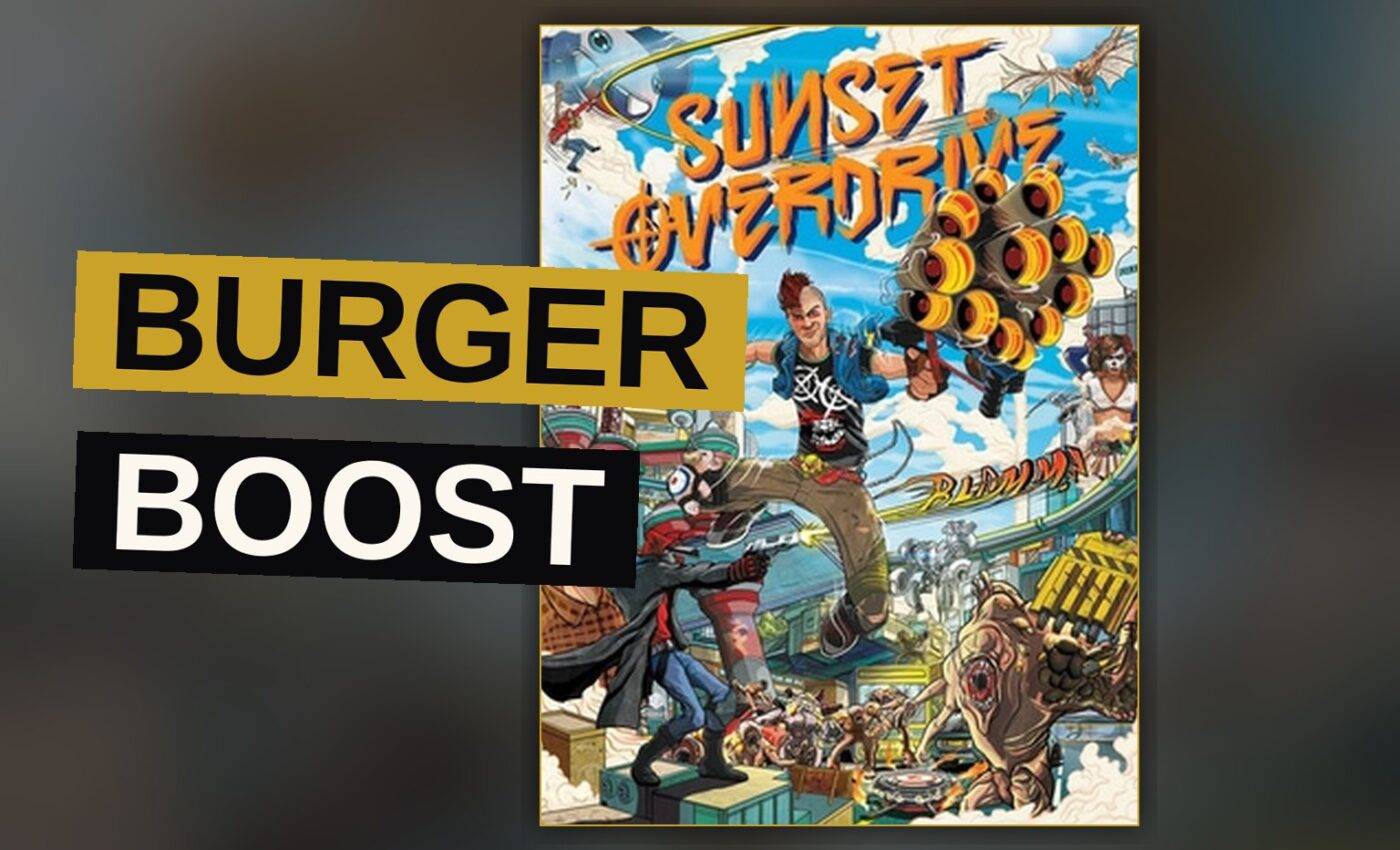
Sunset Overdrive turns a city full of mutants into a playground, and it does not apologize for the mess it makes. The 2014 action-adventure game from Insomniac Games and Microsoft Studios sets its story in 2027, in a fictional metropolis called Sunset City, where a drink called OverCharge Delirium XT has turned most of the people who tried it into boil-covered mutants known as the OD — Overcharge Drinkers. The player is a FizzCo employee with a large arsenal and no cover system, because standing still is not the point. Momentum is the point.
Sunset Overdrive is out now on PC (Microsoft Windows) and Xbox One. It earns 8.2 out of 10.
Trailer, via Insomniac Games.
FizzCo’s OverCharge Delirium XT
The setup is a joke that the game keeps telling without winking too hard. FizzCo rushed its new energy drink to market, skipped health regulation protocols, and let the testing slide. Anyone who drank OverCharge turned into a violent, boil-covered mutant. The outbreak hits within hours of the pre-release party, and the city starts calling that night Horror Night. FizzCo quarantines Sunset City and blames a viral outbreak to cover the deception. Nobody gets in or out.
That premise gives Sunset Overdrive its tone. It is a post-apocalyptic story told as a party that went wrong, not as a tragedy. The game’s own summary calls it an open-world playground of post-apocalyptic possibilities, and the developers described the setting as an “awesomepocalypse” that turns the initial world depiction into a “playground” for players. The game carries themes of action, comedy and open world, and it commits to all three.
The Janitor, Walter and Sam
The plot does not stay at the level of a pitch. On July 13, 2027, FizzCo throws the pre-release party. The player, a janitor employed by FizzCo, gets saved from an attacking OD by Walter, a former FizzCo security guard. Walter brings the player into a small group of survivors that includes Floyd, a former FizzCo chemist whose concerns about OverCharge’s safety went unheeded.
The group’s plan is a makeshift helicopter. The player goes looking for a propeller and rescues a nerdy college student named Sam along the way. Sam’s rich and lazy Oxford West classmates get enlisted, and they 3D print the propeller. The escape almost works. At the last second, Walter spots an invisible wall and pushes the player out of the helicopter, sacrificing himself. Floyd then points the player toward a friend of Walter’s named Bryllcream, the scout leader of Troop Bushido, who might have another escape plan. The troop’s hideout sits in a Japanese samurai museum.
That is a lot of plot for a game that mostly wants you to grind a rail and shoot something. It works because the characters are specific. Walter is not a generic mentor. He is a security guard who saw the wall and made a choice.
Grinding Rails Through Sunset City
The movement is the best argument Sunset Overdrive makes for itself. Players can wall-run, use zip-lines and grind rails to move through the city. They can air-dash, perform parkour and acrobatics, and traverse water. Grind rails let players switch direction instantly at will, and the city is filled with items to bounce up into the air.
Combat focuses on velocity and encourages fast-paced defeats. Players can use weapons while performing these movements, and the game lets them slow down time. There is no cover system, because Insomniac built the game around momentum rather than hiding. The player character is customizable at the start, with sex, body type, hairstyle and outfit all open to change. A vendor named Callista lets players alter the look at any point during the game.
The open world is free to explore at any time, with a fast travel system for reaching different locations quickly. A main campaign carries the story, and side-missions trigger automatically when players enter certain locations. Those quests mostly involve delivering objects to non-playable characters and collecting items, and some have time limits.
Chaos Squad and Seven Players
Sunset Overdrive is not only a solo game. It supports single player, multiplayer and co-operative play. The cooperative multiplayer mode is called Chaos Squad, and it tasks players with completing a series of missions with seven players. That is a real number, not a marketing round-up, and it shapes how the mode plays. Seven people moving through a city built for speed is chaos in the literal sense, which is presumably the joke.
The game’s modes are listed as single player, multiplayer and co-operative. The perspective is third person. The genres are shooter, platform and adventure. Those labels undersell how much the game leans on movement as its own kind of combat.
Prince of Persia, Jet Set Radio and Tony Hawk
Development on Sunset Overdrive began in 2011, after Insomniac finished Resistance 3. The project was green-lit internally, and the studio partnered with Microsoft Studios, which helped fund the game and let Insomniac keep the rights to the franchise. That rights arrangement matters. Insomniac kept control of the series even while Microsoft paid part of the bill.
The team called the game a “celebration of games” and pulled from different sources: Prince of Persia, Jet Set Radio and Tony Hawk’s Pro Skater. Early in development, the team took inspiration from DayZ instead. That early DayZ interest did not survive into the finished game, but you can see the logic. A city full of infected people is a survival premise. Sunset Overdrive took that premise and made it a skate park.
The game is set in a post-apocalyptic future, but the team depicted it as an “awesomepocalypse” that turns the game’s initial world depiction into a “playground” for players.
What Holds Up and What Does Not
The strongest part of Sunset Overdrive is the way it refuses to separate movement from fighting. Wall-running, zip-lining and grinding are not travel options bolted onto a shooter. They are the combat system. The absence of a cover system is the clearest sign that Insomniac meant it. A game that wants you to keep moving should not hand you a button for hiding, and Sunset Overdrive does not.
The weaker part is the mission design. Side-missions that involve delivering objects and collecting items are the filler between the good stuff. Time limits add pressure, but they do not add ideas. The open world is free to explore, and a fast travel system is provided, which is a quiet admission that traversal across the whole map can wear thin even when the traversal itself is the best thing in the game.
The story lands better than the structure around it. Walter’s sacrifice works because the game sets him up as a person with a job and a past, not a plot device. Floyd’s ignored warnings about OverCharge give the outbreak a cause that is human and stupid rather than cosmic. FizzCo skipping health regulation protocols to sell a drink faster is a villain motive that reads as satire, and the quarantine cover-up keeps the joke running.
Horror Night in Sunset City
The date is July 13, 2027. The city is Sunset City. The drink is OverCharge Delirium XT. The mutants are the OD. The night the city falls is Horror Night. Sunset Overdrive is built on specifics like these, and it names them without embarrassment. That confidence is why the game still reads as more than a novelty.
The cooperative mode is called Chaos Squad. The vendor is Callista. The scout leader is Bryllcream. The troop is Troop Bushido. The hideout is a Japanese samurai museum. The classmates are from Oxford West. None of these are generic. A lesser game would have called them the survivors, the shop, the military guy.
Sunset Overdrive is a 2014 action-adventure game from Insomniac Games, published by Microsoft Studios, available on PC (Microsoft Windows) and Xbox One. It is a third-person shooter and platformer with an open world, action and comedy themes, and single player, multiplayer and co-operative modes. The IGDB critic aggregate, across 16 outlets, puts the published critical score at 8.2 out of 10.
- Title: Sunset Overdrive
- Year: 2014
- Developer: Insomniac Games
- Publisher: Microsoft Studios
- Platforms: PC (Microsoft Windows), Xbox One
- Setting: Sunset City, 2027
- Key date: July 13, 2027 (the pre-release party, later called Horror Night)
- Modes: Single player, Multiplayer, Co-operative
- Cooperative mode: Chaos Squad, seven players
- Perspective: Third person
- Genres: Shooter, Platform, Adventure
- Published critical score: 8.2/10 (IGDB critic aggregate, 16 outlets)
The Score
Sunset Overdrive earns its 8.2. The movement system is the reason to play it, and the game knows it. Wall-running, zip-lining and grinding rails are not decoration on top of a shooter. They are how the shooter works, and the missing cover system proves the design was deliberate rather than incomplete.
The story gives the chaos a spine. Walter, Floyd, Sam and Bryllcream are specific people with specific problems, and the FizzCo cover-up gives the player a reason to care about escaping beyond the obvious one. The “awesomepocalypse” framing is not just a marketing line. It is the actual design philosophy, and it holds up.
What keeps Sunset Overdrive from a higher score is the mission structure. Delivering objects and collecting items fills the space between the set pieces, and time limits do not make those tasks more interesting. The open world is free to explore, and the fast travel system is there for a reason. When the best part of a game is moving through it, the parts where you stop to fetch something will always be the weakest.
That is a small complaint against a game that gets the big things right. Sunset Overdrive is funny without being smug, fast without being weightless, and specific about its world in a way that most open-world games are not. It is a 2014 game that still has a clear point of view, and that is rarer than it should be.
Get the Notebook.
The day's best stories and every fresh verdict, in plain English, in your inbox by seven. One email a day, no more.