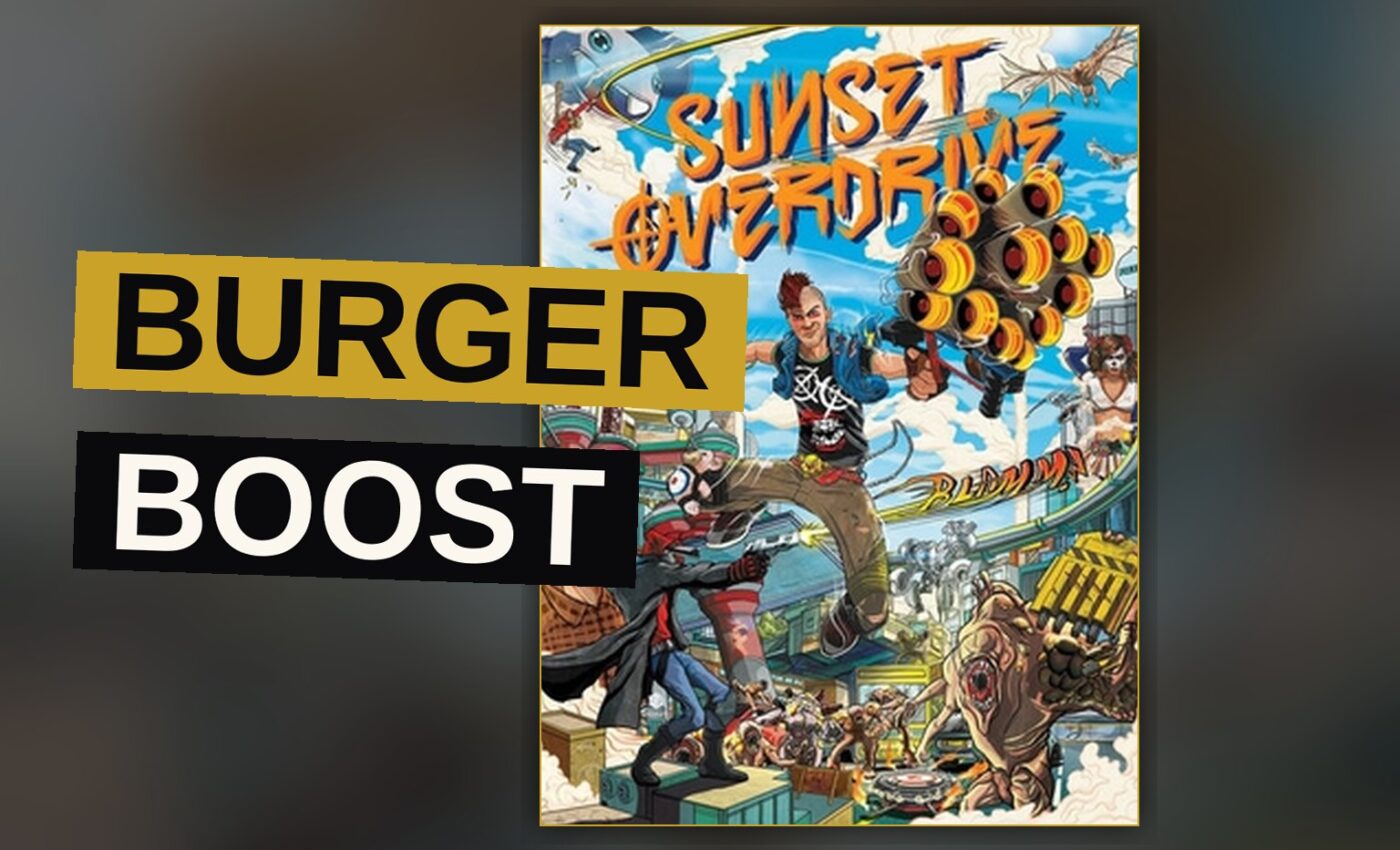
Sunset Overdrive is a game about eating fast food and shooting zombies with skateboards. That premise sounds absurd, and it mostly delivers on that absurdity. The game, released in 2014 for PC and Xbox One, puts players in the role of a young woman named June who finds herself trapped in Fizztown, a fictional city overrun by creatures called Zeds. The game asks players to eat burgers, climb buildings, and blow Zeds apart with a constantly rotating arsenal of weapons.
It is a chaotic, colorful, and occasionally brilliant mess. Sunset Overdrive is not a perfect game, but it is a confident one. It trusts its own instincts and rarely apologizes for them.
Trailer, via Insomniac Games.
Fizztown and Its Burgers
The world of Sunset Overdrive is the star. Fizztown is a neon-lit, pastel-colored sprawl of apartment blocks, skyscrapers, and corporate parks. The city feels lived-in, with posters, billboards, and graffiti scattered everywhere. Players move through it by parkour, bouncing off walls, sliding down railings, and leaping between buildings. The movement system is fluid and forgiving, which matters because the game expects you to be constantly on the move.
The central mechanic is eating. Players collect hamburgers from fallen enemies and eat them to gain health and temporary buffs. Eating three burgers in a row triggers a “Burger Boost,” which grants extra speed and damage. This creates a rhythm: fight, eat, fight, eat. It is simple, but it gives combat a steady pulse. The game also includes a “Burger Combo” system, where certain burger types combine to create unique effects. Eating a burger with a Zed nearby can trigger a small explosion, sending both the enemy and yourself flying.
The burger system is a clever way to make resource management feel natural. Health bars are abstract, but eating is immediate. You see the burger in your hand, you put it in your mouth, and you feel better. It is a small detail, but it makes the game feel more alive than most shooters.
Weapons and Zeds
The arsenal in Sunset Overdrive is vast. Players start with a standard gun, but soon unlock everything from shotguns to sniper rifles to explosive melee weapons. Each weapon has a distinct feel, and the game encourages experimentation. Some guns are better at close range, some excel at range, and some are simply fun to wield. The weapon wheel is easy to access, and switching mid-combat is smooth.
The Zeds themselves are varied. There are basic grunts, fast runners, armored brutes, and giant bosses. Each type requires a different approach:
- Some Zeds can be stunned.
- Others can be lured into traps.
- Others need to be dodged entirely.
The game does not overcomplicate things, but it offers enough variety to keep fights interesting.
The presentation is where Sunset Overdrive shines. Zeds explode into chunks when hit, and the game rewards players for chaining combos and finishing moves. Enemies often drop loot, and players can pick up items from fallen foes. The game is generous with rewards, which keeps players motivated to explore and fight.
The game also features a “Zed Wave” system. Certain areas spawn waves of Zeds that require players to defend a position. These sequences break up the open-world exploration and add tension. They are not frequent, but they are memorable.
The Story and Its Tone
The story of Sunset Overdrive is thin but serviceable. June, the playable character, is a resident of Fizztown who becomes a target of the Zeds after a strange virus outbreak. She is joined by a group of survivors, each with their own quirks and personalities. The dialogue is snappy and often humorous, with plenty of pop-culture references and jokes. The game leans heavily on its tone, and it is confident in its own silliness.
The narrative is not deep, but it does not need to be. The game is about survival, humor, and freedom, and it delivers on those fronts. The story exists to give players a reason to explore, not to drive a complex plot. That is a fair trade-off for a game built around chaos.
The voice acting is solid, and the characters feel distinct. June is the center of the story, but she is surrounded by a cast of supporting players who add color to the world. The game spends time developing these relationships, even if the plot itself is simple.
The Open World and Its Structure
The open world of Sunset Overdrive is large and dense. Players can move freely between districts, and the game encourages exploration by placing collectibles, side quests, and hidden areas throughout the city. The main path is linear, but there are multiple ways to reach each objective. The game rewards curiosity, and there is always something to find.
The game also includes a “Sunset Overdrive” mode, which lets players replay levels with new challenges. This mode adds replay value for those who want to test their skills further. The game is generous with its content, and there is always more to do.
The difficulty curve is gentle. The game is accessible, but it offers harder modes for players who want a challenge. The core loop is easy to grasp, but mastering it takes practice. The game respects players who want to learn its systems.
Performance and Technical Issues
Sunset Overdrive runs well on Xbox One and PC. The frame rate is stable, and the game handles large crowds of enemies without stuttering. The visuals are bright and colorful, with a cartoonish style that suits the tone. The audio design is strong, with a soundtrack that mixes electronic and rock music. The game looks and sounds polished, even if the story is thin.
There are technical issues, though. Some players have reported crashes, glitches, and loading times. These problems are not universal, but they are noticeable. The game is ambitious, and it shows in both its strengths and its weaknesses.
The game also includes a “Sunset Overdrive” mode, which lets players replay levels with new challenges. This mode adds replay value for those who want to test their skills further. The game is generous with its content, and there is always more to do.
What Works and What Doesn’t
Sunset Overdrive succeeds when it commits fully to its own identity. The game is at its best when it is chaotic, funny, and fast. The burger system, the movement, and the weapons all work together to create a satisfying loop. When the game tries to be serious, it falters. The story is thin, and the character development is minimal.
The game also suffers from a lack of polish. The technical issues, while not fatal, are distracting. The game is ambitious, but it is not always refined. The game is a product of its era, and it shows in both its strengths and its weaknesses.
Sunset Overdrive is a game about eating, shooting, and moving fast. It is a game about being silly and loud. It is not a game about depth, but it does not pretend to be. The game knows what it wants to be, and it delivers on that promise.
The Final Score
Sunset Overdrive is a flawed but enjoyable game. It is a game that rewards exploration, creativity, and laughter. It is not a masterpiece, but it is a success. The game is a product of its era, and it shows in both its strengths and its weaknesses. It is a game that deserves attention for its ambition and its confidence.
The game is a reminder that video games can be fun without being serious. It is a reminder that a game can be a toy and a tool at the same time. It is a reminder that sometimes, the best way to survive is to eat a burger and laugh.
Sunset Overdrive scores 8.2 out of 10.
Get the Notebook.
The day's best stories and every fresh verdict, in plain English, in your inbox by seven. One email a day, no more.