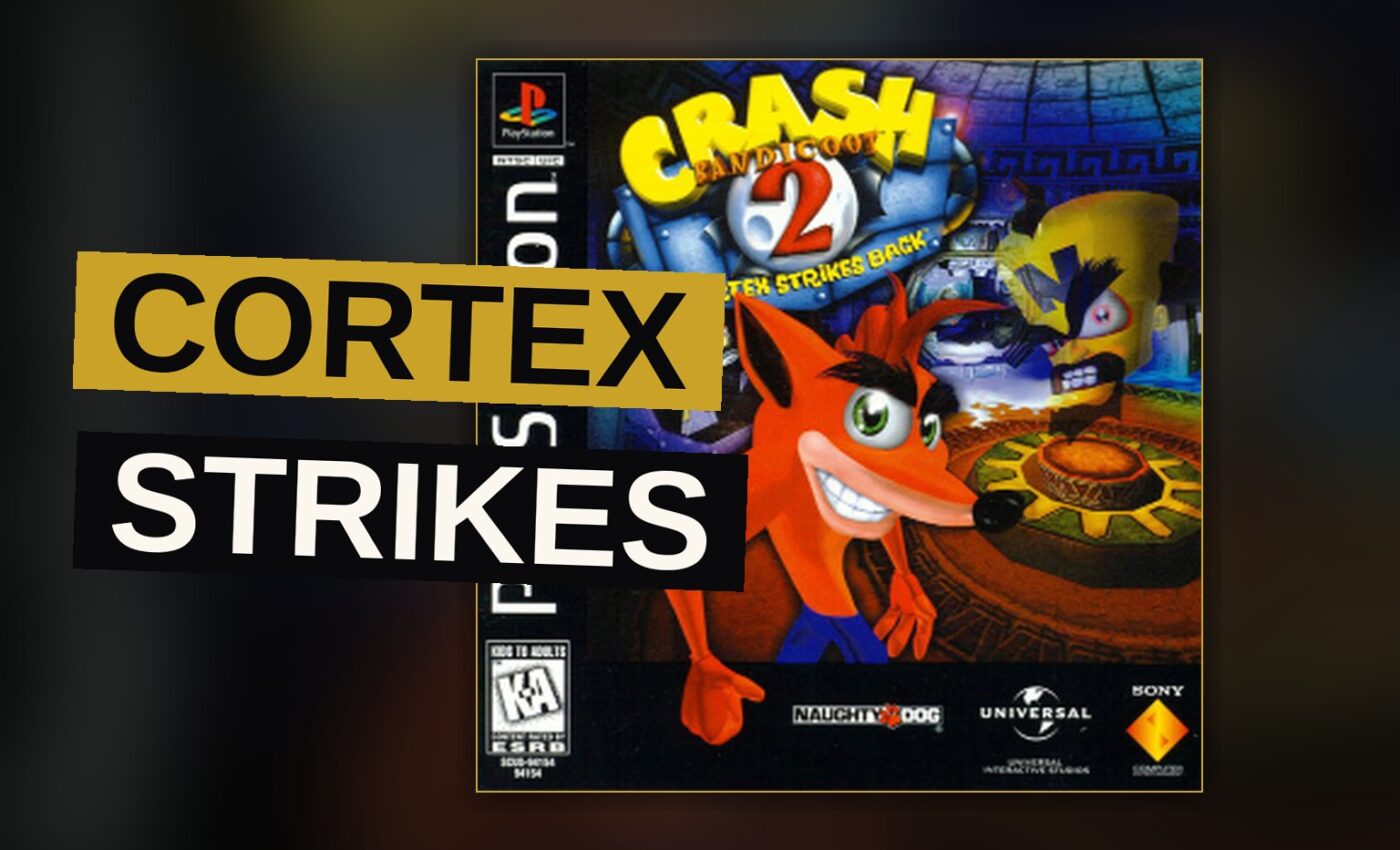
Crash Bandicoot 2: Cortex Strikes Back is the rare sequel that fixes what was broken without losing what worked. Naughty Dog built it for the PlayStation in 1997, with Sony Computer Entertainment publishing, and it follows the anthropomorphic bandicoot Crash as he is abducted by Doctor Neo Cortex and tricked into thinking he is saving the world. The pitch is a lie. The game built on top of it is one of the best platformers of its era.
Warp Rooms and 25 Crystals
The structure is clean. Crash gathers 25 crystals for his nemesis, scattered across 25 levels reached through hub areas called Warp Rooms. Each Warp Room holds five levels. Clear all five and a boss blocks the way to the next room. A level ends when Crash takes its crystal and reaches the end of the path, which returns him to the Warp Room.
Crash jumps, spins in a tornado-like fashion to knock enemies off-screen, slides, and body slams. A jump immediately after a slide carries him higher than a normal jump. Almost every move doubles as a weapon.
Enemies are built to punish habit. Ones with deadly topsides cannot be jumped on. Ones that attack from the front or carry side spikes must be jumped on or slammed. Ones with sharp necklines — frill-necked lizards, long-legged robots with heated circumferences up top — only fall to a slide. Boxes matter too: most hold Wumpa Fruit, and 100 fruit earn an extra life.
Cortex in Space, Coco on the Line
The story picks up after Cortex’s airship defeat, when he falls into a cavern full of powerful crystals. A year later he and his new assistant, Dr. N. Gin, build an upgraded, crystal-powered Cortex Vortex in outer space. It needs 25 more crystals to reach maximum capacity, and Cortex has no operatives left on Earth, so he manipulates Crash into retrieving them.
Cortex claims that an upcoming alignment of the planets will unleash energy capable of destroying the Earth and urges Crash to use the Warp Room to retrieve crystals that can contain this energy.
Coco, Crash’s younger sister, sends him after a laptop battery before Cortex teleports him to an ancient Warp Room on N. Sanity Island. She later hacks Cortex’s holographic projector to warn Crash off. So does Dr. Nitrus Brio, Cortex’s former assistant, who tells Crash to gather gems instead — gems that can destroy the space station — while admitting he will send his own forces to stop Crash collecting more crystals. Those forces include the demented Ripper Roo, the scimitar-wielding Komodo Brothers and the ravenous Tiny Tiger.
Cortex finally orders Crash to hand the crystals to N. Gin. Crash beats him instead. With all 25 collected, Coco lays out the real plan: the planetary alignment powers the gigantic Cortex Vortex on the space station, and Cortex will brainwash everyone on Earth into serving him. Crash reaches him in outer space and wins again before the crystals can be used.
Where It Stumbles
The flaws are real. Trial-and-error design kills runs that were never the player’s fault, level variety thins out across the 25, the boss fights are easy, and as a platform game it innovates less than it polishes. None of that sinks it.
What carries Cortex Strikes Back is control. Crash moves exactly as a player intends, and the slide-jump is the kind of small mechanical gift that makes a whole level set worth replaying. The music and graphics drew the praise they deserved, and the game is widely considered superior to its 1996 predecessor. It became one of the best-selling PlayStation games of all time and replaced that predecessor as the highest-selling Western title in Japan, moving more than 800,000 copies there by April 1998. A remastered version later arrived as part of the Crash Bandicoot collection.
The sequel’s real achievement is that it never confuses difficulty with cruelty for long. Enemies demand the right move, not a lucky one, and the Warp Rooms keep the pace tight between bosses. The trial-and-error stretches are the price of that design, and they are worth paying.
Get the Notebook.
The day's best stories and every fresh verdict, in plain English, in your inbox by seven. One email a day, no more.