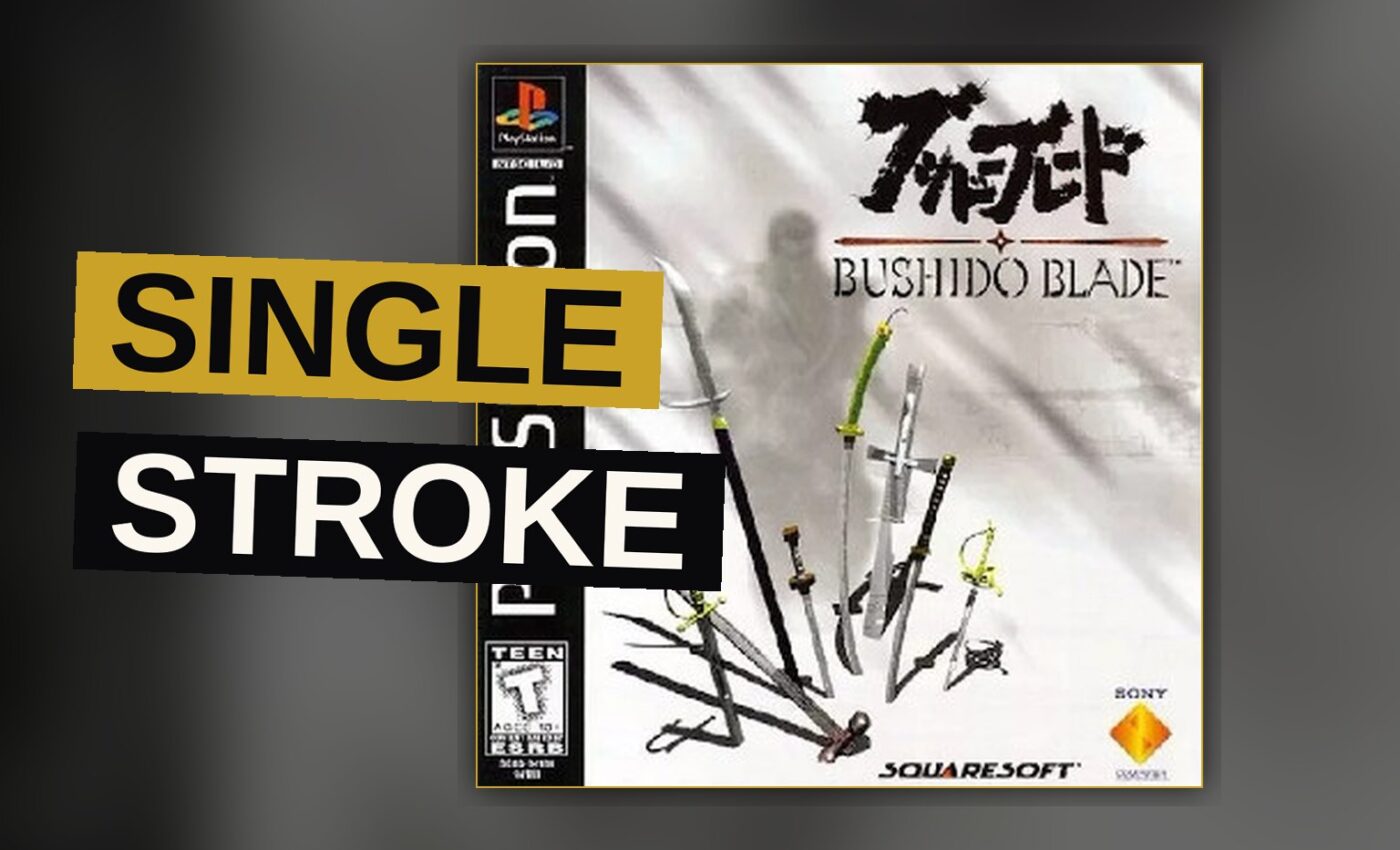
Bushido Blade shipped on the original PlayStation in 1997 with a promise no other fighting game was making: that a single clean strike could end the match. No health bar. No timer. One mistake, one death. Nearly three decades on, that idea still feels less like a gimmick and more like a correction — a fighting game that trusts the player to be afraid.
One Clean Strike Ends the Match
Square published it. Lightweight developed it. The name comes from bushidō, the Japanese warrior code, and the game means it. Combat is one-on-one, third-person, fought across 3D environments you can run, jump and climb through.
Most hits kill instantly. That is the whole design in one sentence, and it changes everything downstream. Traditional fighters ask you to chip a gauge down over thirty seconds. Bushido Blade asks you to not get hit.
The Body Damage System is the part that mattered then and still matters now. You can wound an opponent without killing them. Hits disable limbs in increments — slow a fighter’s attack and run speed, or cripple their legs and force them to crawl. A match can end with one player dragging themselves across the floor toward a sword they will never reach.
That is not a health bar with extra steps. It is a different argument about what a fight is.
Eight Weapons, Three Stances
The arsenal is small and specific: katana, nodachi, long sword, saber, broadsword, naginata, rapier, sledgehammer. Eight weapons, each with fixed power, speed and blocking ability.
Except for the European weapons, which are noticeably shorter than their historical counterparts, each weapon carries a realistic weight and length. That qualifier matters. It is the one place the game’s realism slips, and it slips in a direction that favors balance over accuracy.
Attacks chain through the Motion Shift System, where one swing follows through into another. Many of those combinations exist in only one of three stances — high, neutral and low — switched with the shoulder buttons or axis controls depending on your controller layout.
Six characters round out the roster. Each has different strength and speed, unique special attacks, and varying proficiency with each weapon. Some carry a subweapon they can throw. Every character has one preferred weapon, which quietly turns the select screen into a decision about how you intend to lose.
A 500-Year-Old Dojo
The story is stranger than the box art suggests. Despite characters, themes and weapons pulled from samurai cinema set in Feudal Japan, Bushido Blade takes place in the modern era. You know this when you reach a helicopter landing pad phase set in a large city.
The setting is Meikyokan, a fictional dojo said to be 500 years old, teaching the disciplines of the master Narukagami Shinto. A society of assassins called Kage — “Shadow” — lives inside it.
Utsusemi once led the Kage honorably. He lost the position to Hanzaki in a fierce battle. Hanzaki earned respect as leader until he found a cursed sword called Yugiri, and then he changed, disregarding the group’s honor and the traditions its students held.
Then a Kage member escapes the dojo with its secrets. Others are sent to kill the defector under penalty of death, catching up only within the ruins of the surrounding Yin and Yang Labyrinth Castle.
In single player you play the escaped assassin, regardless of which character you pick, cutting down your former comrades one at a time. The story shifts with each character selected.
That structure is odd and it works. You are always the traitor. The roster is not a menu of heroes; it is a list of people you are about to kill.
What the Fighting Engine Got Right
The realistic engine was the talking point at release, and the Body Damage System was the reason. It is easy to see why. Fighting games before this were built on attrition. Bushido Blade was built on consequence.
The absence of a timer does more than remove pressure. It removes the clock as a referee. Two cautious players can circle each other indefinitely, and the game will let them. Nothing forces the issue except the knowledge that one of you will eventually commit.
Sword matches become unbelievably real where one critical blow is the mean difference between death and victory.
That line from the game’s own summary is marketing, but it is also accurate. The critical blow is the entire product. Everything else — the stances, the weapon weights, the limb damage — exists to make that single moment legible.
The climbing and running matter more than they sound. A 3D arena you can traverse is not a flat plane with a backdrop. Positioning becomes a resource. Retreating is a real option, and so is being cornered.
Where the Realism Slips
The European weapons are shorter than they should be. That is the clearest tell that Bushido Blade is not a simulation and never wanted to be. It is a fighting game wearing historical clothing, and it will shorten a rapier if that makes the matchup fair.
The modern-era setting is the other loose thread. A 500-year-old dojo, a cursed sword, an assassin cult — and a helicopter pad in a major city. The game does not reconcile these. It stacks them.
That should be a problem. It mostly is not. The samurai cinema trappings give the violence a register, and the modern setting keeps it from becoming a period piece. Bushido Blade is not asking you to believe in Feudal Japan. It is asking you to believe that a man with a nodachi is standing between you and an exit.
Six characters is a thin roster by the standards of its genre, even for 1997. Eight weapons is thinner. The game bets that depth of consequence beats breadth of content, and mostly it wins that bet.
Bushido Blade 2 and Kengo
A direct sequel, Bushido Blade 2, arrived on the PlayStation a year later. Another game with a related title and gameplay, Kengo: Master of Bushido, was also developed by Lightweight, for the PlayStation 2.
So the idea had a life. It just never became the default. Fighting games kept their health bars, kept their timers, kept their thirty-hit combos, and Bushido Blade stayed a curiosity — beloved, cited, rarely imitated with any conviction.
That is the part worth weighing. The Body Damage System is the innovation everyone names, and it deserves the credit. But the braver decision was the one that made it necessary: removing the health gauge entirely. You cannot have incremental limb damage as a meaningful stakes-raiser if a bar is quietly counting down in the corner. The two choices are the same choice.
What the Score of 8.3 Reflects
Bushido Blade scores 8.3 out of 10.
The score reflects a game that solved a problem most fighters did not know they had. One clean strike decides the match. Everything else — the eight weapons, the three stances, the six characters, the crawling — serves that sentence.
It is not a complete package. The roster is small, the European weapons are wrong on purpose, and the modern-era setting sits awkwardly against the dojo mythology. None of that touches the core.
What dates is the presentation. What does not date is the fear. A fighting game that can end in two seconds is a fighting game you play differently, and no amount of technical polish since has replaced that specific tension.
Key facts
- Title: Bushido Blade
- Release year: 1997
- Developer: Lightweight
- Publisher: Square
- Platform: PlayStation
- Score: 8.3/10
- Metacritic: 83/100
- Weapons: 8 — katana, nodachi, long sword, saber, broadsword, naginata, rapier, sledgehammer
- Playable characters: 6
- Stances: 3 — high, neutral, low
- Sequel: Bushido Blade 2, PlayStation, one year later
Get the Notebook.
The day's best stories and every fresh verdict, in plain English, in your inbox by seven. One email a day, no more.