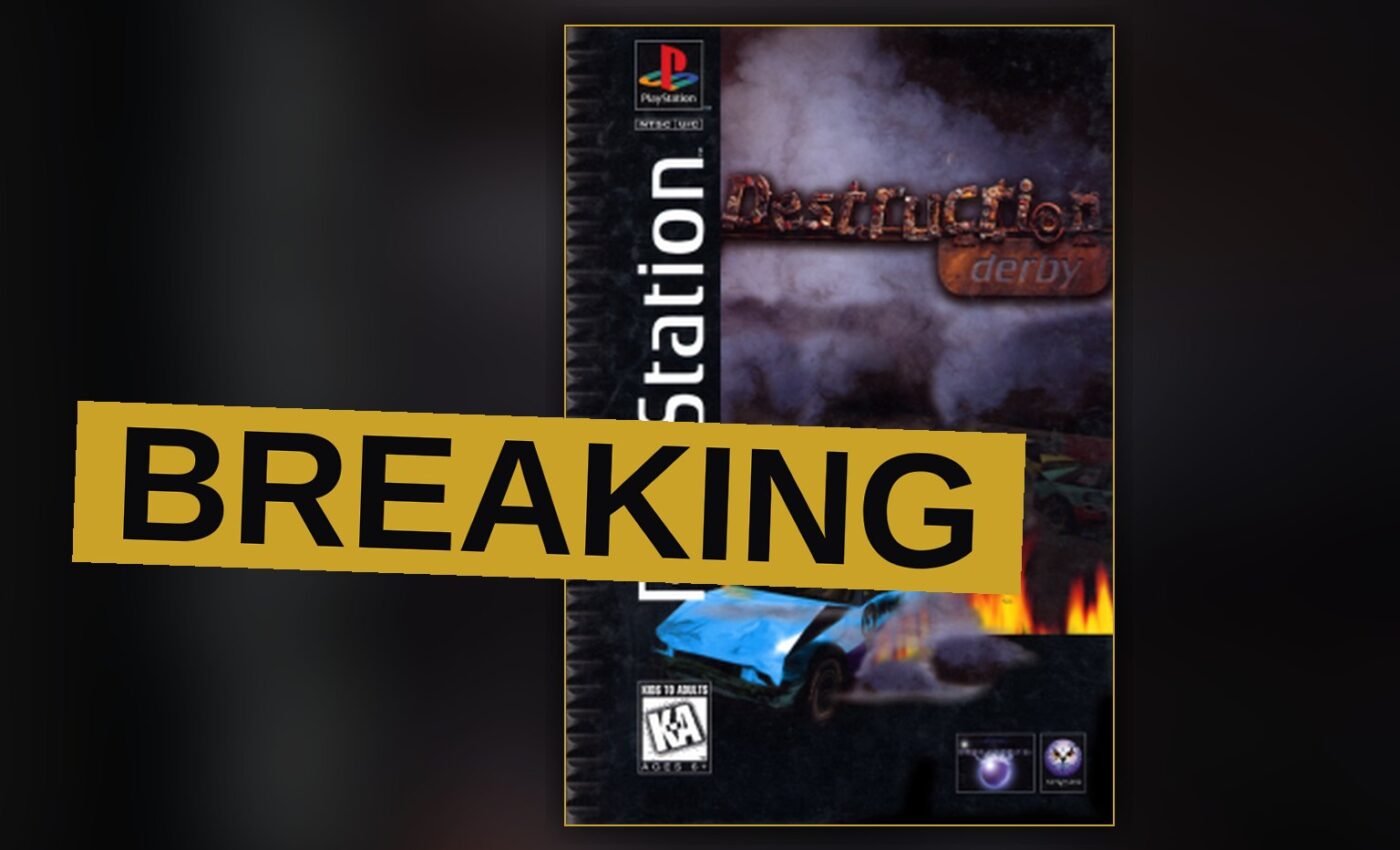
Reflections Interactive built a racer where the finish line matters less than the wreckage. Destruction Derby arrived in 1995 for MS-DOS, PlayStation and Sega Saturn, published by Psygnosis, and it took the sport of demolition derby and made it the whole point. You score by destroying cars. The PlayStation version supports system link play for two players, and the DOS version has an online multiplayer mode.
The Bowl and the Three Cars
Destruction Derby is a vehicular combat racer with three vehicles. Collisions change how each car handles, cutting steering and top speed. Hit someone head-on and you risk the radiator. An overheated car stops running. That is the whole physics lesson, and it is enough.
Four modes carry the game. In Destruction Derby, you earn points by destroying other cars inside a large, trackless arena called The Bowl. In Stock Car Racing, you must finish first, and destroying cars earns nothing. Wreckin’ Racing splits the difference: points for winning, points for wrecking. Time Trial is a solo run against the clock.
The Championship season runs from Rookie to Pro. The field is a motley crew of psycho-waster racers: the Suicide Squaddies, Skum and The Optician. You storm up the rankings against them. Reckon you can handle it?
Small Tracks, Big Wrecks
The developers kept the tracks small on purpose. Small tracks mean more collisions, and more collisions mean more wrecks. They also built simulated physics so the results of a crash are easier to predict. That second choice is the one that matters.
Prediction is not realism. It is legibility. When two cars meet in Destruction Derby, the game wants you to know what happens next and why. A racer that punishes you at random is noise. A racer that punishes you for a bad angle is a game. Reflections picked the second one.
Destruction Derby is a vehicular combat racer based on the sport of demolition derby.
The game has no rulebook and no pit lane. There is no limit on what a driver may do, so the design leans on crumple zones, deliberate ramming and low-slung street fighting. Battering an opponent’s car into uselessness is the objective, and the game sells that objective with crashes that read as physical rather than cartoonish.
The Radiator Is the Real Opponent
Think about what the radiator does to a race. It turns every head-on hit into a countdown. You can win the exchange and still lose the race, because your engine is cooking and your steering is gone.
That single mechanic gives Destruction Derby a spine. It is not enough to be fast. It is not enough to be aggressive. You have to be aggressive in the right direction, at the right angle, and then survive the damage you took doing it.
The Bowl strips away the track entirely and asks the purest version of the question. No laps. No line. Just a large, trackless arena and a field of cars that want yours dead. Stock Car Racing asks the opposite question and forbids the fun. Wreckin’ Racing is the honest compromise, and it is where most players will live.
What the PlayStation Version Gets Right
The PlayStation release is the one to own. System link play gives two players head-to-head action over a serial link cable, and split screen covers the rest. Two players, one couch, a shared screen full of bent metal.
The graphics hold up. The car damage system holds up better. Critics at the time found Destruction Derby enjoyable and praised both, which tracks with what the game actually does well. The Saturn release landed mixed, and that gap is worth noting: the same design, a weaker port, a colder reception.
The three-car roster is thin. Four modes is a modest count. Destruction Derby does not offer breadth, and it never pretends to. It offers one idea executed with real care, then repeats that idea until you either love it or put the controller down.
Where Destruction Derby Still Bites
Here is the ranking that matters, from the mode that best uses the physics to the one that wastes them:
- Destruction Derby — The Bowl is the purest expression of the design. No track, no laps, just damage and points.
- Wreckin’ Racing — Racing and wrecking both score, so both matter. The hybrid earns its place.
- Stock Car Racing — A real race with no reward for destruction. It works, but it fights the game’s own instincts.
- Time Trial — A solo clock. Useful for learning the handling, thin as a reason to stay.
That order is not close. The Bowl is the game. Everything else is scaffolding around it.
A Series Starts Here
Destruction Derby started the Destruction Derby series, which continued with the 1996 sequel, Destruction Derby 2. That is the clearest evidence of what the first game got right. It found a formula worth repeating, and it found it on the first try.
The formula is simple enough to state in one line: make the crash the point, then make the crash mean something. Small tracks. Predictable physics. A radiator that punishes the wrong hit. Destroy the other car, or finish first, depending on the mode. That is the entire game.
It should not be enough. It is.
The Verdict on Destruction Derby
Destruction Derby is a 1995 racer that understood something most racing games of its era did not. Speed is cheap. Consequence is expensive. By tying every collision to steering, top speed and the health of your radiator, Reflections made contact the most interesting thing on the screen.
The flaws are real. Three vehicles is a short list. The Saturn version is the weaker release and reviews reflected that. Time Trial is filler. Stock Car Racing removes the destruction and leaves a thinner game behind.
None of that touches the core. The Bowl is still the best argument for the whole enterprise, and system link play for two players is still the best way to experience it. Wrecking your opponent’s motor is the name of the game, and the game knows it.
What the sequel era never solved is the ceiling on this design. Destruction Derby is a game about consequence that stops short of consequence for the player. There is no career to lose, no car to keep, no damage that follows you out of a session. The Bowl resets, every time, clean. That is the cost of a narrow idea held tightly: it stays sharp, and it stays small.
Get the Notebook.
The day's best stories and every fresh verdict, in plain English, in your inbox by seven. One email a day, no more.