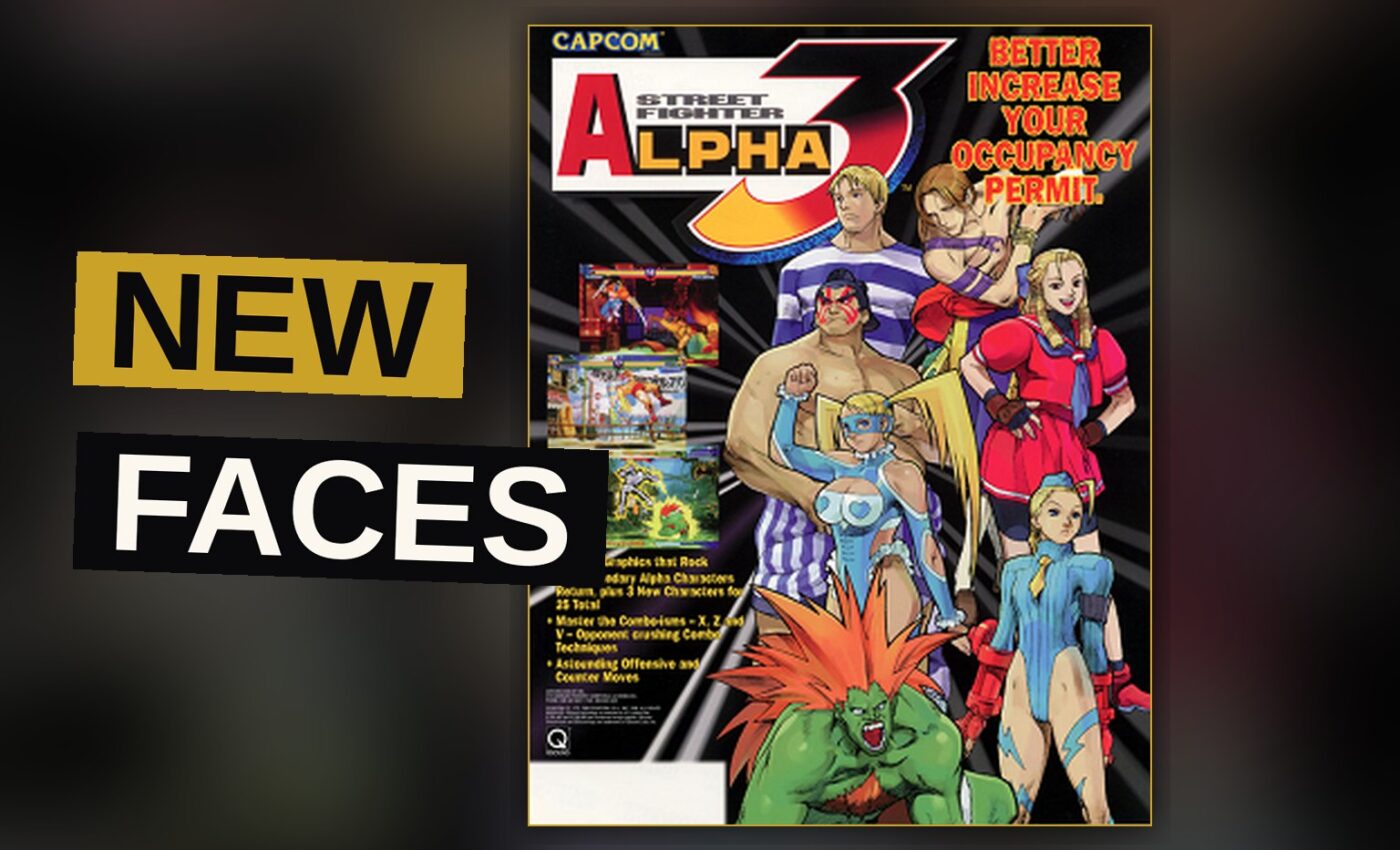
Street Fighter Alpha 3 hit arcades in 1998, built by Capcom Production Studio 1 and published by Capcom on the same CP System II hardware as the earlier Alpha games. It is the third and final entry in the Alpha series. A PlayStation version followed in 1998, adding a World Tour mode and bringing back even more characters.
That port is the one most people talk about. It is also not a clean conversion.
Three Isms, Three Games
Alpha 3 throws out the “Manual” and “Auto” modes from earlier Alpha titles. In their place are three playing styles called isms, and the choice reshapes every match.
A-ism is the standard style, based on the previous Alpha games. It gives the player a three-level Super Combo gauge and access to several Super Combo moves. X-ism comes from Super Street Fighter II Turbo — the name nods to that game’s Japanese title, Super Street Fighter II X. It offers a single-level gauge and one powerful Super Combo, and it strips out air-blocking and Alpha Counters entirely. V-ism allows custom combos like the ones in Street Fighter Alpha 2 but forbids Super Combos outright.
The trade-offs are real. X-ism has the highest attack power and the least defense. A-ism sits between the two on offense with comparable defense to V-ism. Every character gets different movesets across the three modes, which is where the depth lives.
The Guard Power Gauge
Alpha 3 adds a Guard Power Gauge that drains each time a player blocks. Empty it and the player stays open to a hit. The bar shrinks when broken and refills only to its new, smaller maximum.
Hidden modes add handicaps and benefits on top of that. Classic mode blocks Super Combos but makes a character impossible to knock into the air and juggle.
This is a fighting game that punishes passivity. Blocking is no longer free, and the ism system means two players can pick the same fighter and play completely different matches.
Cammy, R. Mika and Karin Kanzuki
The roster is enormous. Alpha 3 brings back all eighteen characters from Street Fighter Alpha 2. It adds Cammy — previously only in the console-exclusive Street Fighter Alpha 2 Gold — plus E. Honda, Blanka, Balrog and Vega. Balrog is unlockable in the arcade version.
New fighters include R. Mika, a Japanese female wrestler who idolizes Zangief, and Karin Kanzuki, Sakura’s rival, first seen in Masahiko Nakahira’s Street Fighter manga Sakura Ganbaru! Cody arrives from Final Fight as an escaped convict. Juli and Juni, two of Shadaloo’s “Dolls,” serve as Bison’s brainwashed assassins and guards, and both are unlockable. Juli is revealed to be T. Hawk’s long-lost lover.
The PlayStation version makes Balrog, Juli and Juni immediately playable. It also adds Dee Jay, Fei Long and T. Hawk from Super Street Fighter II, plus Guile from Street Fighter II, and Evil Ryu and Shin Akuma from Street Fighter Alpha 2. Guile, Evil Ryu and Shin Akuma are unlockable in the PlayStation version.
World Tour and the Final Fight Look
The PlayStation version added an exclusive World Tour mode. That is the port’s best argument, and it is the feature the arcade release does not have.
The presentation sets Alpha 3 apart from its predecessors. The illustrations, select screens, soundtrack and sound effects all share a style with the Final Fight series. That is a deliberate shift, and it gives the game a look distinct from Alpha 2.
What the Port Costs You
The arcade original runs on CP System II hardware. The PlayStation is not that hardware, and this is a 1998 console conversion of a 1998 arcade game. That gap is the price of the World Tour mode and the expanded roster.
The Sega versions went further. On Dreamcast and Saturn, Guile, Evil Ryu and Shin Akuma moved to the default roster, with Shin Akuma sharing a slot with his regular counterpart and playable by a special button combination. Final M. Bison — the true final boss of Alpha 3, carrying a special Shadaloo-ism meter — becomes playable in those versions through a code.
Final M. Bison is not playable on the PlayStation version. If you want the complete roster, the PlayStation is not where you find it.
Release Schedule
| Version | Platform | Year | Notable additions |
|---|---|---|---|
| Arcade | CP System II | 1998 | Base game, three isms |
| PlayStation | PlayStation | 1998 | World Tour mode, expanded roster |
| Dreamcast | Dreamcast | Not specified in source | Guile, Evil Ryu, Shin Akuma default |
| Saturn | Sega Saturn | Not specified in source | Same roster changes as Dreamcast |
| Game Boy Advance | Game Boy Advance | Not specified in source | Yun, Maki, Eagle added |
| PlayStation Portable | PlayStation Portable | Not specified in source | — |
The Numbers That Matter
- Game: Street Fighter Alpha 3
- Developer: Capcom Production Studio 1
- Publisher: Capcom
- Arcade release: 1998
- PlayStation release: 1998
- Arcade hardware: CP System II
- Series: Third and final Street Fighter Alpha installment
- Fighting styles: A-ism, X-ism, V-ism
- Modes: Single player, multiplayer
- Genre: Fighting
Where This Lands
The ism system is the whole argument: three styles, three movesets per character, and a Guard Power Gauge that turns defense into a resource you spend. That is a lot of decisions to make before the first punch lands, and it is the reason Alpha 3 still gets talked about.
The World Tour mode earns its place. The source says the PlayStation version added it as an exclusive, and that is the reason a console owner got something the arcade release did not.
The cost is the roster. Final M. Bison is not playable on the PlayStation version; the Dreamcast and Saturn versions make him playable through a code. If the complete Alpha 3 is what you want, the PlayStation is the wrong disc.
The Final Fight styling is the detail that stands out most. It ties Alpha 3 to Capcom’s brawler past and separates this game from Alpha 2 in a way you can see on the select screen before you throw a single punch.
Get the Notebook.
The day's best stories and every fresh verdict, in plain English, in your inbox by seven. One email a day, no more.