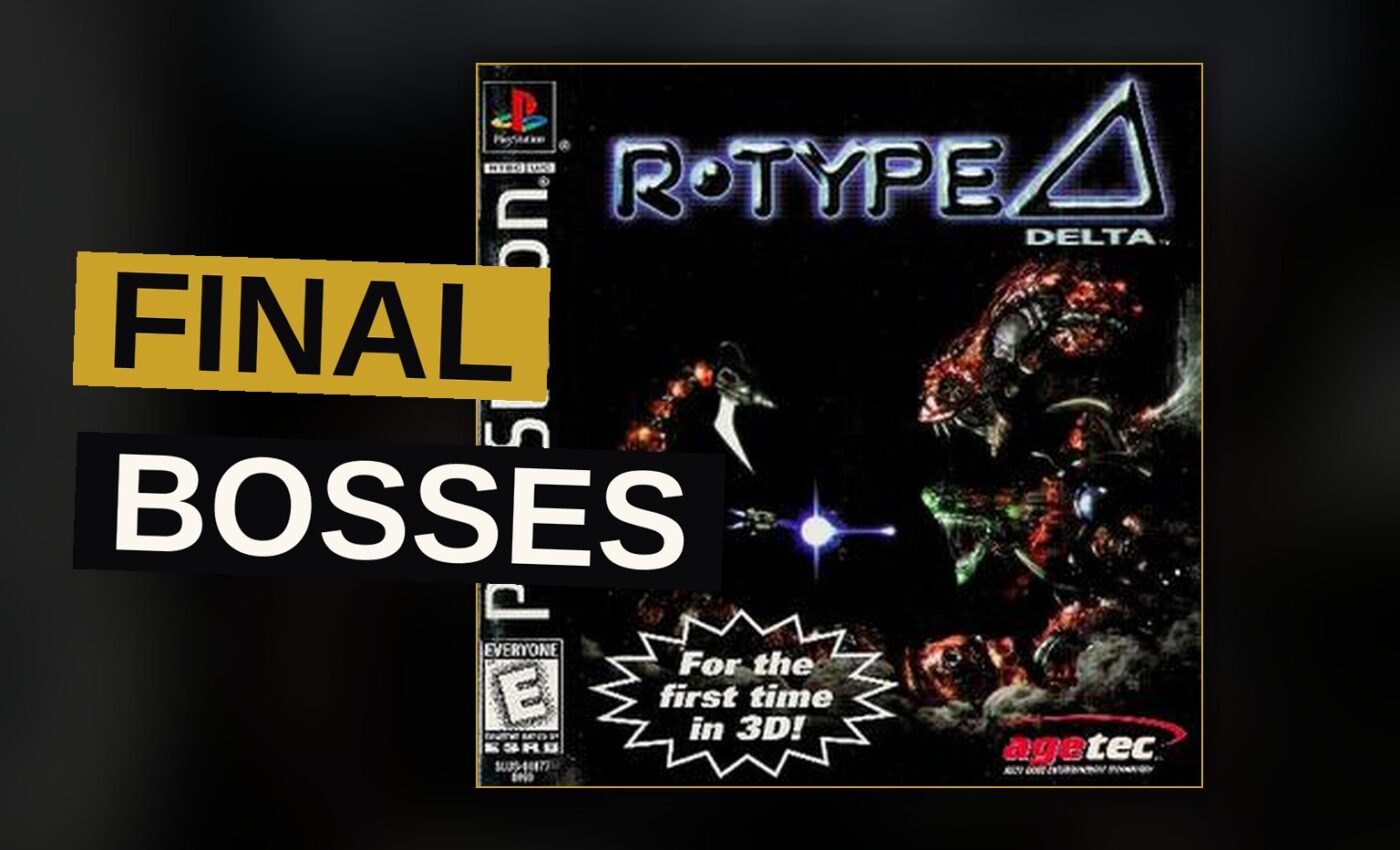
R-Type Delta arrived on the original PlayStation in 1998 as the fourth entry in Irem’s long-running shooter series. It was developed and published by Irem, and it did something no game in the franchise had done before: it rendered the fight against the Bydo Empire in full 3D.
That shift mattered. A series built on precise, side-scrolling combat had to prove it could survive the jump to polygons without losing the tight design that made its name. R-Type Delta passed that test.
The Fourth Letter of the Greek Alphabet
The title is not decoration. Delta is the fourth letter of the Greek alphabet, and R-Type Delta is the fourth game in the series. The naming is exact, and so is the game’s place in the lineage.
Irem built R-Type Delta for the PlayStation. Agetec handled publishing alongside Irem. The game is a horizontally scrolling shooter, played from a side view, built for a single player. No co-op, no second fighter on screen. One pilot, one ship, one war.
That focus shows. R-Type Delta does not spread itself across modes or gimmicks. It takes the series’ established formula and pushes it into 3D, then adds a mechanic that changes how every encounter is fought.
The R-9A2 Delta and the Moritz-G
The story picks up in 2163. The trans-dimensional fighter R-9A Arrowhead has come back from its mission to destroy the evil at the center of the Bydo Empire. It is badly damaged. The battle-cruiser Croque-Monsieur rescues it and brings it to Earth’s orbital space fortress, Aegis.
Then things go wrong. Astronomers in Central Asia watched strange objects fall from the sky. As the objects came closer to Earth, they shrank and vanished from sensors. The astronomers assumed they were meteorites and stopped paying attention.
They were wrong. Electronically-controlled weapons systems in a number of cities went haywire. Astronomers detected abnormal heat signatures. Bydo influence seized control of the orbiting annihilation platform Moritz-G, and the platform was unleashed on Earth.
The Moritz-G descended on a city in Asia. Its planet-destroying capability had not yet activated, but its self-defense system blocked every attempt to approach it. An emergency military operation went into effect. The test fighter R-9A2 Delta was assigned to the attack force.
That is the setup, and it is enough. R-Type Delta does not need a long story to justify its combat. It needs a reason for a single fighter to fly into an annihilation platform’s defense grid, and the Moritz-G provides it.
Fighters, Forces and Wave Cannons
R-Type Delta offers different fighters to choose from. Each one pairs a different Force with a different Wave Cannon combination. The choice is not cosmetic. It changes how the ship fights, what the Force can do, and how the player approaches each stretch of the game.
The game also introduces the Dose System. Forces absorb energy through collisions with projectiles or enemies. Every Force carries a Dose Gauge. When the Dosage reaches 100%, the player can fire the fighter’s Delta Attack — a superweapon whose form depends on which fighter is being used.
That last detail is the important one. The Delta Attack is not a single fixed bomb. It changes with the ship. So the fighter selection at the start of a run shapes both the standard combat and the payoff weapon.
The pieces fit together cleanly:
- Different fighters, each with its own Force and Wave Cannon combination
- The Dose System, which lets Forces absorb energy from collisions with projectiles or enemies
- A Dose Gauge for every Force, filling as energy is absorbed
- The Delta Attack, unlocked at 100% Dosage, with a form tied to the chosen fighter
That is a compact set of systems, and it gives R-Type Delta a layer the earlier games did not have. The player is not just dodging and shooting. The player is managing a gauge, choosing when to absorb hits, and deciding when the Delta Attack is worth spending.
Full 3D and the Side View
R-Type Delta is the first game in the R-Type series rendered in full 3D graphics. That is the headline technical fact, and it carried real risk. A shooter lives on readable hitboxes and clear enemy patterns. Polygons can muddy both.
Irem kept the side view. The game is still a horizontally scrolling shooter. The camera does not swing behind the ship or turn the fight into a rail shooter. The 3D is there to render the world, not to change the angle of play.
That restraint is the right call. R-Type Delta looks like a generational leap while playing like the series it belongs to. The Moritz-G, the orbital fortress Aegis, the Bydo forces — all of it gets the depth and scale that flat sprites could not deliver, and none of it costs the player a clean read of the screen.
A 1998 PlayStation Shooter
R-Type Delta released in 1998 on the PlayStation. It is a shooter in the action and science fiction vein, single player, side view. Those are the boundaries, and the game stays inside them.
The game is also listed for the PlayStation 3 and the PlayStation Portable. The source does not say when those versions arrived or how they were distributed. What is clear is the platform list is wider than the original hardware.
The genre in 1998 was crowded. The PlayStation had no shortage of shooters, and a 3D R-Type had to justify itself against both its own lineage and everything else on the shelf. It did that by being the fourth game and the first 3D one at the same time — a sequel that knew exactly what it was.
What the Dose System Changes
The Dose System is the piece worth arguing about. It gives the player a reason to take hits on purpose, or at least to let the Force take them. That runs against the instinct a shooter trains into you: avoid everything.
Here, the Force is a tool for eating projectiles. Every collision feeds the Dose Gauge. At 100%, the Delta Attack becomes available. So the player is weighing risk against a resource, and the resource is the ship’s own survival.
That is a genuine design idea, not a feature-list bullet. It also ties directly to the fighter selection. Since each fighter has its own Force and Wave Cannon pairing, and the Delta Attack’s form depends on the fighter, the Dose System makes the roster meaningful. Pick a fighter and you pick a whole approach to the gauge.
The Reception for R-Type Delta
R-Type Delta earned generally positive reviews from critics, and that reception is deserved. This is a shooter that understood what it could and could not change.
The 3D was the gamble, and Irem took it without breaking the side view or the scrolling combat. The Dose System was the addition, and it gave the series a mechanic that rewards aggression and resource management rather than pure avoidance. The Moritz-G, the R-9A2 Delta, the Croque-Monsieur, Aegis — the fiction is thin, but it is coherent, and it puts a single test fighter against an annihilation platform with its planet-destroying capability still dormant and its defenses fully active.
One detail is worth flagging: the source dates the story to 2163, while the gameplay text places the game in 2164. The two do not agree, and nothing in the material explains the gap. Report both, and do not pretend the discrepancy is settled.
The weaknesses are the ones the series always carried. This is a single-player shooter with a fixed set of fighters and no co-op. The 2163 setting and the Bydo war are backdrop, not narrative. Players who want story from their shooters will not find much here.
But that is not what R-Type Delta is for. It is for the run, the gauge, the Force, and the Delta Attack at 100%. It is for reading a screen full of projectiles and deciding which ones to eat.
R-Type Delta is the fourth R-Type, the first in 3D, and one of the sharper shooters on the original PlayStation. It holds up because it never let the new graphics dictate the old rules.
Key Facts
- Release year: 1998
- Developer: Irem
- Publishers: Agetec, Irem
- Platforms: PlayStation 3, PlayStation, PlayStation Portable
- Genre: Shooter
- Perspective: Side view
- Modes: Single player
- Setting: 2163 (story), 2164 (gameplay text)
- Series position: fourth R-Type game
- Graphics: first R-Type rendered in full 3D
- Reception: generally positive reviews from critics
Get the Notebook.
The day's best stories and every fresh verdict, in plain English, in your inbox by seven. One email a day, no more.