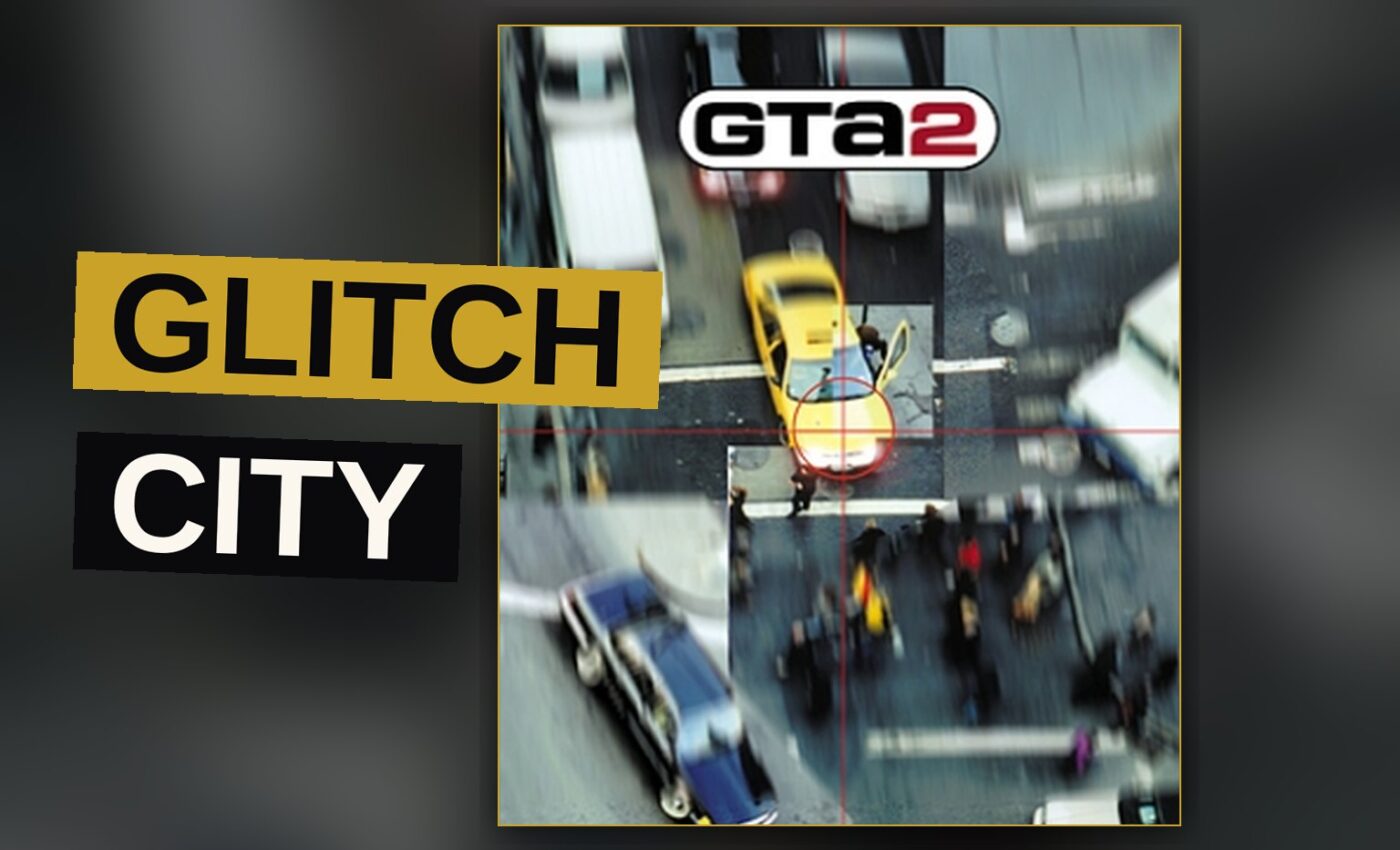
Grand Theft Auto 2 arrived in October 1999 for the PlayStation and Windows, a sequel to a game that had already made a name for itself by letting players cause havoc from a bird’s-eye view. DMA Design developed it. Rockstar Games published it. The Dreamcast and Game Boy Color versions followed in 2000. It is the second main entry in the Grand Theft Auto series, and it is a game caught between two identities: the top-down chaos of its predecessor and the more ambitious crime simulation that would arrive two years later.
The setting is the most distinctive thing about it. Grand Theft Auto 2 takes place in a retrofuturistic metropolis called Anywhere City, divided into three districts — Downtown, Residential, and Industrial. Players move between them as they progress. The time period is deliberately vague. Conflicting sources suggest anything from “three weeks into the future” to the year 2013, though in-game references to the coming “new millennium” imply the game sits around its own release date. That ambiguity is a feature, not a bug. Anywhere City feels like a place outside of time, which suits a game about a criminal with no fixed identity.
Anywhere City and the three districts
The open world design lets players freely roam Anywhere City. The goal is straightforward: take the role of an aspiring thug and climb to the top of the criminal world by completing missions and terrorizing the citizenry. The game focuses on a series of levels, each requiring a set target score to progress. Points come from criminal actions — destroying cars, selling vehicles, and completing missions for crime syndicates. Syndicate jobs award more points than simple street crime, which nudges players toward structure without forcing them into it.
Three syndicates operate across the game. Each level features two unique syndicates alongside a third that appears in all levels. Doing jobs for a syndicate builds respect with that group, which unlocks tougher jobs. That gang loyalty system was one of the game’s genuine improvements, and it holds up as the most interesting mechanical idea here. It gives the mayhem a social texture. You are not just blowing things up; you are building a reputation with people who will remember it.
Wanted levels and the cost of dying
Creating chaos draws police attention. The more crimes a player commits, the higher the wanted level, and higher wanted levels bring a more aggressive response. Police will hound the player to arrest or kill them. Being arrested or dying costs the player any equipment they found and damages their multiplier bonus. That penalty system is simple but effective. It makes the moment-to-moment decisions matter. Do you push for one more job, or do you bank what you have?
Grand Theft Auto 2 also introduced the ability to save during a level by visiting the church where the player starts. The catch is that saving costs a set number of points. It is a small design choice that says a lot about the game’s priorities. Progress is never free. Everything in Anywhere City has a price, including the act of pausing to preserve what you have earned.
The Game Boy Color version stands apart. It offers six playable characters instead of one, a concession to the hardware that makes it a different experience. That version also received negative reviews, the harshest of any platform.
What the game gets right
The soundtrack earned praise, and it deserves it. The gang loyalty system also drew positive notice. These are the parts of Grand Theft Auto 2 that feel like real steps forward for the series. The game also expanded the formula in ways that matter:
- Players can save mid-level at a church, at the cost of points
- Three syndicates operate across the game, with two unique to each level
- Respect with a syndicate unlocks tougher jobs
- Wanted levels scale police response based on player chaos
- Six playable characters in the Game Boy Color version
Where it stumbles
The graphics, controls, and setting received a mixed response. That is fair. The bird’s-eye isometric perspective, while functional, limits how much the player can see and react to. The controls do not always keep up with the ambition of the open world. And the setting, for all its retrofuturistic charm, can feel thin — a backdrop rather than a place with its own logic.
The most persistent criticism is that Grand Theft Auto 2 failed to innovate the formula established by its predecessor, despite the improvements it brought. That charge lands. The game refines more than it reinvents. The core loop — complete levels, earn points, avoid the police — is essentially the same loop from 1997’s Grand Theft Auto. The gang loyalty system and the save mechanic are meaningful additions, but they sit on top of a foundation that was already showing its age.
The score target and the level structure
The level structure deserves a closer look, because it is where the game’s tension lives. Each level demands a set target score before the player can advance. That target is not a suggestion. It is a gate. Players who want to see the next district have to earn their way there, and the fastest route is syndicate work. This creates a push-pull: street crime is easy and immediate, but syndicate jobs pay more and build respect. The game rewards patience over impulse, which is an unusual stance for a series built on impulse.
That said, the target score system can also feel like a chore. It turns crime into a checklist. The open world invites experimentation, but the level gate punishes wandering. There is a tension between the freedom the game advertises and the structure it enforces. Grand Theft Auto 2 wants you to roam, but it also wants you to hit a number. Those two desires do not always coexist comfortably.
Live-action intro and the Rockstar touch
The intro involves live-action scenes filmed by Rockstar Games. It is a curious choice, and it signals the series’ growing interest in presentation. The live-action footage gives the game a sense of place and attitude that the isometric gameplay cannot always deliver. It is also a reminder that Rockstar was already thinking about Grand Theft Auto as something more than a top-down shooter. The intro is not the main event, but it is worth noting as an early sign of where the series was headed.
The verdict on Grand Theft Auto 2
Grand Theft Auto 2 is a moderate commercial success that received mixed reviews for most platforms. That reputation is earned. It is not a bad game. It is a transitional one. The gang loyalty system, the save mechanic, and the soundtrack are genuine strengths. The graphics, controls, and setting hold it back. And the failure to fully reinvent the formula keeps it from being more than a refinement.
What matters most here is the direction of travel. Grand Theft Auto 2 was followed by 2001’s Grand Theft Auto III, which started a new era for the series. The game itself was re-released on Steam in January 2008. Looking back, Grand Theft Auto 2 reads as a bridge. It kept the top-down perspective and the level-based scoring of the original while experimenting with reputation systems and mid-level saves that would echo through later entries. The live-action intro shows Rockstar testing how much personality a Grand Theft Auto game could carry.
The mixed critical response is the right response. This is a game with real ideas and real limitations, and the limitations are not incidental. They are structural. The isometric view, the controls, and the thin setting are not surface problems; they shape what the game can be. The improvements are real, but they are improvements to a formula that was already nearing its ceiling.
For players coming to Grand Theft Auto 2 now, the appeal is historical. It is a chance to see the series before it became a phenomenon, when it was still a top-down curiosity with a mean streak and a growing sense of ambition. The gang loyalty system is the part worth studying. It is the clearest sign that DMA Design and Rockstar were thinking about how crime, reputation, and consequence could fit together. Grand Theft Auto III would take that thinking and blow it up into something else entirely. Grand Theft Auto 2 is the step before the leap.
Get the Notebook.
The day's best stories and every fresh verdict, in plain English, in your inbox by seven. One email a day, no more.