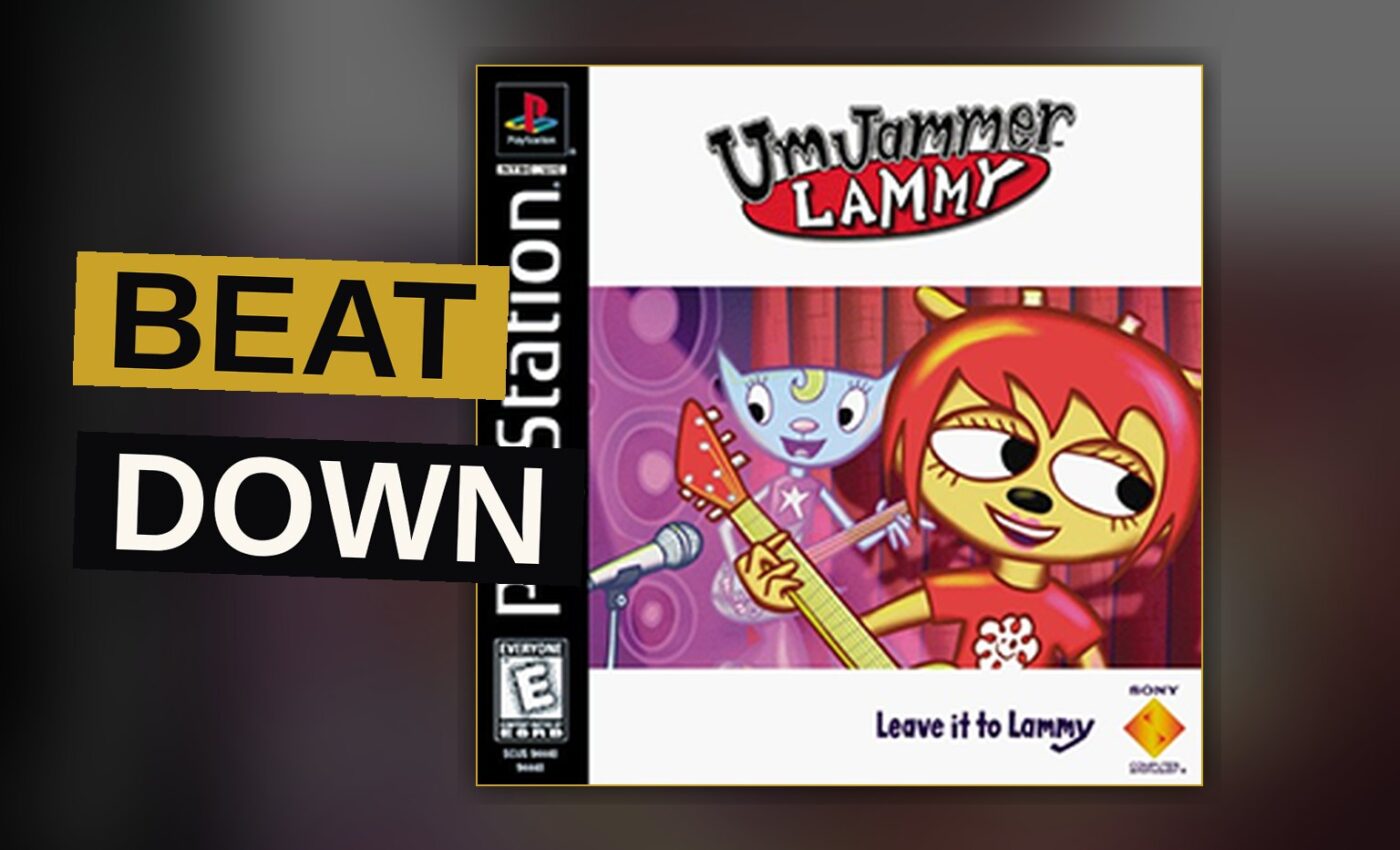
Sony shipped a rhythm game in 1999 that opens with its hero playing a vacuum cleaner. That is the joke, and it is also the thesis. Um Jammer Lammy comes from NanaOn-Sha, the studio behind 1996’s PaRappa the Rapper, and it carries the same producer and designer, Masaya Matsuura, working again with artist Rodney Alan Greenblat. The PlayStation title is a spin-off and a follow-up, not a sequel — a distinction that matters, because it trades rap for a guitar and swaps its hero for a shy lamb.
A Lamb, a Band Called MilkCan
Lammy is a left-handed guitarist who leads MilkCan, a rock band with bassist and lead singer Katy Kat and drummer Ma-san. She is a nervous wreck until she has a guitar in her hands, real or imaginary. Sara Ramirez voices her.
The plot is a countdown. On the night before MilkCan’s first concert, Lammy dreams she is performing with Chop Chop Master Onion, then wakes to find she has been playing a vacuum cleaner. Chop Chop tells her about losing his dojo, which survives in his mind, casino and all.
Dojo, Casino, It’s all in the mind
Lammy wakes with 15 minutes to reach her gig. A fire blocks her route. Chief Puddle asks for help, she spots a casino billboard, remembers the words, and pictures her fire hose as a guitar. She puts out the fire, eats too much pizza, gets mistaken for a pregnant woman by Nurse Cathy Piller, then rocks a baby to sleep as if it were an instrument. A skateboard sends her into a plane, where she helps Captain Fussenpepper fly by using her yoke as a guitar. She crash lands in a parking lot and leaves her guitar behind on the plane.
Symbols on a Scrolling Score
The gameplay follows PaRappa but leans harder on guitar. Each stage pairs Lammy with a teacher, and play alternates between them. Symbols scroll across a score at the top of the screen, with an icon showing whose turn it is. The teacher sings a line, the controller vibrates, and the player hits the buttons that make Lammy answer.
You can copy the symbols or freestyle for extra points. Clean freestyle lines push you from Good to Cool, where the teacher leaves the screen and you play as you like until the song ends. Fall short and you drop back to Good. A code shown on the loading screen opens Fever Mode from Cool, and the points there are massive.
Play badly and you sink to Bad, then Awful. Drop below Awful, or end the stage in either rank, and the song fails. Reaching the end in Good or Cool moves you on. Normal is the default, with set buttons and a save after each stage. Easy covers stages 1 through 6, accepts any button on the line, and saves nothing.
Sound Morphers and a Second Player
From stage 2, Lammy’s story unlocks sound morphers — Flanger, Harmonizer, Wah-Wah, Distortion and Reverb — selected with the Select button. There is a two-player mode, and the package carries a pile of unlockables.
The music runs across rock, heavy metal, punk and pop. The tracks are catchy, and they are funny on purpose. The camera sits third person and side view, with an auditory perspective that is the whole point: you are not watching this game so much as listening for your cue.
Namco co-developed an arcade version, Um Jammer Lammy NOW!, which reached Japanese arcades in December 1999. Wikipedia’s entry on the game states the home release drew generally positive reviews from critics.
Where the Design Actually Bites
The rank system is the smartest thing here. PaRappa asked you to keep time; Um Jammer Lammy asks you to earn the right to improvise. Cool is not a score tier, it is permission — the teacher exits and the song becomes yours. That is a real idea about what a rhythm game can be, and it arrived in 1999.
It is also unforgiving. Ending a stage in Bad or Awful fails the song outright, and the climb back to Good has to happen inside the track. Easy mode softens this for the first six stages, but it will not save your progress, which undercuts its use as practice.
The story is a string of gags, and that is fine. A fire hose, a baby, a plane yoke — each one is a guitar if Lammy decides it is. The game states its own theme without apology.
What holds it back is scope. A run of call-and-response stages, a handful of morphers, and a two-player mode is a thin package next to what the genre would later become. The humor and the hooks carry it further than the structure does.
Um Jammer Lammy is a confident, strange, funny game that treats improvisation as a reward rather than a bonus. Its rank system still has teeth, its soundtrack still lands, and its 15-minute premise is one of the better excuses a rhythm game has ever invented for its own track list. It is not PaRappa with a new skin.
Get the Notebook.
The day's best stories and every fresh verdict, in plain English, in your inbox by seven. One email a day, no more.