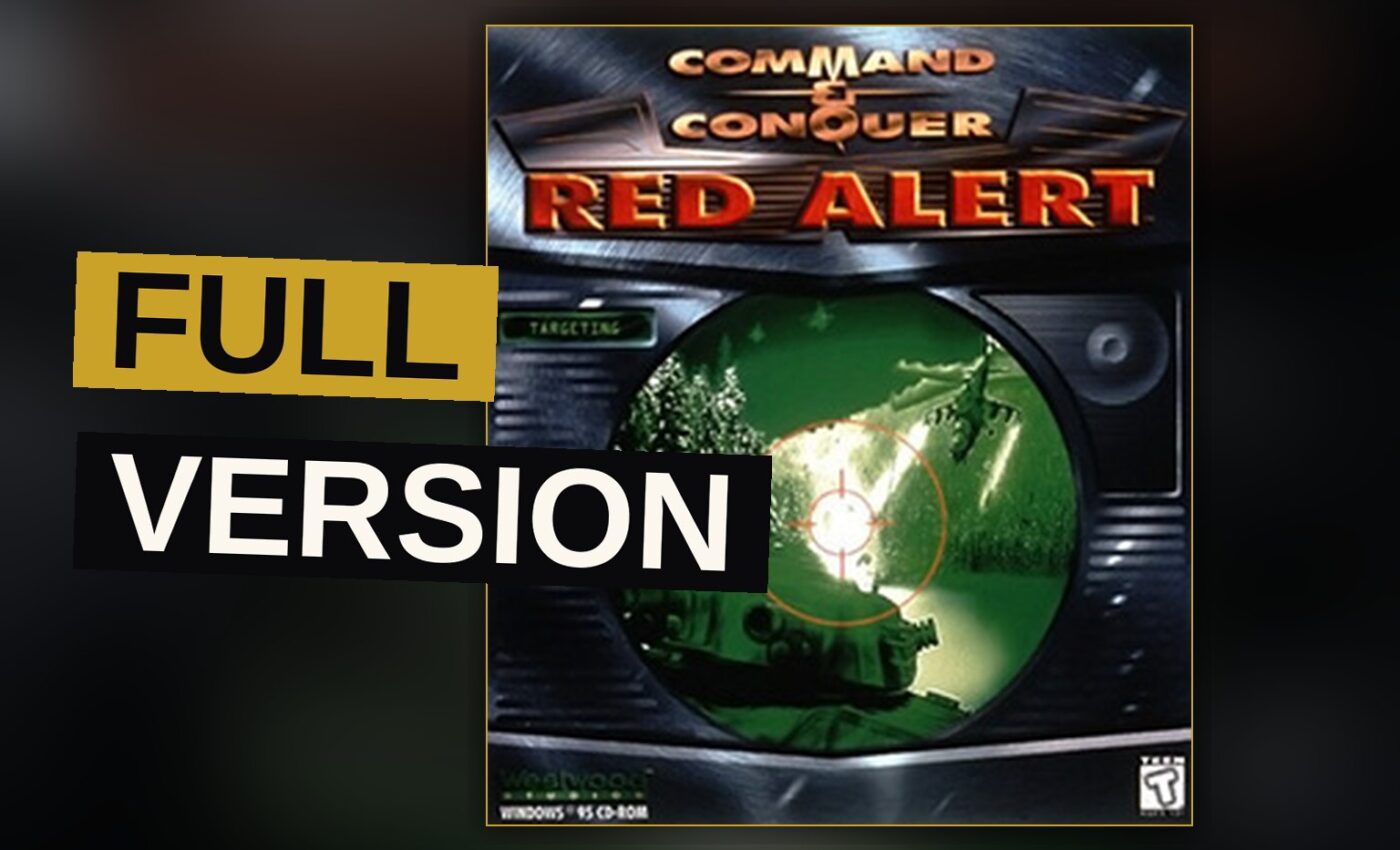
The PlayStation port of Command & Conquer: Red Alert arrives with a problem it cannot solve. Westwood Studios built a real-time strategy game for the mouse and keyboard, then squeezed it onto a console with a digital pad. The result is a fascinating document of 1996, a game whose ideas outrun its controls.
Einstein Builds a Time Machine
Red Alert opens in 1946 at the Trinity Site in New Mexico. Albert Einstein has finished his time machine, the Chronosphere, and uses it to travel back to Landsberg, Germany, on December 20, 1924. There he meets Adolf Hitler just after Hitler’s release from Landsberg Prison.
The two talk briefly. Einstein shakes Hitler’s hand. The gesture erases Hitler from the timeline, and Nazi Germany never rises. Without that counterweight, the Soviet Union grows powerful under Joseph Stalin, seizes land from China, and invades Eastern Europe. Western Europe, including an already-rearmed Germany, forms the Allied Nations and fights back.
This is the setup, and it is one of the great premises in the medium. Red Alert is a prequel to the original Command & Conquer of 1995, and it takes place in the alternate early history of that series. The game asks a simple question: what if removing one man from history made the world worse? Then it hands you a tank and lets you answer with artillery.
Two Campaigns, Two Endings
The single-player campaign splits into Allied and Soviet routes. Most missions have split routes, so the objective stays the same while the map layout differs. Live-action cinematic sequences carry the story between battles.
The Allied ending runs through the siege of Moscow. A platoon finds Stalin buried alive in the rubble of the Kremlin. As the soldiers start pulling debris off him, General Stavros walks in and stops them. He convinces them they saw nothing and orders them to leave. Stavros then stuffs a handkerchief into Stalin’s mouth, covers his head with a large stone, and walks away.
The Soviet ending plays out at a captured Buckingham Palace. Stalin praises the Commander, the player, as the Soviets celebrate. Then Nadia poisons him and guns him down as the poison takes hold.
Both endings are nasty, funny, and quick. Westwood understood that a strategy game’s story is a reward, not a lecture.
Ore, Power, and the Mammoth Tank
The economy is ore and gems. Players mine resources and process them into credits for buildings, vehicles, troops, and repairs. Gems are worth far more credits than ore, but gems do not regenerate on the map. Ore does. You can build extra refineries and ore trucks to mine faster, and unspent credits need ore silos to sit in.
Resource management decides matches. Getting ore fast and denying ore to your opponent is often the whole game.
Power is the second lever. Every base needs power plants to meet the growing demand for electricity. High-powered installations like radar and Tesla Coils will not function without enough power, which is why power plants are often the first thing targeted in a base attack.
Engineers add a third layer. A critically damaged enemy structure can be captured with an engineer, and the captured structure produces units for you. An Allied player who captures a Soviet war factory can build Soviet units like the Mammoth Tank. That single rule makes engineers some of the most valuable units on the field.
The interface holds up better than the port does. Players can queue commands, create unit groups selected by a number key, and control numerous units at once. The game also ships with a map editor and Westwood Chat.
The PlayStation Problem
Red Alert was initially available for PC, with MS-DOS and Windows 95 versions in one package. It was later ported to PlayStation, and that version was re-released as a download on the PlayStation Network for PlayStation Portable and PlayStation 3. It has since been delisted.
The PlayStation version is how a lot of people met the game. It is also the weakest way to play it. Real-time strategy wants a cursor, and a digital pad is not a cursor. Selecting units, issuing orders, and scrolling a battlefield with a controller turns a fast game into a slow one.
This is the central tension of the port. The design is sharp, the controls are dull, and no amount of clever mapping fixes the gap.
What the Port Gets Right
The PlayStation version keeps the full campaign, the live-action cinematics, and the multiplayer mode. The map editor remains a feature of the game, though it is a PC tool at heart, and the core game survives intact.
The alternate-history setting remains the strongest thing Red Alert has. The game does not treat the premise as decoration. It builds two factions, two arsenals, and two endings out of it, then lets the player decide which version of history wins.
The multiplayer holds up for the same reason it always did. Two players who both understand ore denial and power management will fight over the same map for a long time, and the outcome will turn on economy, not reflexes.
The Remaster and the Freeware Release
Electronic Arts acquired Westwood Studios in 1998. On August 31, 2008, EA rendered Command & Conquer: Red Alert freeware. The Command & Conquer Remastered Collection followed on June 5, 2020, through Origin and Steam.
The collection contains a graphically rebuilt Red Alert, the expansions Counterstrike and The Aftermath, additional missions and briefing videos that were exclusive to the PlayStation’s Retaliation port, and an unlockable gallery of unused and “making-of” materials.
That package is now the definitive way to play Red Alert on a modern machine. It also underlines what the PlayStation version was: a compromise. The 2020 remaster is the version to seek out, and the freeware release is the version to try for nothing.
| Version | Platform | Release |
|---|---|---|
| Command & Conquer: Red Alert | PC (MS-DOS, Windows 95) | 1996 |
| Command & Conquer: Red Alert | PlayStation | 1996 |
| Command & Conquer: Red Alert | PlayStation Network | Delisted |
| Command & Conquer: Red Alert | Freeware | August 31, 2008 |
| Command & Conquer Remastered Collection | Origin, Steam | June 5, 2020 |
Why 7.5 of 10
Red Alert is widely considered one of the greatest games ever made, and the PlayStation port is not the reason. It was praised for its engaging gameplay, its alternate history setting, and its competitive multiplayer, and all three survive the trip to the console in some form.
But the port fights its own hardware on every mission. The ore economy, the power grid, and the engineer capture trick are all about speed and precision, and the controller takes both away. What remains is a great game played through a bad window.
The score reflects a landmark design held back by the machine it landed on. Play it for the premise and the two endings, then play it again on a PC, where the cursor and the map editor still live. The port is a history lesson. The original is the game.
Get the Notebook.
The day's best stories and every fresh verdict, in plain English, in your inbox by seven. One email a day, no more.