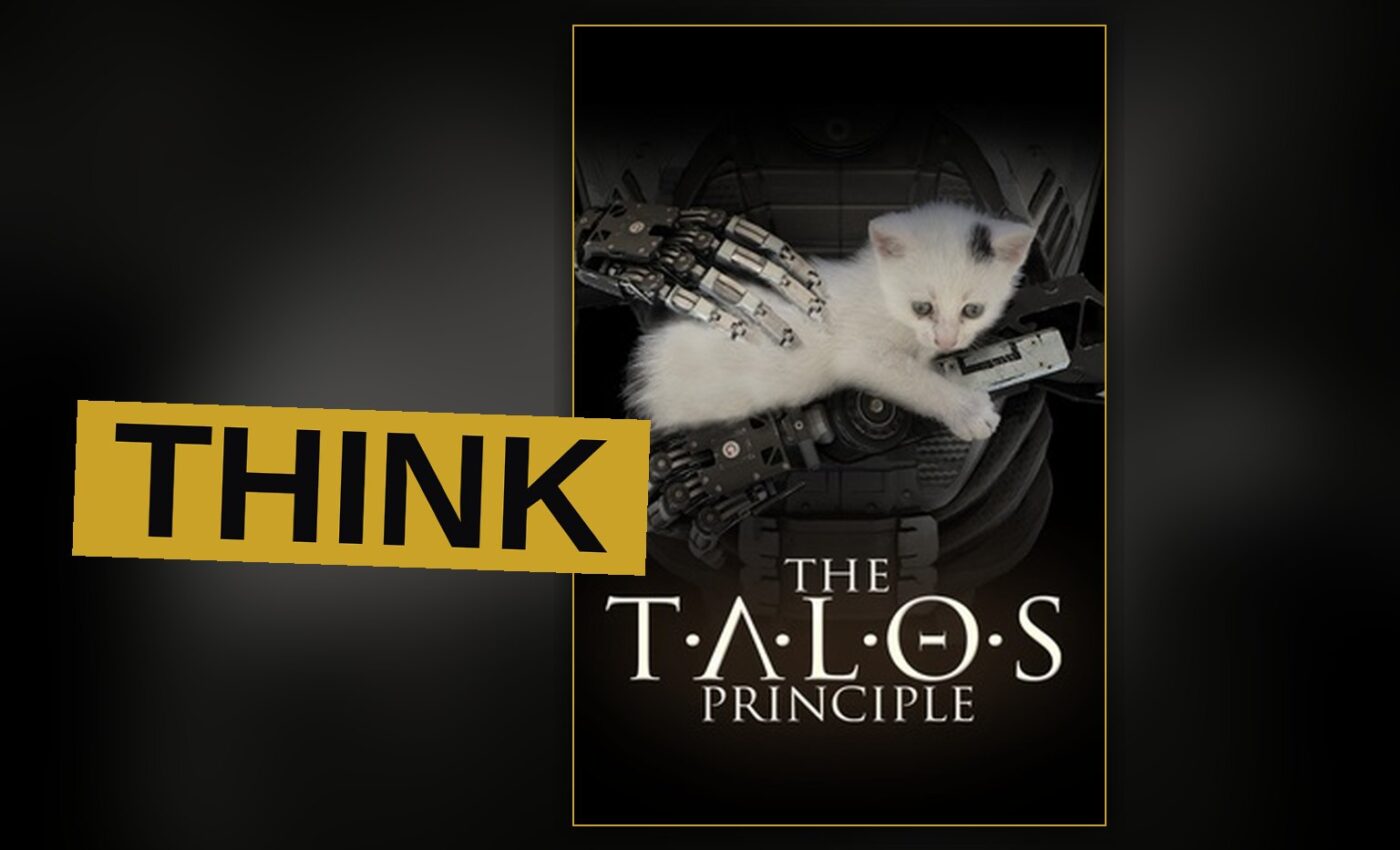
The Talos Principle opens with an android waking in a world of ancient ruins and advanced technology. A voice calling itself Elohim gives the android a task: solve the puzzles, collect the sigils, and do not climb the tower at the center of these worlds.
Croteam developed the game. Devolver Digital published it. It was simultaneously released on Linux, OS X and Windows in December 2014, then spread across platforms for years afterward.
Trailer, via DevolverDigital.
Sigils, Jammers and the Tower
The Talos Principle is a narrative-based puzzle game played from a first- or third-person perspective. The player is a robot with a seemingly human consciousness, exploring environments that hold more than 120 puzzles. Greenery, desert and stone ruins sit against futuristic technology.
The goal in each enclosed area is a tetromino-shaped “sigil.” Drones detonate if the player gets too close. Wall-mounted turrets shoot. Die to either and the game resets the player to the start of that specific puzzle. Portable jammer units disable drones, turrets and the force-field walls that block the path.
New tools arrive as sigils accumulate. Crystalline refractors activate light-based switches. Hexahedrons let the player climb or block a drone’s path. Large fans launch the player and other objects across a puzzle. Later comes a device that records the player’s actions, so a clone of that recording can stand on a switch and hold it down.
Doors and security systems demand a set number of specific sigils. Once collected, the sigils must be assembled into a tiling puzzle to unlock the system. Special star sigils hide behind unique solutions.
Elohim, Milton and the Last Days of Humanity
The story is where The Talos Principle stops being a puzzle game. The android’s worlds exist only in virtual reality. The androids it meets are separate artificial intelligence entities inside a computer program.
Some serve as Messengers, guiding the android through the puzzles without question. Others leave messages that split on Elohim — some say doubt him, some say obey. The Milton Library Assistant, a text conversation program on the computer terminals, pushes the android to question everything and defy Elohim outright.
The terminals also hold news reports and personal logs from humanity’s last days. A lethal virus, dormant in Earth’s permafrost, was released by global warming and drove the species to extinction. Researchers gathered as much of humanity’s knowledge as they could into large databanks, hoping another sapient species would find it.
One researcher, Alexandra Drennan, launched a companion “Extended Lifespan” program to build a new mechanical species that would carry on humanity’s legacy. That required a worthy AI with great intelligence and free will — something Drennan recognized would not arrive until long after humanity was gone.
A Dozen Years of Releases
| Release | Date |
|---|---|
| Linux, OS X, Windows | December 2014 |
| Android | May 2015 |
| PlayStation 4 | October 2015 |
| iOS | October 2017 |
| Oculus Rift and HTC Vive (VR) | 18 October 2017 |
| Xbox One | August 2018 |
| Nintendo Switch | December 2019 |
| The Talos Principle 2 | November 2023 |
| The Talos Principle: Reawakened | 10 April 2025 |
The name comes from a principle formulated by a fictional Greek philosopher, Straton of Stageira. In texts found in the game, Straton argues that the consciousness of Talos of Greek mythology — a mechanical yet conscious man — implies humans are also merely machines, biological ones. Other names follow: Elohim, Gehenna, Samsara, Uriel.
Tom Jubert (FTL, The Swapper) and Jonas Kyratzes (The Sea Will Claim Everything) wrote the game.
What the Puzzle Design Gets Right
Croteam built its name on Serious Sam, and The Talos Principle is the opposite of that series in almost every way. The puzzles are quiet, patient and cumulative. Each new element — refractors, hexahedrons, fans, the time-recording device — builds on what the player already understands instead of replacing it. The sigil-gated doors give the whole thing a spine: progress is earned, not handed over.
The Milton Library Assistant is the best idea in the game. A terminal program that argues with you is a smarter delivery system for the story than any cutscene, and it turns the player’s own curiosity into the engine of the plot. The Elohim material is thinner by comparison — a voice giving orders is a voice giving orders — but it sets up the defiance the game wants you to feel.
The extended lifespan material lands hardest. Humanity’s extinction, the databanks, Drennan’s program: this is the part of The Talos Principle that turns a puzzle box into an argument about what a mind is worth preserving. It is also the part most likely to stay with you after the last sigil.
In this paper’s view, the game falls short of perfect. Its environments repeat motifs, and the philosophical material occasionally states its themes more plainly than it needs to. But the ambition is real, and the execution mostly matches it. A first-person puzzler that asks who you are, what your purpose is, and what you are going to do about it — and then makes you solve for the answer — earns its place.
8.7/10, IGDB critic aggregate.
Get the Notebook.
The day's best stories and every fresh verdict, in plain English, in your inbox by seven. One email a day, no more.