Rolling a marble through six courses sounds simple. On the NES, it turns into a lesson in patience.
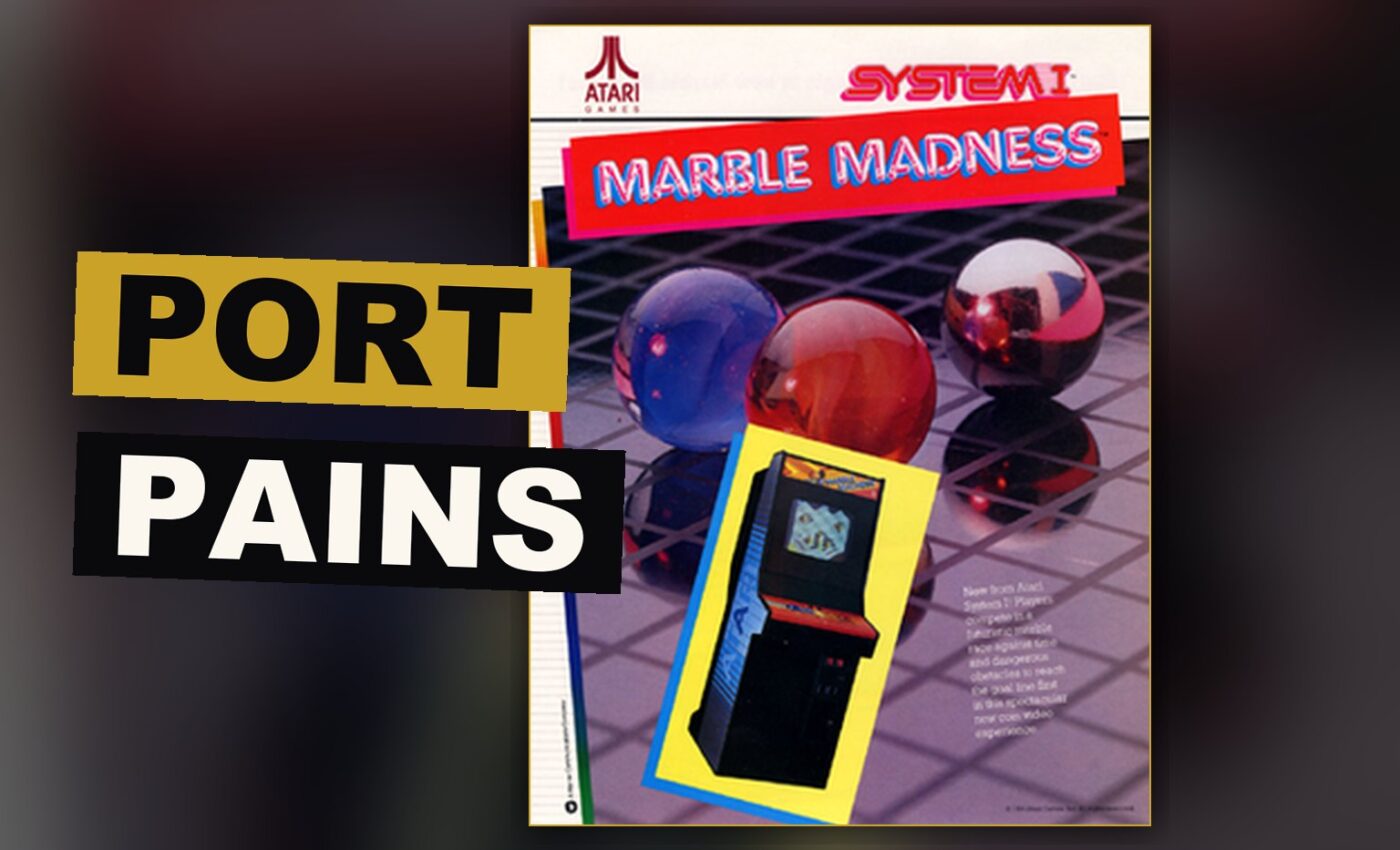
Marble Madness came to Nintendo’s console as a port of the arcade original, and the difference between the two versions shows almost at once. The arcade cabinet let players guide the marble with a rolling ball under the hand. The NES version asks players to do the same work with a set of push buttons instead. That change alters the whole feel of the game.
Controls That Fight Back
The buttons cannot match the fine control the arcade machine offered. Marble Madness asks players to guide a rolling ball around narrow paths, over moving platforms and past enemies that push the marble off course. With buttons instead of a rolling surface, small corrections often turn into large, careless ones.
Falling off the course happens often, and not always because of a poor read on the level. Sometimes the marble simply moves too far, too fast, after a single press. That space between what the player wants and what the controller delivers sits at the center of most complaints about this version.
Six Courses, One Clock
Marble Madness keeps the arcade game’s design. Six courses, each stranger than the last, must be finished before a timer runs out. Early courses are forgiving. Later ones are not.
The level design still holds up as clever and full of surprises. Enemies roll and chase. Platforms move and disappear. The courses ask players to think about weight and gravity, not just direction, and that idea comes through fine on a home console, though the controls make it harder to act on.
Sound and Look
The game’s presentation carries over well enough. The marble rolls with a pleasing sense of weight to it, and the courses keep their distinct colors and rounded shapes. The music, built with the console’s own sound hardware, still has a strange charm to it, though the NES dulls some of the arcade original’s texture.
None of that fixes the main problem. A game built around careful, ongoing motion needs a controller built for careful, ongoing motion. The NES controller was not made for that task, and Marble Madness never quite settles the matter.
What Holds Up, What Does Not
| Element | Arcade Original | NES Version |
|---|---|---|
| Control method | Rolling ball under the hand | Push buttons |
| Accuracy of control | High | Lower |
| Course design | Six clever levels | Same six levels, carried over directly |
| Look | Distinct, rounded shapes | Kept, with small changes |
| Sound | Built for arcade hardware | Same music, flatter tone |
| Difficulty | Hard, but steady with proper control | Harder, due to control limits |
The table makes the shape of the problem clear. Nearly everything about Marble Madness made the move to NES except the one control method the whole design depended on.
That single missing piece drags down an otherwise clever game.
Marble Madness on NES is not a broken game. It is a compromised one. Players who never touched the arcade cabinet may find the controls tolerable, even charming in their faults. Players who remember the original will notice the difference within the first course.
The game still offers something the NES library did not have much of: a puzzle built around gravity and weight, dressed up as an arcade racer. That novelty counts for something. But novelty only carries a game so far when the main mechanism feels harder to control than it should. Marble Madness on NES is an interesting piece of its time, worth a look for curiosity’s sake, but not a game that overcomes the limits of its own hardware.
Marble Madness lands as a decent, at times frustrating port of a truly clever arcade game, held back by a control scheme it was never built for.