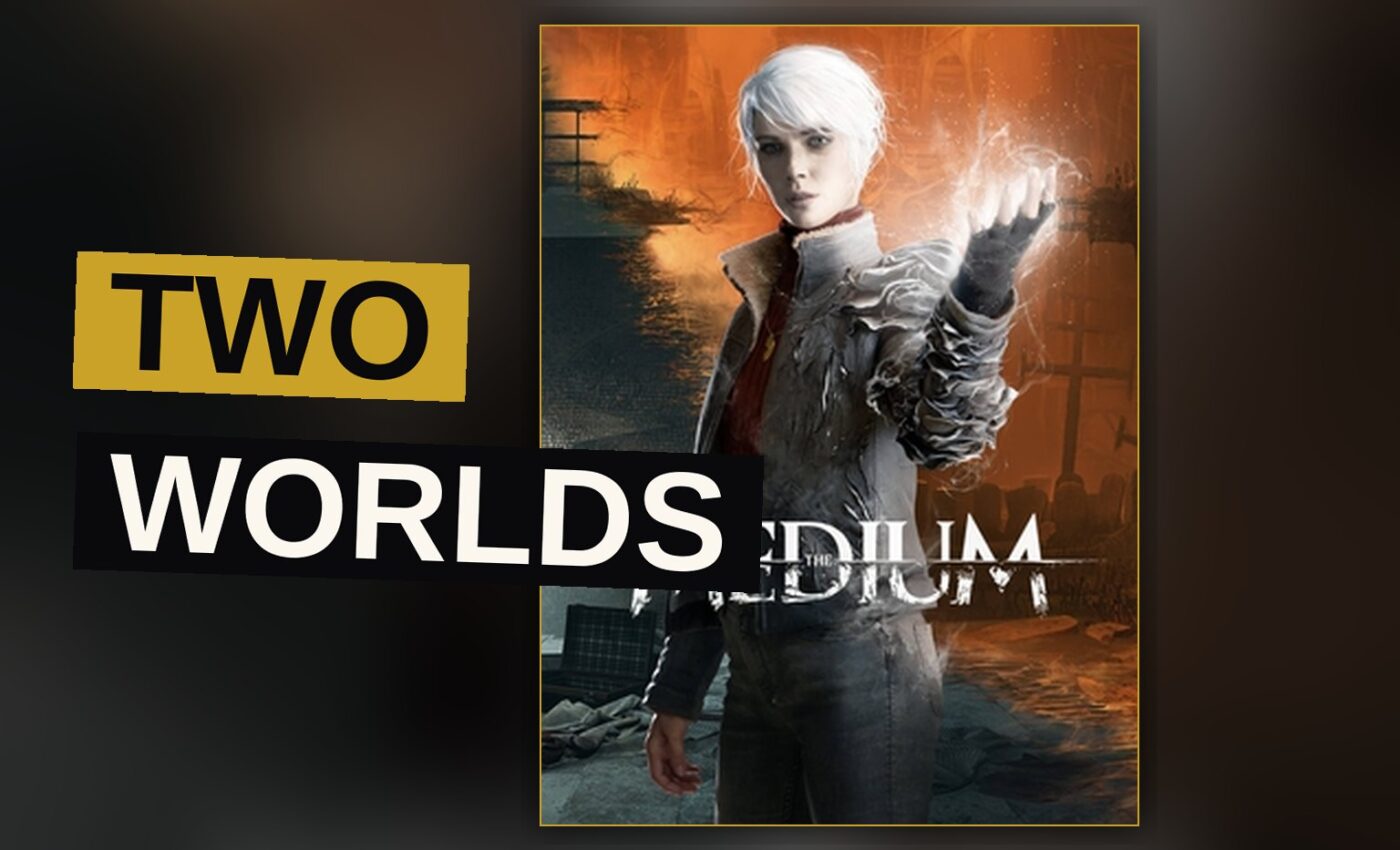
The Medium asks players to split their attention between two worlds at once, and most of the time it succeeds. Developed by Polish studio Bloober Team and released for Series X|S, PC, PS5 and Mac in 2021, the game drops players into a remote Polish spa town that hides a dark secret beneath its surface. The setup sounds simple: explore, solve puzzles, uncover the truth. It is anything but.
Trailer, via Bloober Team.
Two Worlds, One Screen
The central trick is the double vision. Players see both the physical world and a spectral realm at the same time, controlled by a single character named Arkas. This is not a gimmick that wears thin. The puzzle design leans on it heavily, forcing players to move objects in one layer while navigating hazards in the other. A floor tile might be solid ground below but a deadly trap above. The game trusts players to keep track of both, and it mostly pays off.
The controls hold together well across all four platforms. Motion is fluid, and the camera rarely fights the player. The game runs at a steady pace that suits its deliberate, atmospheric tone. On Series X|S and PS5, the load times are short enough that they barely register, which helps keep the flow of exploration intact.
The Spa Town and Its Secrets
The setting is the real star here. The spa town is a closed loop of hotels, thermal pools and narrow streets, built with a painterly, almost impressionistic visual style. The lighting is moody, the sound design is hushed and unsettling, and the overall effect is genuinely eerie. It is a place that feels lived-in and full of history, even when it is empty.
The story unfolds slowly through notes, audio logs and occasional dialogue with characters who live there. The mystery builds around a psychic named Marianne, whose past connects directly to the town’s dark history. The pacing is deliberate, bordering on slow, but the atmosphere carries the weight of quiet moments between revelations.
Puzzles That Test Patience
Not everything lands. Some of the puzzles require precise timing or repeated attempts that feel more frustrating than clever. A few sections ask players to remember details from earlier rooms, and the game does not always make clear which clues matter most. These moments break the spell the game otherwise weaves.
The difficulty curve is uneven. Here is how it breaks down:
- Early puzzles are forgiving, letting players learn the mechanics without much pressure.
- Mid-game puzzles start demanding more precise timing, which can frustrate players who miss the rhythm.
- Late-game puzzles often require returning to earlier rooms to find clues, which can feel like extra work.
- The final stretch pulls everything together, rewarding players who stuck with the game’s logic.
The game does not always explain its logic clearly, leaving players to guess at the rules behind each new obstacle.
Sound and Sight
The music deserves special note. The score blends ambient textures with a piano motif that recurs throughout, giving the game a sense of dread that lingers even after the credits roll. The sound effects are subtle but effective, with footsteps, distant murmurs and the hum of machinery building tension without ever overwhelming the scene. The result is a soundscape that complements the visuals rather than competing with them.
The visuals themselves are strong. The spectral layer glows in soft blues and purples, distinct from the warmer tones of the physical world. The contrast works, though some environments look nearly identical in both layers, which can confuse players trying to navigate while tracking multiple threats at once.
Comparing the Platforms
| Feature | Series X|S / PS5 | PC | Mac |
|—|—|—|—|
| Load Times | Short | Short | Short |
| Performance | Smooth | Smooth | Smooth |
| Visuals | Sharp | Sharp | Sharp |
| Controls | Precise | Precise | Precise |
The game performs consistently across all three platforms. There is no notable difference in how it looks or plays, which is a relief for anyone who owns more than one system and wants the same experience regardless of where they play it.
Final Word
The Medium is a game about perception, memory and the space between reality and imagination. It asks players to trust its strange rules and rewards that trust with some of the best puzzle design in recent memory. The slow burn of its storytelling and the layered exploration make it a standout entry in the horror genre.
It is not perfect. The puzzles occasionally frustrate more than they delight, and the story takes its time reaching its payoff. But the ambition shows in every frame, and the final act delivers on the promise the game has been building toward since the first hour.