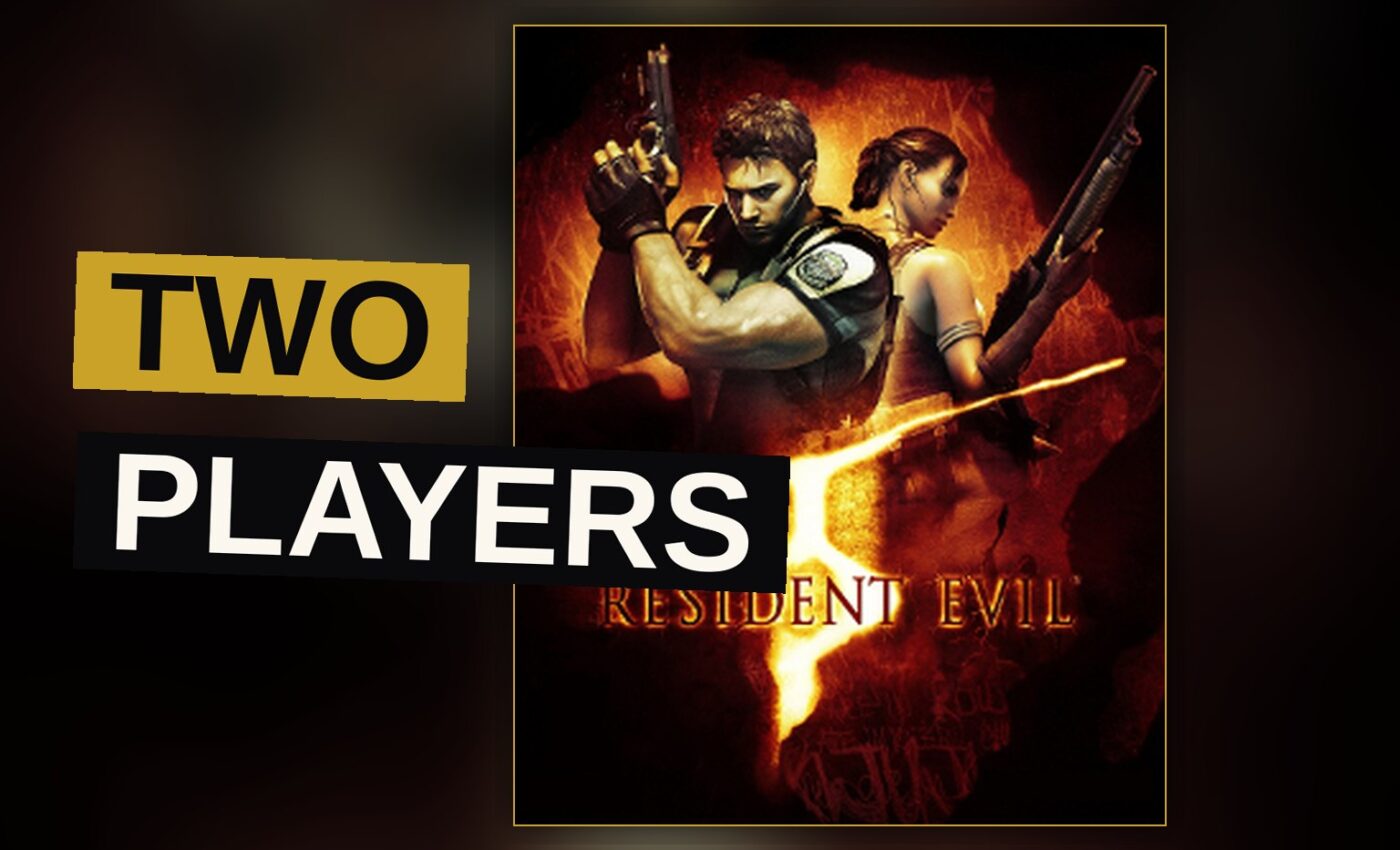
Resident Evil 5 arrived in March 2009 carrying a decade of expectation. Capcom built it as the seventh main game in the series, the follow-up to Resident Evil 4, and the first entry designed from the ground up for two-player cooperative play. It shipped on PlayStation 3 and Xbox 360, with a Windows version following in September 2009.
The result is a game that understands exactly what it wants to be, and mostly gets there. It is also the moment the series stopped being survival horror and became something closer to an action game. That shift is the whole story.
Trailer, via IGN.
Chris Redfield and Sheva Alomar in Kijuju
The plot sends Chris Redfield, now an agent of the Bioterrorism Security Assessment Alliance, to Kijuju, a fictional region of West Africa. He is paired with Sheva Alomar, a local BSAA agent introduced in this game. Their assignment is to apprehend Ricardo Irving before he sells a bio-organic weapon on the black market.
They arrive to find the locals infected by the Las Plagas parasite. The infected are called Majini. The BSAA Alpha Team is already dead. Chris and Sheva are pulled out by the Delta Team, which includes Sheva’s mentor, Captain Josh Stone.
From Stone’s data, Chris sees a photograph of Jill Valentine, his old partner, presumed dead after a confrontation with Albert Wesker. That photograph is the engine of the whole campaign. Chris stops reporting to headquarters and keeps going.
The pursuit of Irving leads through marshy oilfields, a diversion, and a Delta Team slaughtered by a mutating troll-like giant. Irving injects himself with a variant of Las Plagas and turns into a huge octopus-like beast. Chris and Sheva kill him. His dying words point them to a cave, the source of a flower used to make Umbrella’s viruses and a new strain called Uroboros. The trail runs through Tricell, the company funding the BSAA.
The over-the-shoulder view, and what changed
Resident Evil 5 keeps Resident Evil 4’s over-the-shoulder perspective. The weapons list is familiar: handguns, shotguns, automatic rifles, sniper rifles, grenade launchers, plus melee attacks. Players can make quick 180-degree turns to evade enemies. Boss battles lean on quick time events.
The changes matter more than the carryovers.
- Weapons upgrade with money and treasure collected in-game.
- Upgrades happen any time from the inventory screen, with no merchant to find.
- Weapons and items are equipped in real time during gameplay.
- Each player gets nine item slots, and item size is irrelevant.
- Four items can be assigned to the D-pad.
You still cannot run and shoot at the same time. That single restriction does more to define the game’s feel than any addition on the list. It forces you to stop, plant, and commit. Against enemies who now carry guns and grenades, standing still is a genuine decision.
Two players, one checkpoint
Resident Evil 5 is the first Resident Evil designed for two-player cooperative play. One player controls Chris. A second controls Sheva, either online or in split screen on the same console. Alone, Sheva is run by artificial intelligence. Finish the game once and you can make Sheva the primary character.
The cooperative design has a cost. A second player joining a split-screen game in progress reloads the last checkpoint. A second player joining an online game waits until the first player reaches the next checkpoint, or restarts the previous one. That is a clumsy way to handle a drop-in partner, and it shows how hard it was to bolt co-op onto a structure built for one.
Motion capture was used for the cutscenes. Several staff members from the original Resident Evil worked on the game. The Windows version was developed by Mercenary Technology.
A game that left survival horror behind
Resident Evil 5 is considered the first main Resident Evil game to depart from survival horror. Critics at the time said it bore more resemblance to an action game. That reading holds up.
The puzzles are still there, but fewer than in previous games. The environment plays a significant role, and the player depends on a partner more than in older entries. When a partner’s health bar hits zero, that character enters a dying stage: the bar flashes red and gradually lowers. You have a window to reach them. It is a clean piece of design, and it makes the partner a mechanic rather than a passenger.
What is lost is the quiet. Resident Evil 4 balanced dread against firepower. Resident Evil 5 mostly spends its time on firepower. The Majini are numerous and aggressive, and the game rarely asks you to be afraid. It asks you to manage a crowd.
The racism complaints, and the BBFC finding
The game drew divided opinions on whether aspects of it were racist. The Majini are mostly of African descent, and the campaign is set in a fictional West African region where the populace turns into aggressive creatures.
An investigation by the British Board of Film Classification found the complaints unsubstantiated. That is the record, and it should be stated plainly. It does not settle the argument, and the game’s own choices keep it alive. Capcom built a shooter where the enemies are overwhelmingly Black and the heroes are not, and no classification ruling changes what is on the screen.
Years after surviving the events in Raccoon City, Chris Redfield has been fighting the scourge of bio-organic weapons all over the world.
That line, from the game’s own framing, is the tell. Resident Evil 5 wants to be a global thriller about bioterrorism. It reaches for scale and gets a setting it does not examine closely enough.
Controls, and the case against them
The control scheme drew criticism, and it deserves it. You cannot move and shoot. The inventory takes real time to manage. Quick time events interrupt boss fights at the exact moment you want control. The split-screen checkpoint reload is a nuisance.
None of these are fatal. All of them are friction, and friction in a game this long adds up. The weapon upgrade economy is generous, the arsenal is broad, and the 180-degree turn is a genuinely good tool. The bones are strong.
The best-selling Capcom game until 2018
Resident Evil 5 was the best-selling Capcom game until 2018, when Monster Hunter: World outsold it. It was the best-selling Resident Evil game until the Resident Evil 2 remake in 2019.
Those numbers say something the reviews did not. Whatever the critical discomfort, players showed up and stayed. The game was rereleased for PlayStation 4 and Xbox One in June 2016, and it found another audience there.
The commercial record is not an argument for quality. It is evidence that the co-op pitch worked. Two players, one screen, a shared checkpoint, and a partner who can die in your arms if you are slow. That is a durable idea, and Capcom executed it.
What Resident Evil 5 actually is
Resident Evil 5 is a good action game wearing a horror series’ name. Judged as the former, it holds up: the co-op is the point, the weapon progression is satisfying, and the campaign moves. Judged as the latter, it is the moment the series lost its nerve.
The 7.8 out of 10 reflects that split. The craft is real. The atmosphere is thinner than it should be. The racism question was investigated and the complaints were found unsubstantiated, but the imagery remains the game’s most uncomfortable inheritance, and no ruling erases it.
What matters most is the co-op. Resident Evil 5 is the first main game in the series built for two players, and it is still the clearest example of what that design can do. The checkpoint system is clumsy, the controls are stiff, and the horror is gone. But Sheva Alomar is not a sidekick. She is half the game, and when her health bar flashes red, you feel it.
That is the part worth keeping. Resident Evil 5 is not the best Resident Evil game. It is the one that changed what the series could be, for better and for worse.
Get the Notebook.
The day's best stories and every fresh verdict, in plain English, in your inbox by seven. One email a day, no more.