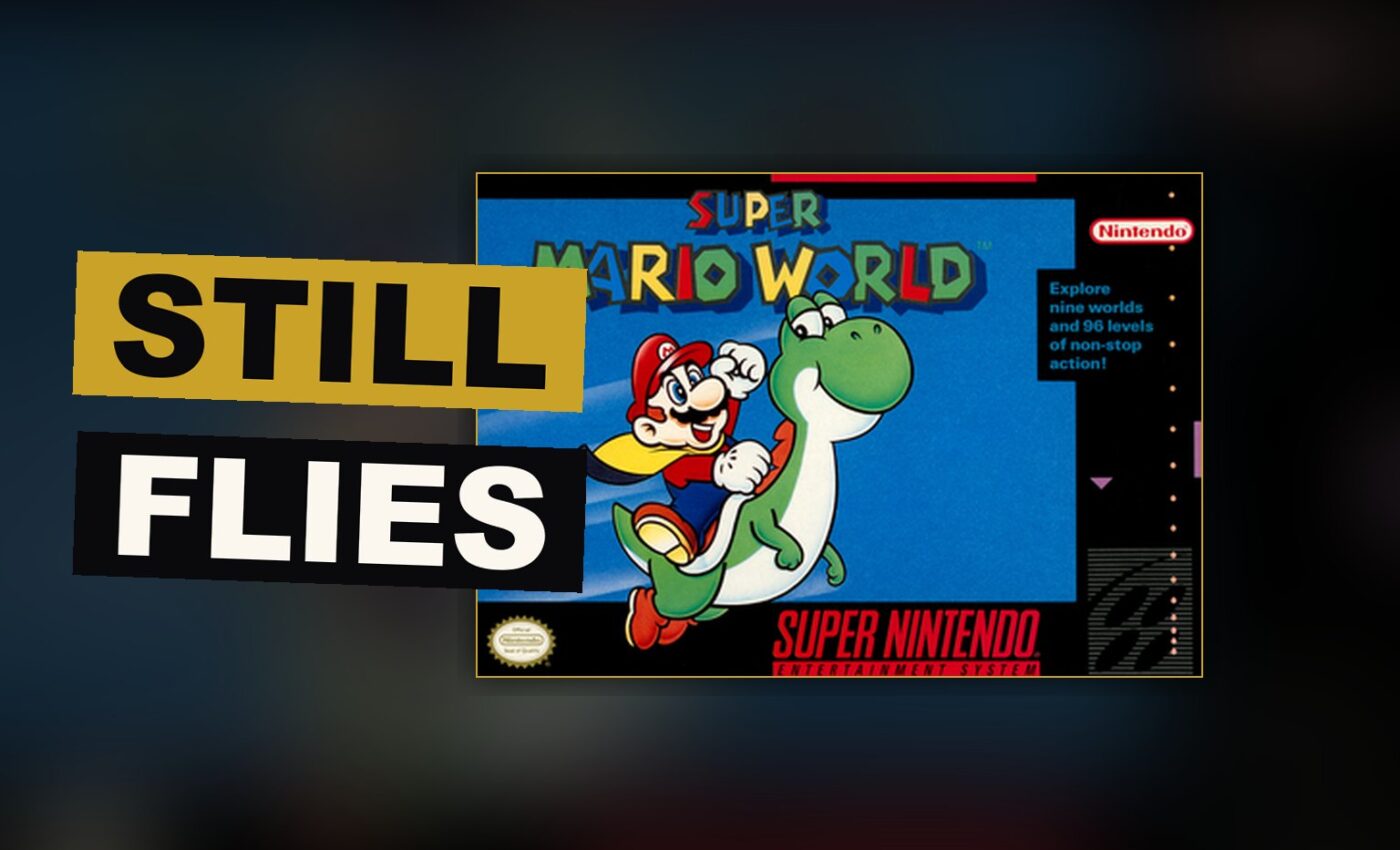
Super Mario World arrived on the Super Nintendo Entertainment System in 1990 in Japan, 1991 in North America and 1992 in PAL territories. It was the first Mario game built for the console, and Nintendo designed it to wring every technical advantage out of the new hardware. The result is a game that still sets the standard for what a platformer can be.
Takashi Tezuka, Shigeru Miyamoto and the SNES
Nintendo Entertainment Analysis & Development made Super Mario World, with Takashi Tezuka as director and Shigeru Miyamoto as producer and series creator. The team had more freedom than it had on the Nintendo Entertainment System installments, and it shows in every corner of Dinosaur Land. Yoshi, the rideable dinosaur, was first imagined during the NES era but held back because the hardware could not carry him. On the SNES, he finally hatches.
That single addition changes how the game moves. Yoshi can eat enemies and spit some of them back out as projectiles. Mario can leap off his back mid-air. The dinosaur is not a gimmick bolted onto a sequel; he is a second set of verbs.
Cape Feather and P-Balloon
The movement arsenal is the real story here. Mario and Luigi can dash and jump as always, but the Cape Feather lets them fly or float, and the P-Balloon does similar work in the air. The new Spin Jump crushes enemies, bounces off normally invulnerable ones safely, and breaks certain blocks, but only when a power-up is active.
There are 96 level exits in total. That number matters. It tells you the game is not a straight march from start to castle. The overworld map shows an overhead view of each world, with several paths running from the entrance to a castle. Action panels, fortresses, ghost houses and castles sit on those paths, and players can take different routes to the same goal.
A Less Linear Dinosaur Land
The structure is the quiet revolution. Earlier Super Mario games pushed you down a line. Super Mario World hands you a map and lets you choose. Moving your on-screen character onto an action panel or castle opens that course. The majority of play still happens in 2D linear levels, full of obstacles and enemies, where you dash, jump, dodge and defeat. But the connective tissue between those levels belongs to the player.
The save system is the other structural change. You lose a life if Small Mario touches an enemy, falls off the screen, gets crushed, touches lava or runs out of time. Run out of lives and the game ends, but you can continue from the most recent save point — a completed castle, fortress or haunted house.
| Feature | Earlier NES Super Mario games | Super Mario World |
|---|---|---|
| Overworld | Linear path | Branching map with multiple routes |
| Save system | None | Save at castles, fortresses, ghost houses |
| Riding companion | None | Yoshi, rideable, eats enemies |
| Flight item | Raccoon Leaf | Cape Feather, P-Balloon |
| Level exits | Fewer | 96 total |
Seven Worlds, Seven Koopalings
Each of the seven worlds features a fortress controlled by one of the Koopalings, and you have to beat that Koopaling to move on. The bosses are not interchangeable. They are the game’s pacing mechanism, the thing that tells you a world is finished and a harder one is coming.
The plot, detailed in the instruction booklet, sends Mario and Luigi on vacation to Dinosaur Land with Princess Toadstool after the events of Super Mario Bros. 3. While they rest on the beach, Bowser captures the princess. The brothers search for hours and find a giant white egg with green spots. It hatches, and out comes Yoshi, who explains that Bowser’s kids, the Koopalings, have imprisoned his dinosaur friends in eggs.
Mario and Luigi realize Bowser’s forces must have taken Toadstool too. Yoshi gives Mario a cape, and the journey begins. Bowser hears they are coming and sends the Koopalings to dispose of them. The brothers defeat the Koopalings, free Yoshi’s friends, reach Bowser’s Castle and send him flying into the sky. Dinosaur Land is at peace.
What Holds Up and What Doesn’t
The art direction and the level design are the parts that have aged best. Nintendo built Super Mario World to show what the SNES could do, and the confidence is visible in every ghost house and fortress. The expanded movement arsenal means the skill ceiling keeps rising long after the credits. Players who only dash and jump will finish it. Players who learn the Spin Jump and the Cape Feather will find a different game underneath.
The weaker ground is the difficulty curve. The early worlds are gentle to a fault, and the save system softens the sting of failure further. That is a design choice, not an accident, and it makes the game welcoming. It also means the first hour asks very little of you.
Super Mario World sold more than twenty million copies worldwide, making it the best-selling SNES game. It led to an animated television series and a 1995 prequel, Yoshi’s Island. It is often named one of the best games in the series and one of the greatest video games ever made. That reputation is earned, but the more interesting fact is how much of it rests on one decision: building the game around what the SNES could do that the NES could not.
The branching map, the save points, Yoshi, the Cape Feather — none of these are separate features. They are one argument about what a platformer should be. Super Mario World makes that argument better than most games made since.
Score: 9.2 of 10.
Get the Notebook.
The day's best stories and every fresh verdict, in plain English, in your inbox by seven. One email a day, no more.