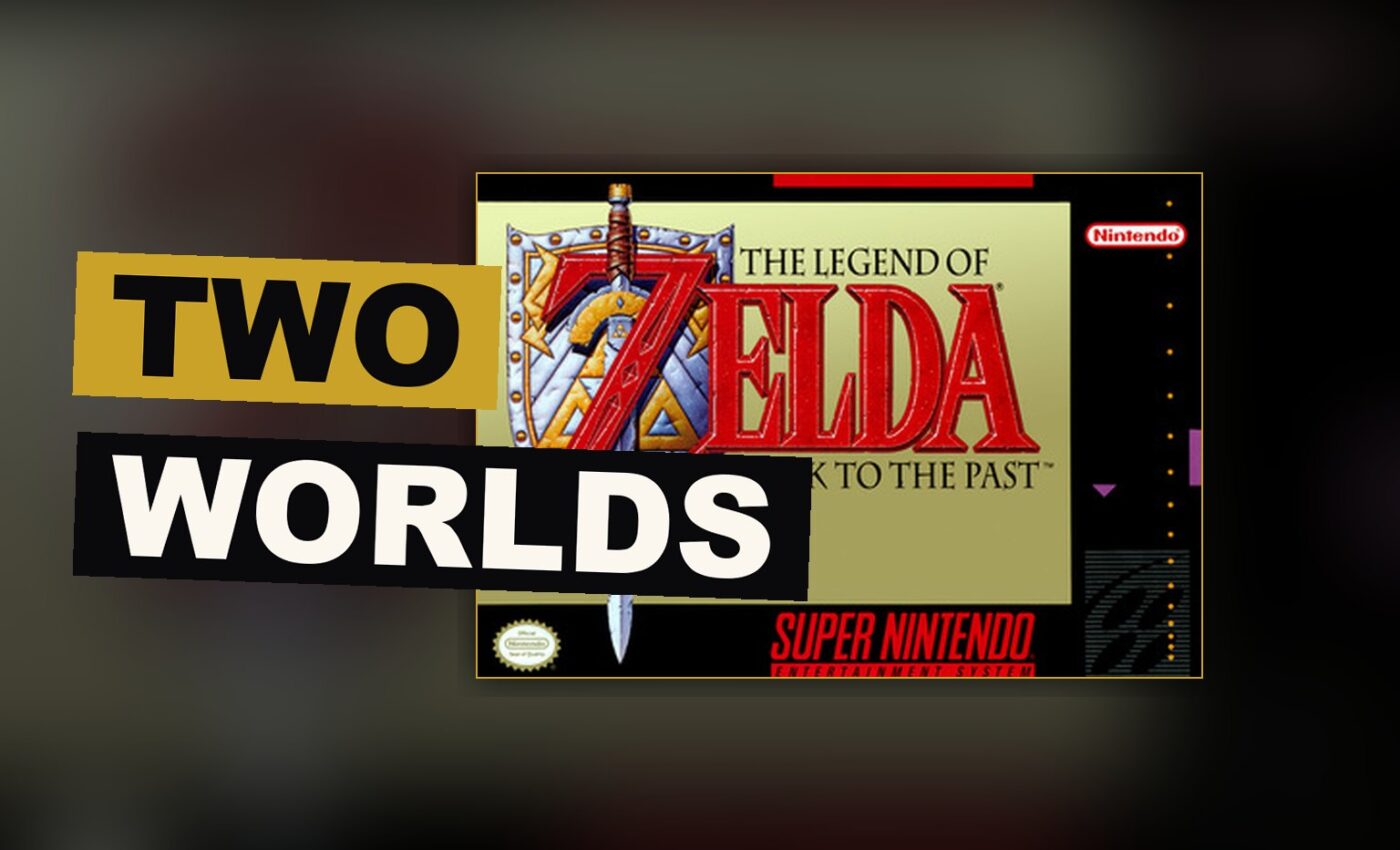
Nintendo’s third Zelda game arrived in Japan in 1991 and reached North America and Europe in 1992, and it did the one thing a series in trouble needed: it went back to what worked. The Legend of Zelda: A Link to the Past drops the side-scrolling of Zelda II: The Adventure of Link and returns to the overhead view of the 1986 original — then improves nearly everything around it. In this reviewer’s view, it is the best game on the Super Nintendo Entertainment System, and one of the best ever made.
Link Moves Diagonally Now
The change sounds small. It is not. In the first The Legend of Zelda, Link could move in four directions. In A Link to the Past, he moves diagonally as well. Combat, dodging, and the simple act of crossing a room all feel looser and more exact because of it.
The player controls Link from an overhead perspective, exploring Hyrule’s overworld and entering dungeons to defeat bosses and collect the items his quest requires. Those dungeons are often multi-level. Link climbs stairs, descends them, and drops through holes to move forward, and the layout makes each floor a small problem to solve rather than a corridor to clear.
His sword and shield arrive early and can be upgraded several times. Other items matter too. The Lantern burns magic points when used, which forces a choice about when a light is worth the cost. Each dungeon hides a large chest holding a piece of equipment that is usually necessary to finish the game.
Heart Pieces sit out in the overworld as optional health upgrades. Collect four, and they form a Heart Container that raises Link’s health by one. It is a clean reward for wandering off the path.
Agahnim Takes the Kingdom
The story is a distant prequel, set many years before the events of the first two Zelda games. The wizard Agahnim has been abducting the descendants of the Seven Sages, and he means to use their power to destroy the barrier that holds the Dark World shut. One of those descendants is Princess Zelda, and she is the one who tells Link what is happening.
Before the game begins, the sages’ descendants are captured one by one and sent to the Dark World. The King of Hyrule is murdered. Agahnim takes over. Link is the last descendant of the Knights of Hyrule, and the game opens with him and his uncle waking to a telepathic message from Zelda: she is locked in Hyrule Castle’s dungeon and needs rescue.
His uncle goes first. Link follows against orders. The uncle is mortally wounded and, before he dies, hands Link a sword and a shield. Link gets into Hyrule Castle and hides Zelda in the Sanctuary, which was his uncle’s last wish.
The priest there explains the rest. Agahnim is a powerful wizard trying to free Ganon from the Dark World, where he was imprisoned for attempting to use the Triforce for evil. Agahnim’s weak point is the Master Sword, a relic only the chosen hero can wield. To claim it, Link needs three pendants. Sahasrahla helps him along the way.
He gets the sword. He returns to the Sanctuary to find the priest dying, and the priest tells him to rescue Zelda. He tries. He fails. Agahnim sends her to the Dark World. Link defeats Agahnim, and the wizard sends him to the Dark World anyway, where he must rescue the maiden descendants of the Seven Sages. He fights Agahnim a second time. When Agahnim falls, Ganon rises from the corpse and flies to the Pyramid.
Two Worlds, One Map
A Link to the Past introduced parallel worlds to the series, and the idea still carries the game. Link starts in the Light World. Portals take him to the Dark World, a parallel version of the same place with different enemies, different non-playable characters, and different dungeons. Progress usually means moving back and forth between them.
The two maps line up. Kakariko Village in the Light World has a counterpart in the Dark World. That correspondence is the design’s real trick: the player learns one landscape and then has to read it twice, spotting where the same ground now hides something worse.
What the Game Gave the Series
The list of things A Link to the Past established is long, and most of it stuck.
- The Master Sword, the relic weapon only the chosen hero can wield.
- Parallel worlds, the Light World and the Dark World.
- A top-down Hyrule, the perspective the series had started with and that this game restored.
It also sits at the head of the official chronology. A Link to the Past is the first game in the “Defeated Hero” timeline, the branch where the Hero of Time loses to Ganondorf in Ocarina of Time. Ganon is imprisoned in the Sacred Realm in his Dark Beast form, and having gathered all three pieces of the Triforce, his desires turn that realm into the Dark World.
The predecessors of Link and Zelda face monsters on the march when a menacing magician takes over the kingdom.
That is the premise, and the game delivers it without padding. It was ported to the Game Boy Advance in 2002 as A Link to the Past and Four Swords, and had sold 6.5 million copies across both platforms by 2004. Re-releases followed on the Wii, Wii U, and New Nintendo 3DS through the Virtual Console, on the Nintendo Switch through the Nintendo Classics service, and on the Super NES Classic Edition. A sequel, A Link Between Worlds, came to the Nintendo 3DS in 2013.
The Case for 9.5
The praise for A Link to the Past has always centered on its presentation and its gameplay, and both hold up. The diagonal movement, the multi-level dungeons, the magic-point economy on items like the Lantern, the Heart Piece hunt — none of it is filler. Each system feeds the next.
The Dark World is the part that matters most. A parallel map is easy to draw and hard to make mean something, and this game makes it mean something by tying it to Agahnim’s plot and to Ganon’s imprisonment. The world you are trying to save and the world you are trying to fix are the same place, drawn twice.
The half-point comes off, in this reviewer’s view, for how much of the structure later games would refine. A Link to the Past sets the template, and the template has rough edges that its successors smoothed. That is a complaint about influence, not about execution.
Nintendo built the standard here. In this reviewer’s view, every overhead Zelda since has been measured against this one.
Get the Notebook.
The day's best stories and every fresh verdict, in plain English, in your inbox by seven. One email a day, no more.