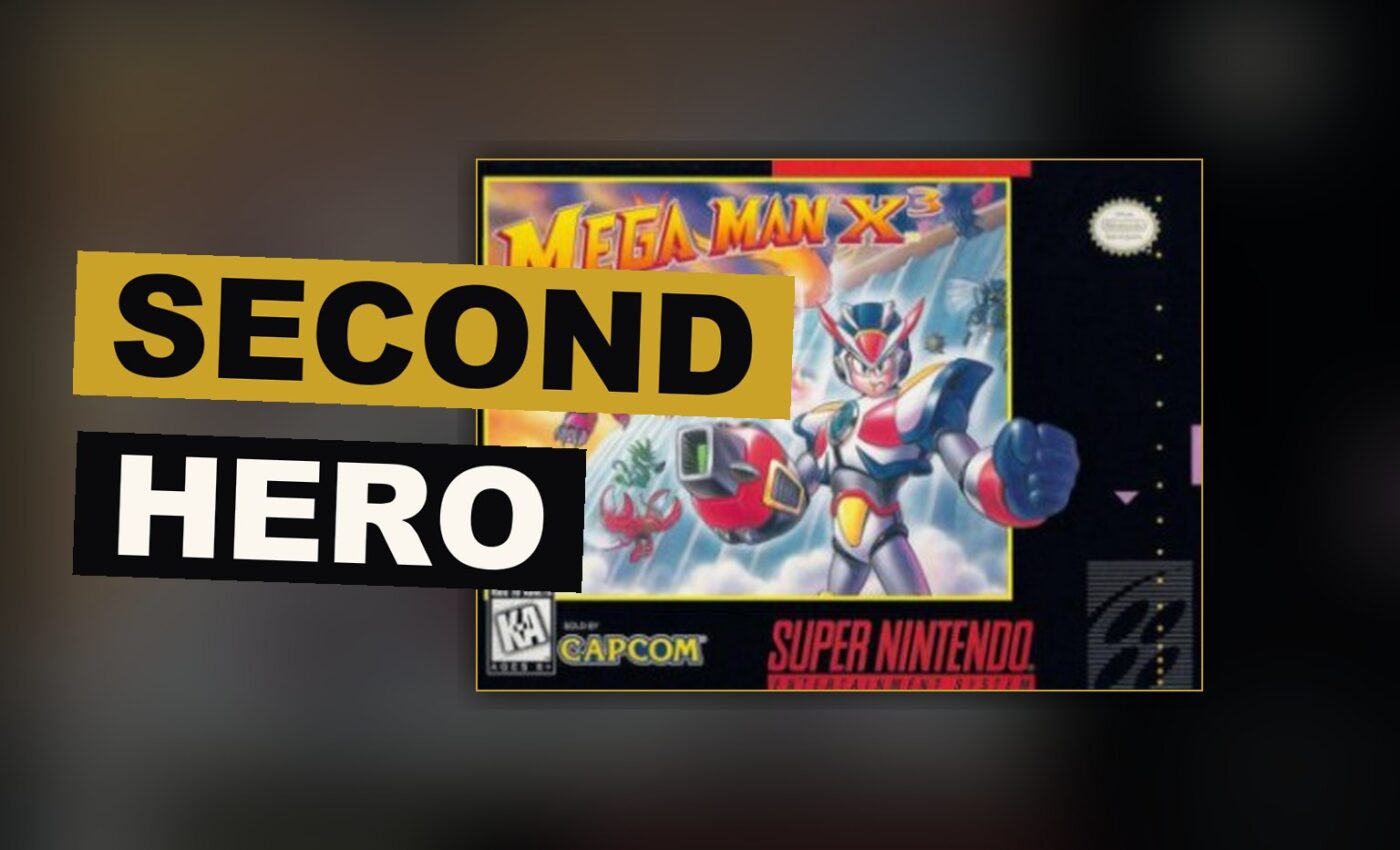
Mega Man X3 arrived in Japan on December 1, 1995, and reached North America and PAL regions the following year. It was the last Mega Man X game to appear on the Super Nintendo Entertainment System. Capcom published it. Minakuchi Engineering developed it. And it carries a problem that no amount of polish quite fixes: it is a very good game standing in the shadow of two better ones.
That tension runs through everything here. X3 does almost nothing wrong. It also does almost nothing new.
Eight Stages, Any Order
The structure is the series standard. The player picks from eight stages in any order, fights through traps and enemy robots, and takes the special weapon of each stage’s end boss. Every boss is weak to one particular weapon, so the smart play is choosing a stage order that exploits those weaknesses. X keeps his old moves: run, jump, dash, cling to walls, fire the chargeable X-Buster.
Armor parts return. Head, body, legs, and X-Buster upgrades sit in capsules scattered through levels. Special chips add further abilities, and X can generally only benefit from one chip at a time, which forces a choice. Heart Tanks extend maximum life energy. Sub-Tanks store energy for later. Ride Armor vehicles can be piloted in some stages, and hidden items let the player summon them at will.
None of this is a knock. It is a well-built machine. The problem is that it is the same machine.
Zero Finally Steps Forward
The real headline is Zero. Mega Man X3 is the first game in the series where X’s partner is playable, though in limited form. Zero can be called to take X’s place during nearly any stage. He cannot collect X’s armor parts or power-ups. He cannot fight mid-stage or end-stage bosses. Later games would loosen those chains. Here they stay tight.
That limitation is the most interesting thing about X3, and it is also its clearest frustration. Zero is the character the fiction has been building toward since the first game. Handing him to the player and then fencing him off from the game’s whole reward structure is a strange bargain. You get the thrill of the switch and then the deflation of realizing the switch costs you progress.
Still, it happened here first. That counts for something.
Doppler Town and the Sigma Virus
The story picks up in the year “21XX,” after the events of Mega Man X2. Humans and Reploids coexist. Some Reploids go Maverick. Dr. Cain built the Maverick Hunters to stop them, and X and Zero have already beaten Sigma twice.
Then Dr. Doppler, a Reploid scientist, develops technology that stops Mavericks from going berserk. Reformed Reploids build a utopia near him called Dopple Town. It looks like peace. It isn’t. The former Reploids revert and attack Hunter headquarters. Doppler is held accountable, and X and Zero are sent to contain the threat.
Beat Doppler and he comes to his senses. He explains that Sigma is alive as a computer virus, and that Doppler was corrupted to build Sigma a new body. X hunts Sigma down. After the fight, the Sigma Virus in pure form chases X to infect and possess him. At a dead end, the endings split. In one, Zero takes Doppler’s true antivirus software and uploads it onto his sabre offscreen.
That is a real story with a real turn. It also leans on a villain the series has already spent two games on.
The Cx4 Chip and the 32-Bit Port
Technically, X3 does move. It uses the “Cx4” chip, same as Mega Man X2, for limited 3D vector graphics and transparency effects. On 1995 hardware that was a genuine showpiece.
A 32-bit version later landed on PlayStation, Sega Saturn, and Microsoft Windows across various countries. That version was included in the North American Mega Man release line. The SNES original remains the one people mean when they say Mega Man X3.
Here is the running order of the game’s key releases and the series’ platform history:
| Date | Release | Platform |
|---|---|---|
| December 1, 1995 | Mega Man X3 (Rockman X3) | Super Famicom / SNES (Japan) |
| 1996 | Mega Man X3 | SNES (North America, PAL) |
| Later | Mega Man X3 | PlayStation, Sega Saturn, Microsoft Windows |
| Later | Mega Man X3 | Wii U, New Nintendo 3DS, Legacy Mobile Device |
Where X3 Sits
Mega Man X3 is a shooter, a platformer, and an adventure, played from a side view, single player only. It is competent at every one of those things. It is not better than Mega Man X. It is not better than Mega Man X2.
What it is: the series at its most settled. The eight-stage loop is tuned. The armor and chip system asks for real decisions. Zero’s debut as a playable character is historically important even in its restricted form. The Doppler story gives the game a villain with an actual arc, and the antivirus resolution is a better ending than the series usually manages.
What it isn’t: a step forward. X3 repeats X2’s structure, X2’s chip, and X2’s boss logic, then adds a playable character it won’t fully commit to. The Zero limitation is the whole game in miniature. It reaches for something and stops short.
That is why 7.6 of 10 is the right number. Not a dismissal. A measurement. X3 is the last SNES Mega Man X game, and it plays like a series that had learned everything it could from the hardware and was waiting for the next machine to say something new. Buy it for Zero. Stay for the armor hunt. Just don’t expect it to outrun the two games in front of it.
Get the Notebook.
The day's best stories and every fresh verdict, in plain English, in your inbox by seven. One email a day, no more.