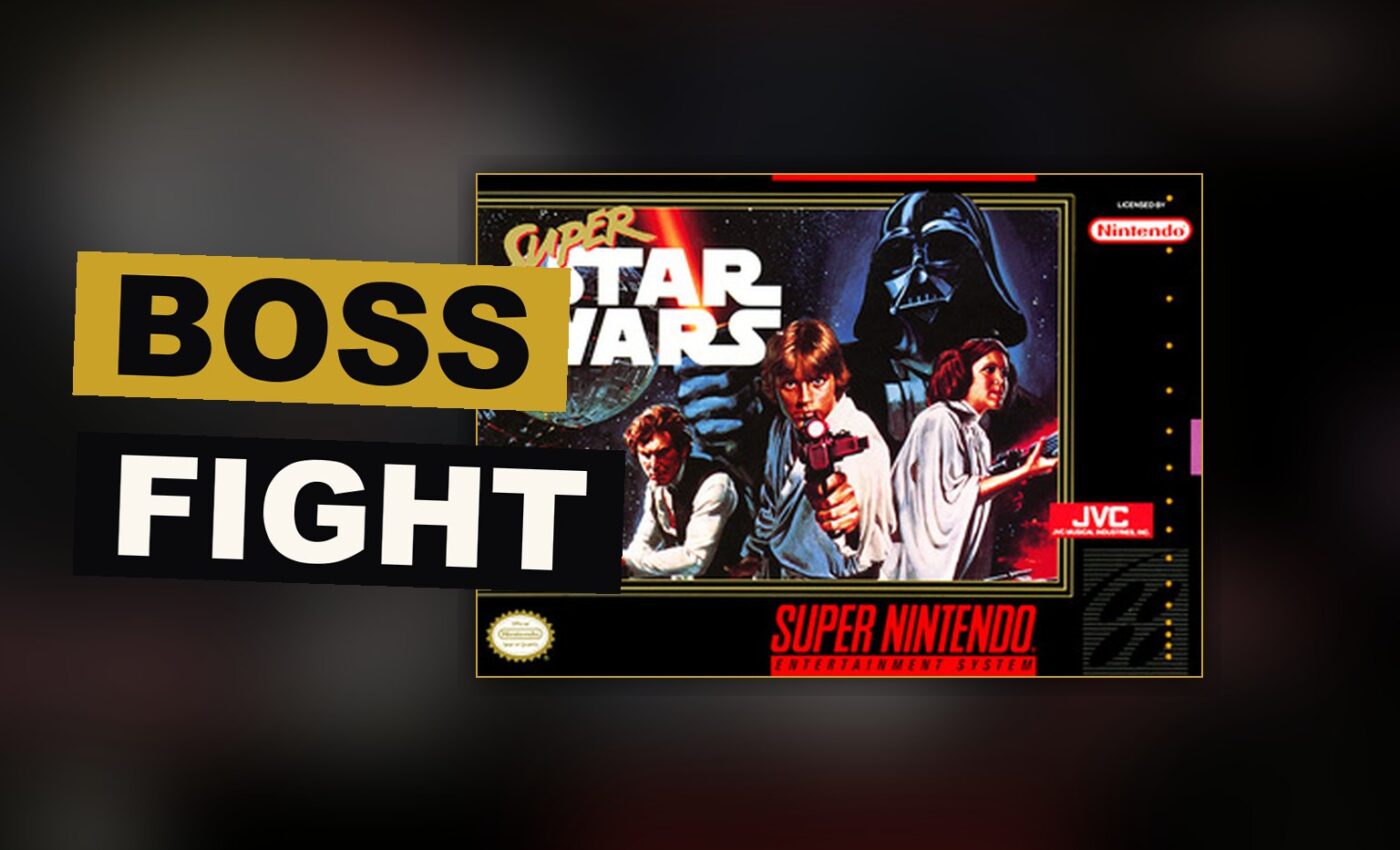
Super Star Wars is a 1992 run and gun game that takes the 1977 film Star Wars and turns it into something you can lose an afternoon to. It was developed by LucasArts and Sculptured Software and published by JVC Musical Industries for the Super Nintendo Entertainment System. It is not the movie. It knows it is not the movie, and that is most of why it works.
Luke Skywalker and the Jawa Sandcrawler
The game follows the plot of Star Wars, with allowances made to suit an action game. The clearest example sits early. Instead of simply buying C-3PO and R2-D2 from the Jawas, Luke Skywalker has to fight his way to the top of a Jawa sandcrawler while leaping from a series of moving conveyor belts. That change tells you what kind of game this is. A transaction becomes a climb. A quiet errand becomes a gauntlet.
Most of the stages are run and gun and platforming, with several different upgrades available to the standard blaster weapon. Luke can also wield a lightsaber after acquiring it from Obi-Wan Kenobi. The stages are not all the same shape, though. Some break the pattern with vehicle sections, letting the player take control of an X-Wing or a landspeeder.
Later stages let you play as Han Solo or Chewbacca. The game features multiple playable characters with different abilities, so the back half does not play like the front. Brief cutscenes between levels tell an abbreviated version of the film’s story, which keeps the whole thing moving without pretending to be a remake.
X-Wing, Landspeeder, and the Trench Run
The variety is the point. Super Star Wars is a side-scrolling game with a side view perspective, but it keeps interrupting itself on purpose.
- Run and gun stages with an upgradeable blaster
- Platforming sections, including the Jawa sandcrawler climb
- Vehicle levels in an X-Wing or a landspeeder
- Playable Han Solo and Chewbacca in later stages
- A lightsaber for Luke, acquired from Obi-Wan Kenobi
The end of the game has players reenacting Luke’s Death Star trench run to destroy the Death Star, with Darth Vader confronting the player in his TIE Advanced x1. That is the right place to finish. The trench run is the film’s set piece, and the game treats it as one.
It is a single-player game. There is no co-op, no second controller, no way to hand Han Solo to a friend. For a game built on a trio, that is a real absence, and it is the first thing a modern player will notice.
A 1992 Game That Kept Coming Back
Super Star Wars was followed by two sequels based on the later films: Super Star Wars: The Empire Strikes Back in 1993 and Super Star Wars: Return of the Jedi in 1994. The first game was re-released in November 1996 as part of Nintendo’s Player’s Choice series. LucasArts put it on the Wii’s Virtual Console in 2009.
Then it came back again. In 2015, Disney Interactive Studios re-released Super Star Wars for the PlayStation 4 and PlayStation Vita, with Code Mystics developing the ports. Those versions add enhanced saving options, including cross-save, along with leaderboards and trophies, and support for modern displays and controllers. The game was also bundled with a purchase of Star Wars Battlefront for the PlayStation 4, alongside Star Wars: Racer Revenge, Star Wars: Jedi Starfighter and Star Wars Bounty Hunter.
That is a long life for a licensed platformer from the early Super Nintendo years. Most of them stayed on the shelf. This one kept getting picked back up.
What Holds Up and What Does Not
The platforming is the part that has aged least gracefully. Leaping between moving conveyor belts on a sandcrawler is a good idea, and it is also the kind of idea that turns into a memorization exercise. The blaster upgrades help, but the game leans on precision jumps in a way that will read as unforgiving to anyone who did not grow up with it.
The vehicle stages are the opposite. Driving a landspeeder or piloting an X-Wing breaks the rhythm at exactly the moment the run and gun starts to feel repetitive. They are not deep. They do not need to be. They are there to change the pace, and they do.
The Star Wars license is doing real work here, and it is worth being honest about that. Strip the characters out and you have a competent side-scroller with a handful of good ideas. Keep them in and the trench run lands, because you already know what is at stake when Vader shows up in the TIE Advanced x1. The game is smart enough to spend that recognition rather than explain it.
Pilot two vehicles in high-speed, first-person, 3-D sequences.
The abbreviated cutscenes are the weakest link. They exist to bridge levels, and they do it, but they never become more than connective tissue. The game is at its best when it is moving and at its most forgettable when it stops to tell you what you already watched.
The 2015 port is the version most people will meet first now, and it is the right one. Cross-save and trophies are small things, but they are the difference between a museum piece and a game you can actually sit down with on a current display.
Super Star Wars earns its place as the start of a trilogy rather than a one-off. The formula — take a film, keep its shape, rebuild its quiet scenes as action — is not complicated, and this game executes it with more care than the era usually got.
Get the Notebook.
The day's best stories and every fresh verdict, in plain English, in your inbox by seven. One email a day, no more.