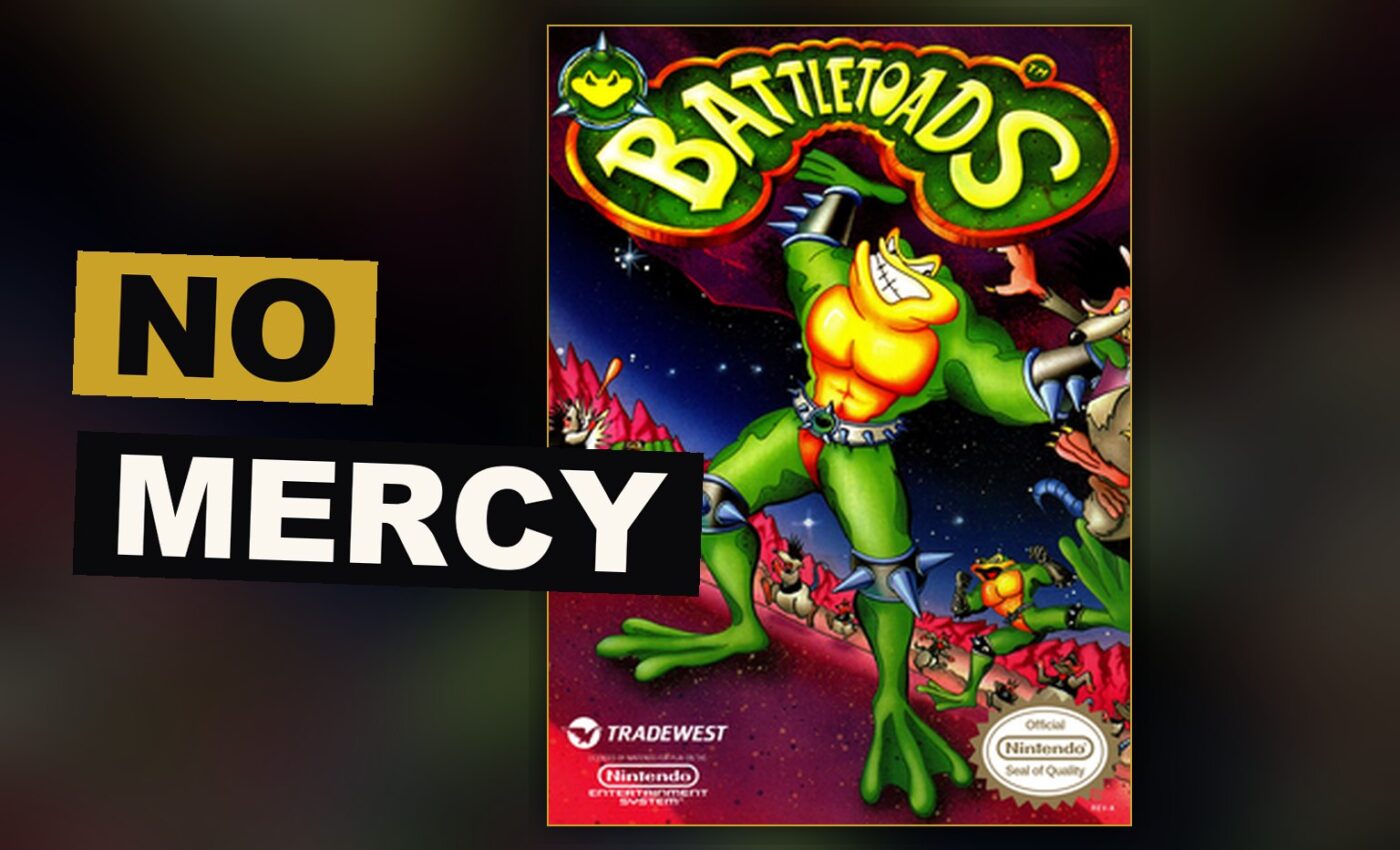
Battletoads for the NES stands as one of the hardest games made for the console. Rare built it around three hard fighters, then buried players under punishing level design. Decades later, that difficulty still shapes how people talk about Battletoads.
Fighting Stages
The opening stages of Battletoads work as a fairly standard fighting game shown from the side. Players use kicks and large fists against enemies, and the game allows a mode for two players, a feature that adds real value. The fighting holds up well: hits land with force, animations sell the weight, and the character designs remain remarkable and easy to tell apart.
Enemy variety keeps these early stages fresh. Rats, flying creatures and armored soldiers each demand different tactics, and boss fights punish careless play. For a few stages, Battletoads feels like a confident, solid effort in a busy genre.
Then the game changes shape entirely.
A Sudden Change
Stage three drops the fighting and puts players on vehicles racing at great haste through a narrow passage. This part, often praised and cursed by those who follow it closely as one of the hardest in NES history, gives almost no warning. Walls appear with barely any notice. Timing windows shrink to split seconds.
One misjudged move sends a player off the track, and progress stops. The rise in difficulty here is not gradual; it arrives without warning and asks players to remember what comes next rather than react with natural skill in the moment. Later stages keep changing style again, moving from platform puzzles to parts built around careful timing and careful motion, and each new style brings its own harsh rules.
Battletoads does not ease players in. It throws them into the deep end and dares them to swim.
Where It Lands
Some parts of Battletoads remain truly strong. The soundtrack, built for the NES hardware, still sounds full of spirit and energy. The look of the game pushes the console’s limits, with smooth animation and original enemy designs. The humor, often absurd, gives the game a character many other games of its time lacked.
The mode built for two players adds real value, even if it also adds risk. One player can accidentally push the other off a platform or into an enemy. That risk creates real stakes, but it also means a shared win can turn into shared annoyance within seconds.
Ranking the key traits of Battletoads helps explain why opinions on it remain split:
- Fighting design in the early stages
- Sound and look for the NES hardware
- Humor and character
- The famous rise in difficulty, especially in the vehicle stage
- How steady the game stays from one stage to the next
The first three items on that list explain why Battletoads earned respect when it came out. The last two explain why so many players never finished it.
Difficulty alone does not sink a game. Many NES titles from the same time demand patience and accuracy. What sets Battletoads apart is how suddenly the demands change. A player comfortable with the fighting gets no warning before the vehicle stage arrives, and no gentle increase prepares them for the timing it needs.
This lack of balance makes Battletoads hard to recommend without some reservation. New players not knowing its reputation may give up within the first few stages. Those who push through often describe a mix of satisfaction and lasting annoyance, since beating a part rarely feels like learning a skill so much as surviving a test of memory.
The game’s short length works in its favor here. Battletoads does not stay too long, and its stages move quickly once known well. That short length keeps the annoyance contained rather than constant.
Battletoads remains a fascinating piece of NES history. Rare’s willingness to change styles mid-game, mixing fighting, racing and platform puzzles, was bold for its time and still feels remarkable today. The presentation, from the soundtrack to the character animation, holds up decades later.
But the difficulty, especially the sudden rise in stage three, keeps Battletoads from being an easy recommendation for players today. It rewards patience and memory more than natural skill, and that approach will trouble as many players as it satisfies. Battletoads earns its place in gaming history for its ambition and its famous challenge. It is a game best approached with patience, and better still a second player willing to share both the pleasure and the annoyance.