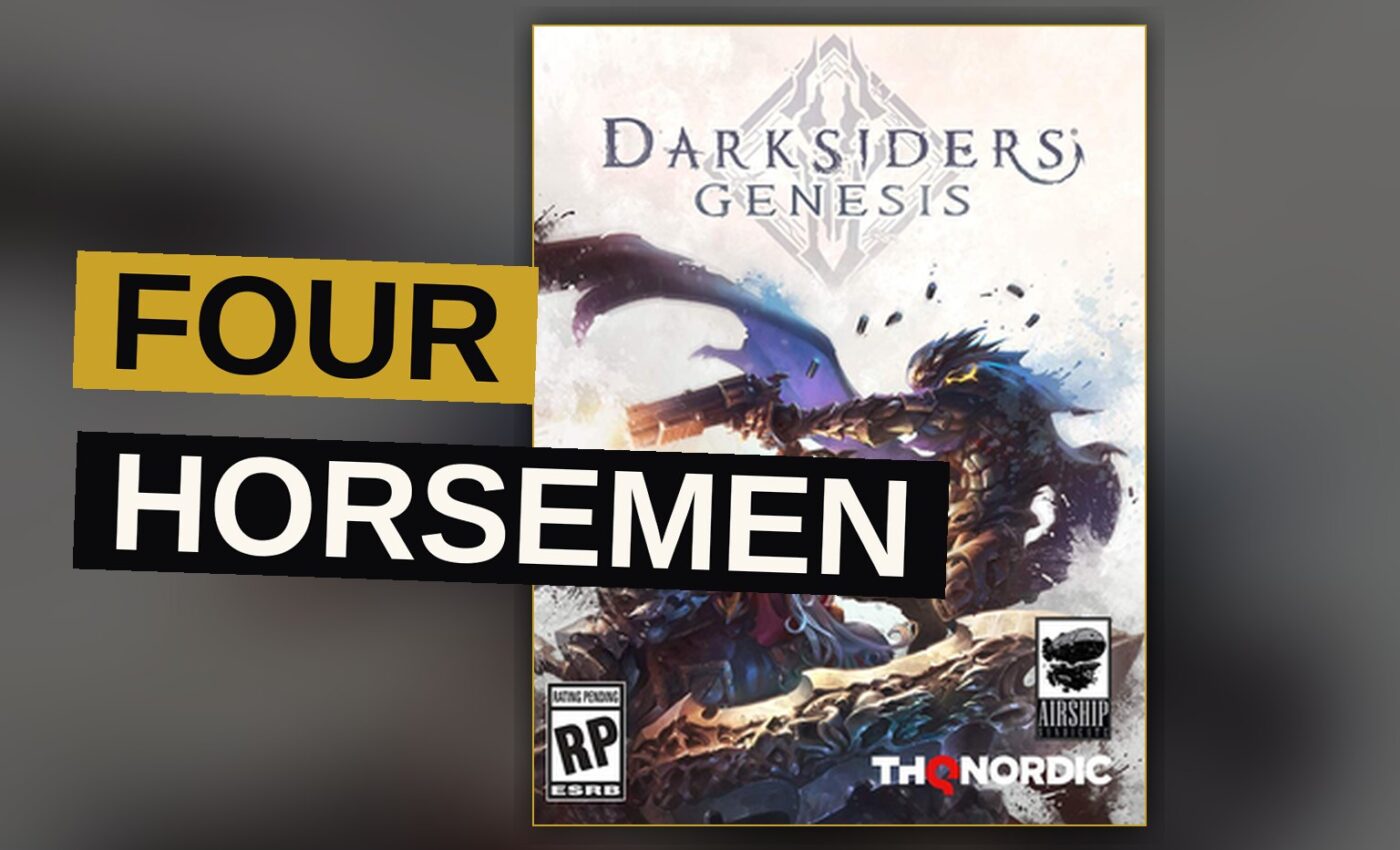
Darksiders Genesis hands you Strife, the fourth Horseman of the Apocalypse, and a pair of pistols called Mercy and Redemption. That is the pitch, and it is a good one. Airship Syndicate built a top-down action RPG that pulls the Darksiders series out of the third-person camera and into an isometric brawl, and the shift works better than it has any right to.
The game launched on Google Stadia and PC on 5 December 2019, then arrived on Nintendo Switch, PlayStation 4 and Xbox One on 14 February 2020. THQ Nordic published it. It is a spin-off prequel, set before the events of the main series, and it carries a critic aggregate of 7.5/10 across 11 outlets. That score is fair. Darksiders Genesis is a confident, compact hack and slash that knows exactly what it is, and it rarely overreaches.
Trailer, via IGN.
Strife, War, and the Charred Council
The story opens after the Four Horsemen have already done their worst. They attacked and decimated the Nephilim in Eden, a bloody battle ordered by the Charred Council. The Horsemen are themselves Nephilim, beings spawned from the union of angels and demons, and they wiped out the rest of their kind at the Council’s command. That is the tragic cost of their power, and Darksiders Genesis treats it as backstory rather than a playable sequence.
From there, the Charred Council summons War and Strife. The Council suspects the demon king Lucifer is planning something with Samael to upset the Balance. War and Strife are ordered to investigate. That investigation drives the whole game, and it takes the Horsemen through Samael’s keep, into the Void, and across a series of confrontations with lesser Masters of Hell.
The plot moves quickly. Moloch attacks Samael’s keep, Samael teleports the Horsemen to the Void, and the Horsemen find Vulgrim, who agrees to help track Lucifer in exchange for artifacts. After the artifacts are collected, Vulgrim reveals Lucifer has visited Mammon, another Master of Hell. Samael suggests the Horsemen find Mammon and make him talk. They do. Mammon is carrying relics and weapons from Eden, and the Horsemen kill him.
It escalates from there. Lucifer opens a path to Eden, brings its sacred water through, and turns it into poison. The demon Belial runs that operation. The Horsemen stop it, defeat Belial, and spare him. Lucifer arrives after they leave and punishes Belial for the failure. Then Dagon, the Drowned King, enters the picture, helping Lucifer because Lucifer has offered him Eden. The Horsemen meet Abaddon, the guardian angel of Eden, who tells them Lucifer is spreading corruption and asks for help cleansing it. The Horsemen track down and kill Dagon. They return to the Void, and Samael advises them further.
That is a lot of plot, and Darksiders Genesis handles it with a light touch. The cutscenes are short, the objectives are clear, and the game never lingers on lore when it could be sending you toward another fight.
Mercy, Redemption, and Chaos Eater
The combat is the reason to play Darksiders Genesis, and it is the reason the reviews landed where they did. You can switch between Strife and War at any time. Strife uses his pistols, Mercy and Redemption. War uses his sword, Chaos Eater. The two play differently enough that the swap feels meaningful rather than cosmetic. Strife keeps his distance and chips away. War closes the gap and swings.
Two players can take the game on in co-op, with each player controlling one of the characters. That is the best way to play it. The top-down camera keeps both characters readable on screen, and the character swap becomes a real tactical choice instead of a solo gimmick.
Kill enough enemies and you unlock burst abilities, which let you take down enemies faster. The currency is souls, earned by killing enemies that spawn before you. Platforming elements return from previous Darksiders games, and mechanics like bombs are present. The game is played from a top-down perspective, and it marks the first full-scale Darksiders adventure built that way.
The whole thing runs on a simple loop. Fight through a room, solve a puzzle, platform across a gap, fight a boss, move on. It is not trying to reinvent the genre. It is trying to be a good version of a thing you already like, and it succeeds.
Serpent Holes from Heaven to Hell
Darksiders Genesis features intense combat, exploration, puzzle-solving, epic boss battles and serpent holes from heaven to hell. That list is the game’s own summary of itself, and it is accurate. The serpent holes function as the connective tissue between zones, and the boss battles are the high points. Mammon, Belial and Dagon all get proper fights, and each one asks something slightly different of you.
The isometric view is the biggest change, and it is the one that could have gone wrong. Darksiders has always been a third-person series, and moving to a top-down camera risks losing the scale that makes the Horsemen feel like Horsemen. Airship Syndicate avoids that by keeping the bosses large and the environments wide. You still feel small next to the things you are killing.
The art direction holds up. The game looks like a Darksiders game, which sounds like faint praise until you remember how many spin-offs lose the visual identity of the thing they are spinning off from. Eden, the Void, and the various hellscapes all read as part of the same world.
What the 7.5 Actually Means
A 7.5 out of 10 is a score that says a game is good without saying it is essential. Darksiders Genesis earns that. It is not a game that will change how you think about action RPGs. It is a game that gives you solid combat, a co-op mode that justifies the price of admission, and a story that fills in a corner of the Darksiders timeline without demanding you care about the rest of it.
The combat is the strongest part, and that is where the praise landed. It is responsive, the character swap is meaningful, and the burst abilities give fights a rhythm. The boss battles are the peaks. The puzzle-solving is fine. The platforming is fine. Nothing embarrasses itself.
The weaknesses are the ones you would expect. The story is dense with proper nouns and thin on emotional stakes. You are told the Nephilim were annihilated and that it was tragic, but you never see it. The game opens after the massacre, which is the right call for a prequel, but it means the emotional weight of the Horsemen’s central crime is carried entirely by exposition.
The isometric camera also flattens some of the exploration. Previous Darksiders games used vertical space to make you feel like you were climbing through a world. Darksiders Genesis uses vertical space to make you feel like you are looking down at one. That is a trade, and it mostly pays off, but it is a trade.
The Co-op Is the Point
If you have someone to play Darksiders Genesis with, the calculus changes. Co-op turns a good game into a better one. Two players, one on Strife and one on War, cover the weaknesses of each character. Strife’s ranged chip damage and War’s close-range pressure complement each other, and the top-down camera keeps both players visible at once.
Solo play is still good. You can swap between the two Horsemen at any time, so you are never locked out of a tool you need. But the co-op option is the one that makes the game click.
That is the part worth watching if you are on the fence. Darksiders Genesis is not a game you need to play alone.
The Numbers
- Title: Darksiders Genesis
- Developer: Airship Syndicate
- Publisher: THQ Nordic
- Release date (Stadia, PC): 5 December 2019
- Release date (Switch, PlayStation 4, Xbox One): 14 February 2020
- Platforms: Google Stadia, PlayStation 4, PC (Microsoft Windows), Xbox One, Nintendo Switch
- Genres: Role-playing (RPG), Hack and slash/Beat ’em up, Adventure
- Modes: Single player, Multiplayer, Co-operative
- Perspective: Third person, Bird view / Isometric
- Critic aggregate: 7.5/10 (11 outlets)
The Horsemen and the Balance
The Darksiders series has always been about the Balance, and Darksiders Genesis is the entry that explains why the Horsemen are willing to enforce it. The Council maintains the Balance across existence. The Horsemen carry out their orders. They pledged themselves to the Council and were granted immense power. The cost was the genocide of their own kind.
That is a strong foundation for a prequel, and Darksiders Genesis uses it well enough. It does not interrogate the morality of the Horsemen the way a longer game might. It treats the Eden massacre as a fact of the world and moves on to the next demon. That is a choice, and it keeps the game moving, but it leaves the most interesting question on the table.
What you get instead is a tour of the Darksiders cosmology. Samael, Vulgrim, Mammon, Belial, Dagon, Abaddon, Lucifer. The game introduces a dozen players in the cosmic conflict and gives each one a fight or a conversation. It is a prequel that functions as a primer, and for a spin-off, that is a reasonable thing to be.
Should You Play It
Yes, if you like hack and slash games and you have a co-op partner. Yes, if you are invested in the Darksiders series and want to see where Strife came from. Yes, if you want a game that respects your time and does not ask you to grind.
No, if you need a story that earns its emotional beats. No, if you have already played every top-down action RPG and want something that pushes the genre. Darksiders Genesis is a good game in a well-worn mold, and it knows it.
The 7.5 is the right number. It is not a knock. It is a measure of a game that does what it sets out to do, does it well, and does not pretend to be more than that. Airship Syndicate built a spin-off that justifies its existence, and THQ Nordic published it without bloating it. That is rarer than it should be.
Score: 7.5 of 10.
Get the Notebook.
The day's best stories and every fresh verdict, in plain English, in your inbox by seven. One email a day, no more.