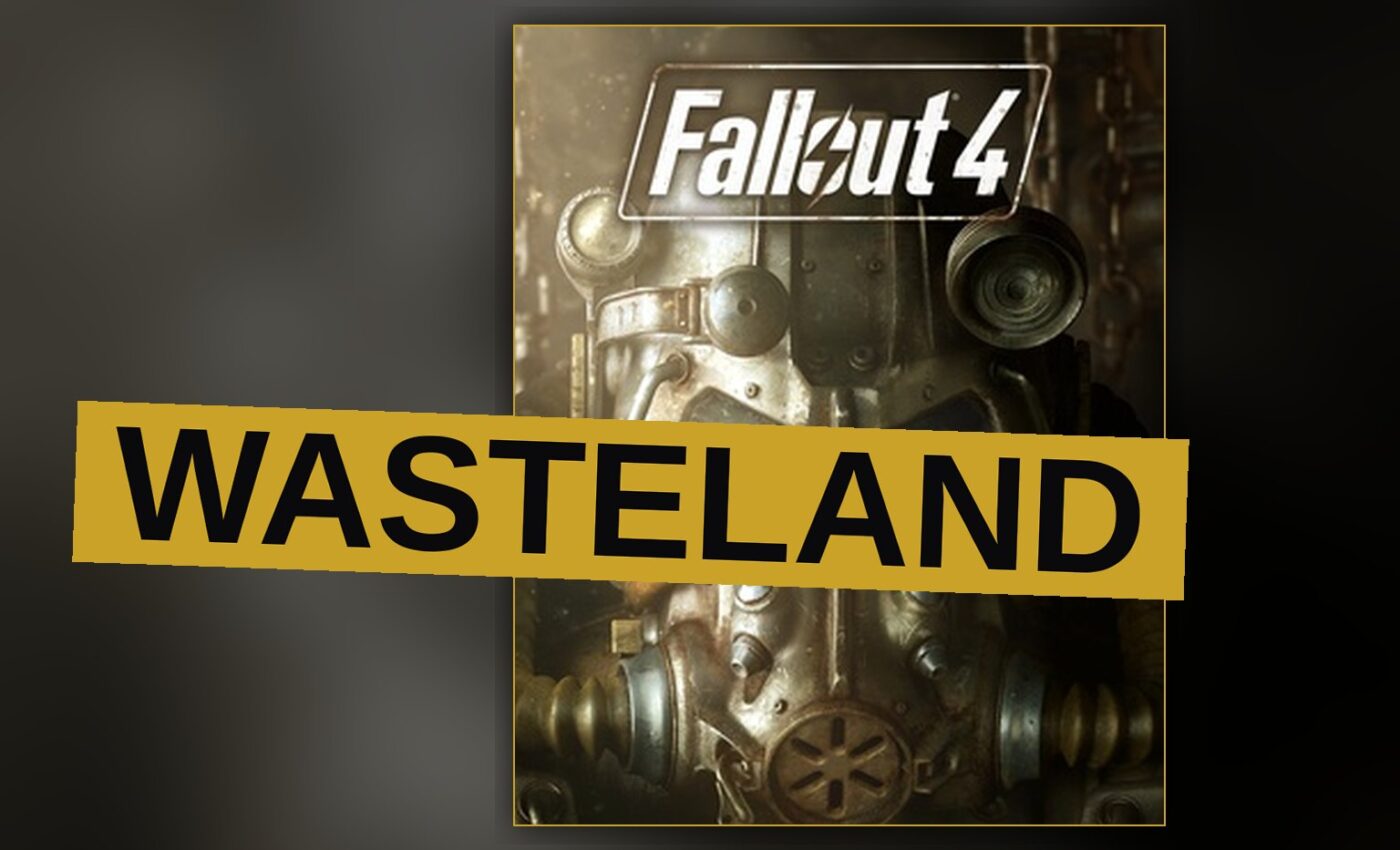
Fallout 4 opens on October 23, 2077, the day the bombs fall. You are a resident of Vault 111, and within the first hour your spouse is murdered and your infant son, Shaun, is taken. You wake from cryogenic stasis 210 years later, on October 23, 2287, and walk out into the Commonwealth — Boston and the surrounding Massachusetts region, flattened by the Great War and left to the raiders, the Super Mutants and the Feral Ghouls.
That is the setup Bethesda Game Studios built for its fourth main Fallout game, released November 10, 2015, for PlayStation 4, Windows and Xbox One, with PlayStation 5 and Xbox Series X/S versions arriving April 25, 2024. It is a shooter and a role-playing game at once, played solo, in first or third person. And it is the most ambitious thing the studio had attempted: a sandbox where the search for a kidnapped child keeps colliding with the question of what you are willing to build in his place.
It holds up. Fallout 4 is not the sharpest role-playing game Bethesda has shipped, and its story buckles under the weight of its own factions. But the world it puts in front of you is enormous, specific and full of things worth picking up.
Trailer, via Bethesda Softworks.
Vault 111 and the 210-year gap
The premise is a cold open, and the game knows it. Fallout 4 begins on the day of the Great War, a Sino-American conflict over natural resources that ended in nuclear holocaust. Unlike Fallout 3 and Fallout: New Vegas, which drop you into the ruins long after the fact, this one makes you watch the sky catch fire first.
Then it takes the world away from you twice. Once in the blast, once in the freezer. The Sole Survivor — that is the only name the game gives your character — emerges into a Commonwealth that has had two centuries to organize itself without you.
The search for Shaun is the spine of the main story. It is also the weakest part of it. The game keeps handing you factions to choose between, and the choice of which path to take in rebuilding the Commonwealth is genuinely yours. But the emotional engine is a missing child, and the game spends most of its running time asking you to do something else.
The Institute, the Brotherhood and the Minutemen
Three of the Commonwealth’s main factions are clear. The Institute is a secretive technocracy descended from the former Commonwealth Institute of Technology, and it builds artificial humanoids called synths. The Brotherhood of Steel is a quasi-religious paramilitary outfit that wants to regulate advanced technology, by force where necessary. The Minutemen are a militia. The game is better when it lets you sit with how little any of them deserve your loyalty.
This is where Fallout 4 does its most interesting work and where it most often fumbles. The factions are not moral puzzles so much as delivery mechanisms for quests. You will meet Nick Valentine, a prototype synth detective, and Piper Wright, a reporter, and Deacon, a Railroad agent, and John Hancock, the mayor of a settlement called Goodneighbor. You will meet Preston Garvey of the Minutemen, who will ask you to help settlements until you resent him for it.
Dogmeat, a German Shepherd, is the only companion you are required to take. There are thirteen possible companions in all. The six you must at least encounter — Codsworth the robotic butler, Deacon, Hancock, Valentine, Wright and Garvey — carry more personality than the plot they are embedded in.
111,000 lines and 700 weapon mods
The systems are where Fallout 4 earns its keep. Gunplay was handled by id Software this time, and it shows: shooting in Fallout 4 is a different activity from shooting in Fallout 3 or New Vegas, which is to say it is an activity you might choose on purpose.
The armor is layered. Power Armor, including the T45, was redesigned to work more like a vehicle than a suit — it runs on battery-like fusion cores, and you can bolt a jet pack onto it or pick separate plating for each part of the suit. There are over 50 guns and more than 700 modifications for them, covering receivers, barrel types and laser focuses. The dialogue system carries 111,000 lines.
And then there is the building. Fallout 4 lets you craft and deconstruct settlements, breaking down in-game objects and structures for raw materials and putting them back together as your own. You can wire the towns for power. You can furnish them. This is the feature that ate the series, and it is the feature that makes the Commonwealth feel less like a level and more like a place.
A retro-future built on vacuum tubes
The setting is the best idea in the game. Fallout 4 takes place in an alternate history that never left the 1940s and 1950s behind — diners, drive-in theaters, advertisements and living styles largely unchanged — while the technology ran ahead anyway. Society can produce laser weapons, manipulate genes and build nearly autonomous artificial intelligence, all of it running on atomic power and vacuum tubes.
The result is a retro-futurism with teeth. Robotic rocking horses for children. Vaults as high-tech fallout shelters. Bottle caps as currency, usually just called caps. The Institute’s synths sit at the far end of that logic, and they are the game’s cleanest expression of what this world’s optimism turned into.
The map covers Boston and parts of New England. It is dense in a way Bethesda’s earlier worlds were not, and it rewards the specific vice the game is built around: looting every object in a room because every object in a room can become something.
What the Commonwealth gets right
Fast travel exists, unless you are playing on Survival Difficulty, where it is disabled — a small rule change that forces you to actually live in the world you have been rebuilding. Conversations can be left at any time. The camera switches between first and third person. Mole Rats, Raiders, Rad Roaches, Super Mutants, Deathclaws and Feral Ghouls all return.
Here is the schedule the game runs on:
| Date | Event |
|---|---|
| October 23, 2077 | The Great War; the Sole Survivor enters Vault 111 |
| 2077–2287 | 210 years of cryogenic stasis |
| October 23, 2287 | The Sole Survivor emerges; the main story begins |
| November 10, 2015 | Release on PlayStation 4, Windows and Xbox One |
| April 25, 2024 | Release on PlayStation 5 and Xbox Series X/S |
Ten years separate the main story from the events of Fallout 3. Two hundred and ten separate it from the bombs.
What matters here is not the timeline. It is that Fallout 4 is a game about the gap between the life you had and the one you woke up in, and that its best material — the settlements, the Power Armor, the layered armor, the sheer volume of stuff you can take apart and put back together — is all in service of filling that gap yourself. The kidnapping plot is the excuse. The Commonwealth is the point.
The 2024 ports put the game on current hardware without changing what it is. That is the right call. Fallout 4 does not need a remake; it needs the player to stop treating the main quest as the reason to be here.
The weaknesses are real and they have not aged out. The dialogue system gives you four options that often amount to the same answer. The factions talk about moral weight and then hand you a fetch quest. The Institute is a better idea than it is a place. If you came for a tight, authored role-playing game, this is not that, and it never was.
But the crafting system implements every object in the game, and that single decision changes how you move through it. You are not clearing rooms. You are prospecting. The settlements turn a wasteland into a project, and the project is the most persuasive argument the game makes — that rebuilding is a choice you keep making, badly, with whatever you found on the floor.
Fallout 4 is a shooter and a role-playing game in equal measure, a family story that became a faction story, and a 2015 game whose 2024 ports are still worth the trip to Boston. It is uneven. It is also enormous, and it respects your time by wasting it in interesting ways.
Get the Notebook.
The day's best stories and every fresh verdict, in plain English, in your inbox by seven. One email a day, no more.