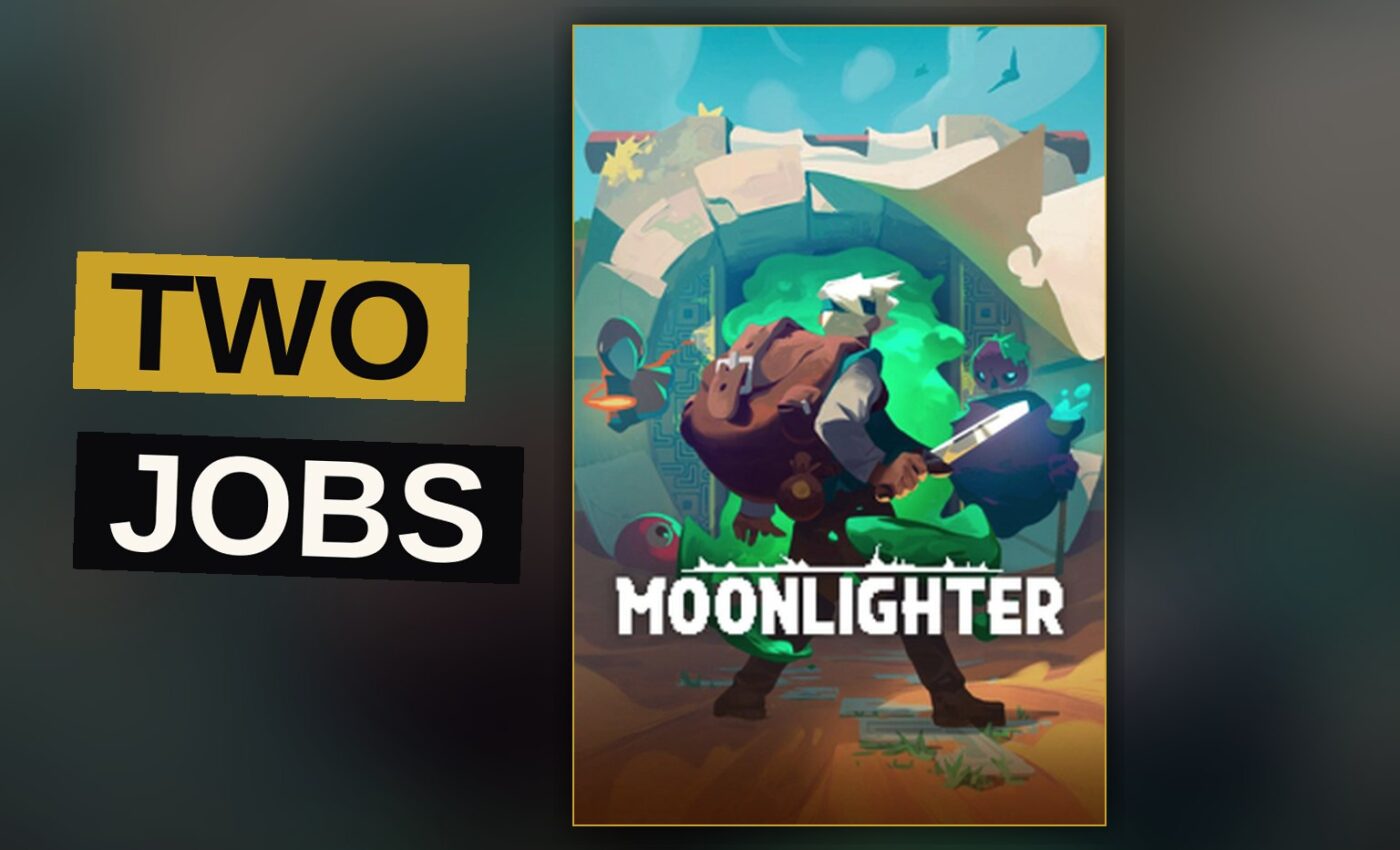
Moonlighter asks a simple question: what if the person who runs the shop is also the person who clears the dungeon? Digital Sun’s 2018 action RPG answers it by splitting every day in two. Will, a 17-year-old orphan, sells artifacts out of his family store, the Moonlighter, from morning until evening. Then he picks up a sword and walks into the dark. The game holds both halves at once, and it is the tension between them — not the combat, not the shopkeeping on its own — that makes it worth playing.
Trailer, via GHO.
Rynoka and the Doors That Would Not Close
The setting does the heavy lifting. Rynoka was built when mysterious doors were found leading to unique places full of artifacts. People called them Dungeons and went in to gather resources to sell. Two kinds of people make that trip: heroes, who kill monsters for fame and glory, and merchants, who look for artifacts in chests and sell them. Heroes get the esteem. Merchants get called money-grubbers.
That hierarchy is the game’s real subject. Will is a merchant by trade and a hero by secret ambition, and Moonlighter never lets him forget which one the town thinks he is.
The town’s history is a slow decline. When the dungeons were first found, Rynoka was full of travelers and warriors, and it prospered. Then the casualty rate climbed too high, and the town started closing the dungeons to protect its citizens. Since Rynoka relied on the artifacts pulled from those doors, closing them hollowed the place out. Only one dungeon remains open.
Four Dungeons, Four Guardians, One Key Each
The story starts with a body. Exploring the first dungeon, Will finds a note from Crazy Pete, a friend of his grandfather who used to research the dungeons. The note says each of the 4 dungeons holds a guardian carrying a key. Those keys open a 5th dungeon that has stayed shut since the doors were discovered.
Will is warned off. He is a merchant, not a hero. He ignores it, beats all four guardians, and takes their keys. The town starts calling him the hero-merchant, and travelers begin returning to Rynoka.
The 5th dungeon is where Moonlighter shows its hand. Will finds it full of the bodies of an alien species and notes scattered through the halls. The place was the base of a group of interdimensional pirates — a civilization that cracked interdimensional travel faster than anyone else and raided other dimensions for resources. The other dungeons were doorways the pirates built to streamline the looting. When a governmental group called the ICT closed in, the pirates hid inside their own base to mask its signal and handed the keys to a minion. The minion was supposed to open the base within 1 month and resume the raids. Crazy Pete found the minion first and attacked. Both died. The pirates stayed trapped.
That is a sharper turn than the shop-and-sword premise promises, and it lands because the game has spent hours teaching you what a dungeon is before it tells you what a dungeon was for.
Shop by Day, Sword by Night
Moonlighter runs on a loop. Days go to the shop: manage goods, take in money, invest in the town. Those investments add services — a potion-maker, a blacksmith — and let you craft weapons, armor and health potions, hire a part-time worker to sell during the day, and upgrade equipment.
Nights go to the dungeons. You fight hordes of enemies that drop loot when they fall, and you can pull loot from chests once a room is cleared. Each dungeon has a mini boss on every floor and a dungeon guardian at the final level. The four are the Golem, Forest, Desert and Tech dungeons, and they escalate in a straight line.
The structure is a bird’s-eye, isometric action RPG with rogue-lite elements, single player, and the genre tags stack up: RPG, simulator, hack and slash, adventure, indie. The themes are action, fantasy and business, and for once the last one is not decoration.
What the Loop Actually Costs You
Here is the part Moonlighter gets right, and it is not the fighting. Every hour in the dungeon is an hour the shop sits unattended. Every item you haul out is stock you have to price. The game makes you choose between being the hero and running the business, then punishes you for choosing badly in either direction.
The combat is competent rather than exceptional. Rooms clear, loot drops, floors end in a mini boss, dungeons end in a guardian. It works. It rarely surprises. The rogue-lite elements keep runs tense without ever making death feel like a design statement.
The shop is the better half. Pricing goods, watching money come in, deciding whether to spend it on a blacksmith or a potion-maker — that is where Moonlighter feels like its own thing rather than a competent entry in a crowded field.
A Town That Needs Saving Twice
Rynoka’s decline is the emotional engine, and the game is smart about how it resolves it. Will does not save the town by killing something. He saves it by becoming the hero-merchant, a category that did not exist before him, and travelers come back because of it.
That is a genuinely good idea. The town’s problem was never monsters. It was that the people who went into the dungeons were sorted into heroes and merchants, and the sorting was stupid. Will breaks the sorting.
The 5th dungeon reveal then reframes everything underneath it. The dungeons were never natural wonders. They were infrastructure, built by pirates to move stolen resources between dimensions. Every artifact Will has been selling was somebody else’s loot. The game does not belabor this. It just lets it sit there, and the shop you have been running for hours suddenly looks different.
Where Moonlighter Stumbles
The pirate backstory arrives late and moves fast. Notes carry most of it, and the ICT, the minion, and the 1-month deadline all land in a short stretch at the end. A game that spent hours on pricing potions spends minutes on the reason any of it exists.
The four dungeons are distinct in theme — Golem, Forest, Desert, Tech — but the progression through them is linear and the difficulty curve is polite. Players looking for a rogue-lite that fights back will find Moonlighter gentler than the label suggests.
The mobile versions complicate the record. Moonlighter came to iOS and Android in November 2020 and September 2021, was delisted, then returned on May 24, 2022, through Netflix Games. A Stadia version, developed by 11-bit studios with Crunching Koalas, arrived on July 1, 2021. The Between Dimensions expansion landed July 23, 2019. A sequel, Moonlighter 2: The Endless Vault, hit early access in November 2025.
That is a lot of platforms and a lot of ports for a game this modest in scope, and it tells you something about how well the core idea travels.
The Verdict on Will’s Two Jobs
Moonlighter is not the best action RPG of 2018 and it is not trying to be. What it is: a game with one clean idea — that running a shop and raiding a dungeon are the same job viewed from different ends — executed with enough discipline to carry a full playthrough.
Ranked against what it actually delivers:
- The shop-and-dungeon loop, which is the reason to play and the reason to keep playing.
- Rynoka’s decline and Will’s answer to it, the hero-merchant, which gives the loop a point.
- The 5th dungeon reveal, which recontextualizes every artifact you sold.
- The four dungeons themselves — Golem, Forest, Desert, Tech — solid, distinct, rarely dangerous.
- The combat, which is fine and forgettable in equal measure.
- The pirate backstory delivery, which is the weakest link in an otherwise well-built chain.
The order matters. The thing Moonlighter does that almost nothing else does is make commerce feel like adventure. The fighting is the vehicle. The shop is the game.
It is worth saying plainly: Moonlighter’s reputation rests on the halves, not the whole. Strip the shop out and you have a pleasant, unremarkable rogue-lite. Keep it, and you have something that understands why a merchant would dream of being a hero — and why the town needs him to be both.
Get the Notebook.
The day's best stories and every fresh verdict, in plain English, in your inbox by seven. One email a day, no more.