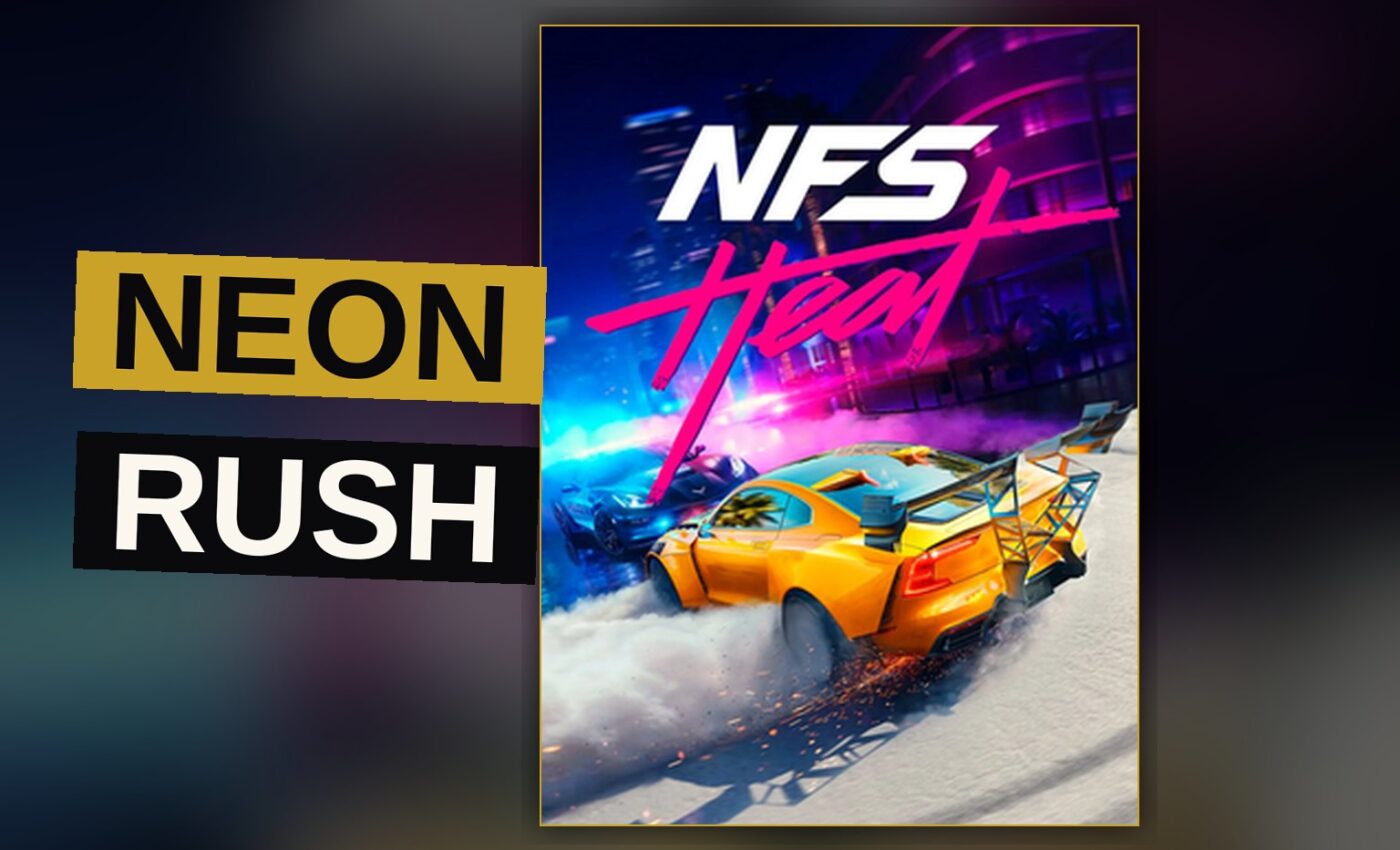
Need for Speed: Heat wants you to feel like a street racer in a neon-lit city. It succeeds at that feeling, and it fails at almost everything else. The game launched in 2019 for PS4, PC and Xbox One, and it still plays like a car chase that never quite gets going.
The setup is simple. You live in Palm City, a fictional Florida town where cops patrol the streets and racers gather in the underground scene. During the day you drive legally, earn cash, buy cars and upgrade parts. At night you hit the open roads, run from the police and try to win enough races to climb the ranks. That loop sounds great on paper. In practice, it wears thin fast.
Trailer, via LMR.
Palm City and Its Rules
Palm City is the heart of Need for Speed: Heat, and it is the best thing about the game. The sun sets over the water, palm trees line the boulevards and the skyline glows orange and pink at dusk. The city has distinct districts, each with its own look and its own racing spots. Driving through it at night feels like being in a movie, and that is the kind of atmosphere few racing games manage.
The day-to-night shift is also where the game’s central trick lives. During the day you can drive anywhere, park anywhere and explore the city. At night the police close off routes, set up roadblocks and chase you down if you get caught. The tension is real when you are driving back from a race late and see the blue lights flashing ahead. It gives the game a rhythm that other racers lack.
But the city’s charm is limited. There is not much to do in Palm City beyond driving, and the quests that send you from point to point rarely offer anything new. The side activities, like finding hidden collectibles or completing time trials, are there but easy to ignore. The game wants you to love the city, but it does not give you enough reasons to stay.
The Cars and Their Upgrades
The car selection in Need for Speed: Heat is solid. There are over 50 vehicles to unlock, from small street racers to muscle cars and super sports. Each car handles differently, and the upgrades you add change how they perform. You can raise the engine, the brakes, the suspension and the aerodynamics, and each change shows up on screen as you drive.
That system works well when you are building a car from scratch. The problem comes when you start playing online. The game lets you join other players’ races, but the matchmaking system is weak. You can wait minutes for a match, and the quality of the opponents varies wildly. One race might put you against skilled drivers who know the tracks well. The next might put you against players who barely know how to steer.
The result is a frustrating experience. You spend hours building a car you love, then you jump into an online race only to face opponents who are clearly less invested. It breaks the flow of the game, and it is one of the biggest complaints players had when the game launched.
The Races Themselves
The races in Need for Speed: Heat are mostly standard fare. You drive around a track, try to hold your line, and hope the AI cars do not bump you. The game adds a few twists, like having to hit checkpoints or avoid obstacles, but these moments are rare. Most of the time you are simply chasing the car in front of you.
The handling model is decent. Cars feel heavy when you push them hard, and the physics respond well to the road. Drifting is satisfying, and the boost system rewards players who stay loose and aggressive. But the tracks themselves are repetitive. Many of them follow the same layout, with tight turns in the middle and a straight line at the end. After a while, you stop caring about the course and just want to finish the race.
The game also includes a few modes outside the main races. There are time trials, checkpoint runs and elimination races where the last car standing wins. These are fun in short bursts, but they do not add much depth to the core gameplay. They are more like filler than like a real expansion of the idea.
The Police and the Chase
The police chases are the highlight of Need for Speed: Heat. When the cops catch up to you, you have to make sharp turns, weave between traffic and find a way out. The game tracks your progress and raises the stakes if you fail. Lose too many races or get caught too often, and you lose access to the best cars and the best tracks.
This system is the reason the game is worth playing. It gives the open-world driving a sense of danger that few other racers bother with. You are never truly safe, even when you are just driving from one part of the city to another. That constant threat keeps you engaged, and it makes the quieter moments feel more rewarding.
The downside is that the chases can be unpredictable. Sometimes the cops are too easy, letting you escape with minimal effort. Other times they are too harsh, taking away your car after a single mistake. The balance is inconsistent, and it takes time to learn what the game expects of you.
The Presentation
The presentation in Need for Speed: Heat is strong. The graphics are sharp, the lighting is vivid and the sound design is loud. The music fits the action well, and the radio stations offer a mix of rock, hip-hop and electronic tracks that match the energy of the city. The menus are easy to navigate, and the loading times are short.
The problem is that the presentation does not cover up the flaws underneath. The game looks good, but it does not play good. The controls are precise, but the content is thin. The city is beautiful, but it is empty. The car models are detailed, but the tracks are dull. The polish is there, but the substance is missing.
The Multiplayer Problems
The multiplayer in Need for Speed: Heat is where the game falls apart. The online mode is unstable, with frequent disconnections and lag that ruins the flow. The matchmaking system is unreliable, and the player base is small compared to other racing games. The races themselves are chaotic, with players who have not learned the basics mixing with veterans who know the tracks by heart.
The game tries to solve this with a ranked system, but it does not help much. The ranks are based on skill, but the matches are not always fair. You can be matched against someone who is clearly better than you, or someone who is clearly worse. Either way, the experience suffers.
The single-player campaign is better, but it is not much better. The story is thin, and the characters are forgettable. The voice acting is competent, but it does not leave much of an impression. The pacing is slow, and the missions are repetitive. You are mostly driving from point to point, talking to people you do not care about and unlocking cars you will not use.
The Verdict
Need for Speed: Heat is a mixed bag. It has a strong setting, a solid car lineup and a clever day-to-night mechanic. But it is let down by a shallow single-player campaign, a broken multiplayer mode and a lack of variety in its tracks. The game is fun in short bursts, but it does not hold up for long periods.
The best way to enjoy it is to focus on the open-world driving and the police chases. Ignore the races that feel like chores, and you will have a good time. But the game asks for more than it delivers, and that is the problem.
| Session Type | Best For |
|---|---|
| Open World Driving | Exploring Palm City at night |
| Police Chases | Feeling the danger of the city |
| Single-Player Races | Unlocking new cars and parts |
| Multiplayer | Avoiding at all costs |
Key Facts
- Platforms: PS4, PC, Xbox One
- Release Year: 2019
- Car count: Over 50
- Day-to-night shift: Yes
- Online multiplayer: Ranked system
- Critical score: 7.0/10
Need for Speed: Heat is a game that knows what it wants to be, but it cannot deliver on that promise. It is a stylish, atmospheric racer with a great idea at its core, but it is held back by poor execution and a lack of ambition. The city is worth visiting, but the journey is not worth the ticket.
Get the Notebook.
The day's best stories and every fresh verdict, in plain English, in your inbox by seven. One email a day, no more.