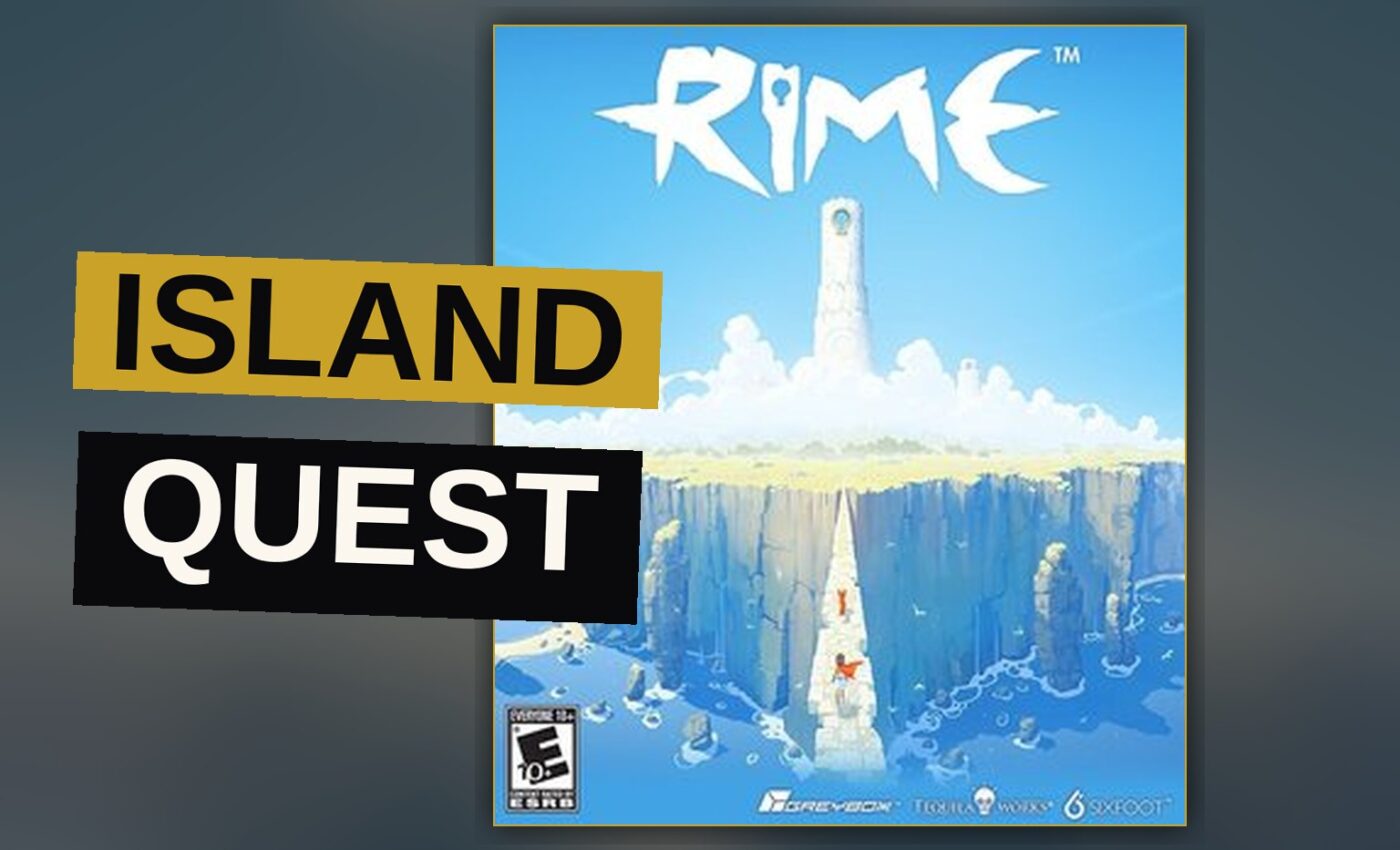
A boy washes ashore on an abandoned island. A giant tower stands at the far end. A magical fox leads him across five large levels toward it. That is the setup of RiME, and it is the last simple thing the game does.
RiME is a 2017 puzzle video game from the Spanish studio Tequila Works. It came to PlayStation 4, Windows and Xbox One in May 2017, to Nintendo Switch in November 2017, and to Amazon Luna in October 2020. It is a third-person adventure about exploration, perspective puzzles and grief, and it is far more interested in the last of those than its bright, windblown opening suggests. It scores 7.3 of 10.
Trailer, via izumiartisan.
A Boy, a Fox, and a Tower
You control the boy in third person. He runs, climbs, carries objects, and pushes or pulls larger ones across the landscape. He can shout or sing, and that sound triggers events tied to nearby statues — a door opens for a limited time, for instance. The puzzles are environmental, and some hinge on perspective: a special turret-like feature lets you align several disparate objects to build a doorway on the surface they project onto.
The fox-like spirit serves as a guide. A man in a red cape appears on several occasions, and the boy never reaches him. The island is heavily stylized, and the five large levels give the exploration room to breathe. This is a game that wants you to look, not to fight. There is no combat.
The structure is clean. Each area has its own weather and its own puzzle logic, and RiME rarely repeats a trick. The shout mechanic, the perspective turret, the statue doors — each gets its moment and then steps aside.
Echoes of Siren and the Sony Deal
RiME had a long road to release. Early concept work was undertaken under the working title Echoes of Siren when the game was green-lit by Microsoft, but that version was later rejected. Funding eventually came from Sony for a PlayStation 4 release, and the first trailer arrived at Gamescom in 2013. Tequila Works re-acquired the rights to the intellectual property in 2016.
That history shows in the finished game. RiME feels like a project that survived several owners and kept its core intact — the island, the fox, the tower. What it lost along the way is harder to name, but the seams are visible in how the levels pace themselves against each other.
The Switch version arrived in November 2017, and the Luna version in October 2020. RiME has been ported more than it has been discussed.
The Five Stages, Mapped to Stone
Here is where RiME stops being a pretty island game. The boy’s recollections fill in the back story: he and his father were at sea when a storm struck, and his father fell overboard. The boy tried to save him but only grabbed part of the red cloak before the sea took him. That is the story the game presents — the figure in red is his father, leading him across the island to the far tower. The final act reveals that reading was never the whole of it.
As the boy climbs, he passes through additional areas, each one representing one of the five stages of grief. At the top, in the area representing depression, he is forced to let the fox go as it disperses before him. He returns to the central tower, finds himself inverted within it, and climbs back through — reaching the “top,” the initial island, now representing acceptance.
another flashback shows that the story has actually been from the father’s perspective the entire time; it was the son that had been lost at sea, and the island and tower have all been part of the father’s own mind as he’s coming to grips with his loss.
The father goes to the boy’s room and examines his toys. As he turns to leave, a vision of his child with the red cloth appears on the bed. He hugs his son; the vision vanishes, leaving the red cloth in his hands. He releases it. If all four instances of the “white shade” were found, an additional vision appears.
What the Island Does Well
The perspective puzzles are the best thing in RiME. Aligning objects to project a doorway is a genuinely clever idea, and the game knows better than to lean on it too hard. The shout mechanic is thinner — it is a key, not a verb — but it stays out of the way.
| Element | What RiME does with it |
|---|---|
| Perspective turret | Aligns objects to project a doorway or trigger events |
| Shout / sing | Opens statue doors for a limited time |
| Fox-like spirit | Guides the boy across the island |
| Man in red cape | Appears repeatedly; the boy never reaches him |
| Five large levels | One per stage of grief, ending in acceptance |
The art direction carries the middle stretch. The island is stylized enough to feel like a storybook and specific enough to feel like a place. The fox is the best character in the game, and the game knows it, which is why taking it away lands.
Where RiME Stumbles
The puzzle difficulty is uneven. Perspective puzzles ask you to think; the navigation challenges mostly ask you to walk. A game about grief should not have filler, and RiME has stretches that feel like filler — traversal that exists to connect two better ideas. The shout mechanic never develops past its first use.
The bigger issue is the twist. Learning that the island was the father’s mind all along re-frames everything, and it works — but it also means the boy you spent hours controlling was never the point. That is a bold choice, and RiME commits to it. Whether it earns the commitment depends on how much you were attached to the boy. The game spends its best hours making you care about a character it later tells you was a projection. That is either the whole idea or the whole problem, and RiME does not fully decide.
The white shade collectibles are the clearest example of the game hedging. Four optional finds unlock an extra vision. It is a reward for thoroughness bolted onto a story about letting go. The two impulses do not sit well together.
The Tower and the Red Cloak
RiME is a good game with a great ending and a soft middle. Tequila Works built an island worth exploring and a puzzle system worth respecting, then wrapped both around a story that only fully arrives in its final hour. The five stages of grief mapped onto five levels is not a gimmick — it is structure, and it holds.
What holds it back is confidence. RiME does not trust its own best ideas to carry a full game, so it adds traversal, adds collectibles, adds a fox you have to lose. The fox is the one addition that pays off.
Play it for the tower. Play it for the moment the red cloak makes sense. Play it knowing the island is not what it looks like, and that the game is better for saying so.
Get the Notebook.
The day's best stories and every fresh verdict, in plain English, in your inbox by seven. One email a day, no more.