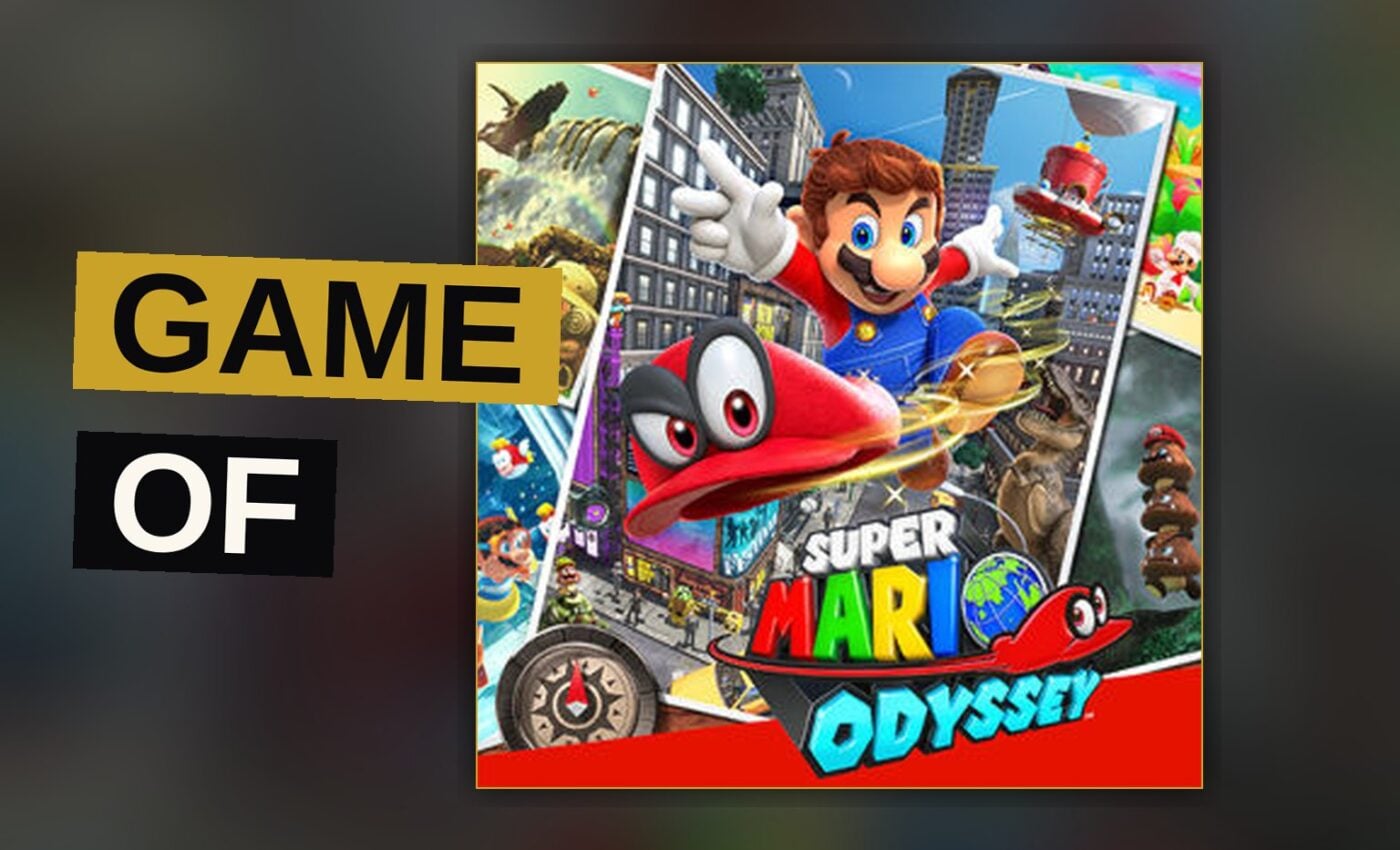
Super Mario Odyssey is the game that reminds you why Mario matters. It is not the most serious platformer ever made, and it is not the hardest. It is the most joyful one, and that joy is engineered with a level of craft that borders on the obsessive. The game takes the basic act of jumping and turning it into a language, then spends dozens of hours teaching you new words for that language until you are fluent.
This is a Switch game from 2017, and it remains the console’s finest hour. It is a game about travel, about collecting moons, and about the pure physical pleasure of movement. It is also, quietly, a masterclass in game design that most other developers are still trying to catch up to almost a decade later.
Cappy Turns Everything Into a Toy
The core trick of Super Mario Odyssey is Cappy, Mario’s sentient hat. Cappy is not just a weapon. He is a tool that lets Mario take control of almost anything in the world. You can capture a frog and jump higher. You can capture a Bullet Bill and fly. You can capture a tank, a tree, a dinosaur, or even a stack of goombas.
This capture mechanic is the entire game. It is the reason every kingdom feels fresh. Just when you have mastered one moveset, the game hands you another. The result is a game that never sits still. It is constantly asking you to rethink what Mario can do, and the answer is always “more than you thought.”
The capture ability is not a gimmick. It is a structural principle. Every level is built around a specific capture, and the game is smart enough to introduce each one in a safe context before throwing you into a challenge. The pacing is impeccable. You are never overwhelmed, and you are never bored.
Kingdoms Built for Wandering
The game is structured around a series of kingdoms, each with its own theme and visual identity. The Cascade Kingdom is a rocky mountain with ruins. The Sand Kingdom is an Egyptian desert with a massive inverted pyramid. The Lake Kingdom is an underwater city of glass. The Wooded Kingdom is an industrial forest.
Each kingdom is a dense, handcrafted playground. They are not large by modern open-world standards, but they are packed with secrets. The game hides moons everywhere. Behind a wall, under a platform, inside a puzzle, at the top of a tree. The sheer density of content is staggering, and the game never points you toward all of it. It trusts you to explore.
The level design is the star here. The game is a 3D platformer, but it borrows the structure of a collect-a-thon. You are not walking a linear path. You are wandering a space and finding reasons to stay. The best kingdoms, like the Moon Kingdom and the Metro Kingdom, feel like they were built by someone who loves the act of jumping.
New Donk City Steals the Show
The Metro Kingdom is the game’s most famous level, and it deserves the reputation. It is a city of skyscrapers and neon, populated by realistic human beings who look like they wandered in from a different game entirely. This is the kingdom where Mario wears a suit and a tie, and it is the kingdom where the game’s most famous set piece happens.
Near the end of the Metro Kingdom, the game stages a festival. Mario runs down a street lined with lights and music, and the camera pulls back to show the whole city dancing. It is a moment of pure spectacle, and it works because the game has earned it. You have climbed those buildings. You have jumped on those cars. You have learned the rhythm of the city, and now the city is celebrating you.
That sequence is a reminder that Super Mario Odyssey is not just about mechanics. It is about feeling. The game wants you to feel like a hero, and it is willing to put on a show to make that happen.
Puzzles in the Sand Kingdom
The Sand Kingdom is a different kind of triumph. It is a desert, but it is not empty. The central structure is a massive pyramid, and the game spends a good portion of the kingdom guiding you through it. The puzzles here are based on the capture mechanic, and they are consistently clever.
One moment you are a bullet bill, flying through a narrow gap. The next you are a Jaxi, a giant lion statue that can dash across the sand. The game switches between these modes with ease, and it never feels like it is padding the runtime. Every puzzle is a new idea, and every idea is resolved before it overstays its welcome.
The Sand Kingdom also introduces the game’s approach to boss fights. The bosses are not difficult, but they are theatrical. They are large, loud, and they give you a clear window to attack. They are not the point of the game. They are punctuation marks between the real content, which is the exploration.
Low Gravity on the Moon Kingdom
The Moon Kingdom is the game’s final area, and it is a strange, beautiful place. It is a low-gravity environment, which means Mario floats when he jumps. That change in physics is a simple trick, but it reframes the entire game. You have spent hours learning the weight of Mario’s jump, and now that weight is gone.
The final sequence of Super Mario Odyssey is a long, escalating climb. It is not a boss rush. It is a gauntlet of platforming challenges, each one pulling a trick from the game’s back catalog. It is a test, but it is a fair test. The game has taught you everything it is asking you to do.
The final boss is a fight against Bowser, and it is a spectacle. It is not hard, but it is satisfying. It is the culmination of a story that has been running quietly in the background of the game. The story is thin, but it is enough. It gives the game a shape, and it gives the ending a weight.
Hunting All 880 Moons
The game does not end when the credits roll. The postgame opens up new areas and new challenges. The objective is to collect all 880 moons, and that is a task that will take dozens of hours. The game is generous with its moons, but it is also demanding. The later moons require real skill, and the game is not afraid to ask for it.
The postgame is where the game’s depth becomes clear. The main campaign is a warm-up. The real game is the hunt for every moon, and that hunt is where the platforming gets serious. The game respects your time, though. It never asks you to grind. It asks you to look, and it rewards you for looking.
The moon collection is also the game’s answer to difficulty. The game is accessible, but it is not shallow. The moons are the difficulty curve. The early moons are easy, and the later moons are hard. The game lets you choose how hard you want it to be, and that is a rare and valuable quality.
Controls That Feel Perfect
The controls of Super Mario Odyssey are perfect. That is not an exaggeration. Mario has a moveset that includes a ground pound, a long jump, a backflip, a wall jump, and a hat throw that can be used as a platform. The game gives you all of these tools from the start, and it expects you to master them.
The feel of Mario’s movement is the game’s greatest achievement. He is fast, but he is not slippery. He is agile, but he is not weightless. Every jump has a clear arc, and every landing has a clear consequence. The game is precise, and that precision is what makes the hard challenges fair.
The motion controls are a minor annoyance. You can play the game with a single Joy-Con, but the motion gestures are not always reliable. The game works best with a Pro Controller, and it is telling that the game is still excellent even when the motion controls are ignored.
Comparing the Kingdoms
| Kingdom | Theme | Best Capture | Signature Moment |
|---|---|---|---|
| Cascade | Rocky mountain | T-Rex | The first jump off the ship |
| Sand | Desert | Jaxi lion statue | The inverted pyramid climb |
| Lake | Underwater city | Cheep Cheep fish | The glass corridors |
| Wooded | Industrial forest | Fire Bro | The giant steam vents |
| Metro | New Donk City | Human | The festival sequence |
| Moon | Low gravity | Bowser | The final climb |
The table is a rough guide. The truth is that every kingdom has something to offer, and the game is best played without a plan. The joy of Super Mario Odyssey is in the surprise. You never know what is around the corner, and the game never stops surprising you.
The game is also a technical marvel. It runs at 60 frames per second on the Switch, and it looks bright and clean. The art direction is varied and colorful, and the music is catchy. The game is a complete package, and it is hard to find fault with any part of it.
Super Mario Odyssey is a game that understands its own history. It is a love letter to the platforming genre, and it is a proof that the genre still has room to grow. It is not a revolution. It is a refinement, and it is a perfect one.
It is the best game on the Switch. It is one of the best games ever made. It is a game that you will finish and then immediately want to play again. It is a game that you will think about for years.
That is the highest praise a game can get.