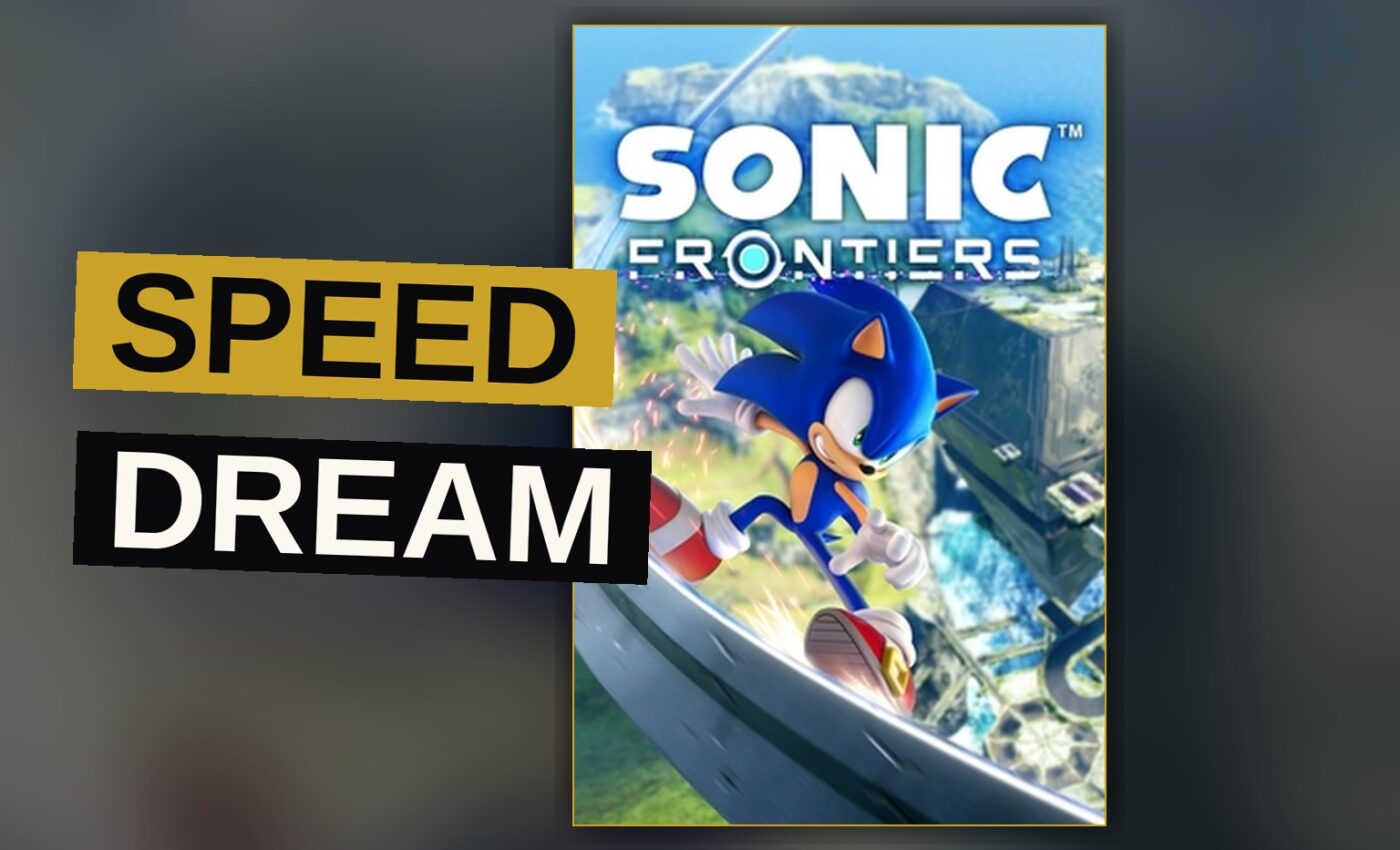
Sonic Frontiers asks Sonic to stop running through a straight line and start moving across a map. That change is the whole point of the game, and it is also the reason Sonic Frontiers feels like two separate games stitched together with duct tape. One half is a tight, fast platformer that shows off why Sonic still matters. The other half is a slow, grinding open-world grind that keeps trying to get in the way.
The game drops Sonic into the Lost Zone, a vast island filled with ruins, forests, and machine cities. Sega calls it a “open zone” design, which is Sega’s way of saying it borrows the wide-open sandbox style that other companies made famous. Sonic runs fast, glides, and bounces off walls, but he also spends long stretches wandering between objectives, grinding rails, and fighting waves of enemies while the pace slows to a crawl.
Trailer, via Gematsu.
The Open Zone and Its Problems
The open zone works best when you are moving. Sonic can dash across grass, grind along rails, and perform a spin attack that sends enemies flying. The controls feel sharp, and the game rewards players who learn to chain moves together. A quick dash into a grind into a wall bounce into a final attack looks smooth and feels satisfying.
But the open zone falls apart when you stop. The Lost Zone is full of side quests, collectibles, and grindable rail tracks, and Sonic Frontiers wants you to chase all of them. That push toward completionism is where the game loses focus. Side quests often involve walking across empty fields to talk to a character, then walking back to report the result. Grinding rails turns into a series of repeated moves, not a skill test. The main story campaign barely scratches the surface of the Lost Zone, leaving most of it unlocked for later exploration.
The pacing swings between pure joy and pure tedium within minutes. A chase sequence through a city street can be thrilling, and then you are suddenly asked to walk across a field while a pop-up menu fills the screen with text about a side quest. The contrast is jarring, and it shows how difficult it is to build a truly fast open-world game when the genre itself is built around wandering.
Sonic’s Moves and How They Land
Sonic’s move set is the strongest part of Sonic Frontaries. He can dash forward, jump, glide, and perform a new move called the Sonic Burst, which lets him break apart walls and enemies with a spinning charge. Each move can be chained into the next, and the game encourages players to learn combos by rewarding them with speed boosts and extra points.
The dash is particularly impressive. Sonic Frontiers lets you hold down the dash button and keep moving at full speed, which means long stretches of running across grass or water can feel almost effortless. The game also includes a grind move that lets you ride along rails, and a wall bounce that sends Sonic into the air for a second jump. These moves combine into a fluid system that feels natural once you get used to it.
The problem is that the game does not always let you use them. In open areas, the camera can drift, making it hard to see where you are going. In tight spots, the game sometimes forces you to slow down and move carefully, which breaks the momentum the dash is meant to create. The game also includes a stamina meter that drains during long dashes, which adds a layer of risk to extended runs.
Here is a rough breakdown of how the moves compare:
| Move | Use | Feel |
|---|---|---|
| Dash | Running forward | Fast, smooth |
| Glide | Falling through the air | Controlled, steady |
| Sonic Burst | Breaking walls and enemies | Powerful, satisfying |
| Grind | Riding rails | Fast, linear |
| Wall bounce | Jumping high | Rewarding, risky |
The Sonic Burst stands out as the most distinctive new addition. It lets you break apart walls and enemies with a spinning charge, and it feels different from anything Sonic has done before. It is a bold move, and it shows Sega is willing to experiment with the formula.
Zones and Their Variety
The Lost Zone is divided into several distinct zones, each with its own look and feel. The Ruined City is a crumbling metropolis filled with broken buildings and mechanical enemies. The Forest of Wonders is a green, mysterious area with hidden paths and secret locations. The Machine City is a towering, industrial region with factories and conveyor belts.
Each zone introduces new enemies, new moves, and new challenges. Some zones ask you to solve puzzles involving switches and platforms. Others ask you to chase enemies across open ground. The variety helps keep the game from feeling repetitive, even when the open-world structure starts to drag.
The zones also contain a series of blue markers that lead to speed challenges. These are short courses where you race against the clock, and they are some of the best-designed parts of Sonic Frontiers. They strip away the filler content and let you focus on pure movement. The game tracks your time, and beating your own record becomes a small but compelling loop.
The blue markers are a welcome relief from the open-world grind, but they are scattered across the map and easy to miss. The game does not always make it clear where they are located, which means you might spend time searching for them instead of enjoying them. The challenge is there, but the presentation is not always clear.
Combat and Its Limits
Combat is a mixed bag in Sonic Frontiers. Sonic can fight enemies with his spin attack, and he gains new moves over time, including a drill attack and a tornado spin. The combat is serviceable, but it is not the reason anyone picks up a Sonic game. It is functional, and it gets the job done, but it rarely feels exciting.
Boss fights are a bigger issue. Some bosses require you to dodge attacks and time your counterattacks, which can be satisfying. Others are simply endurance tests where you take damage until the boss falls. The game does not always explain what you are supposed to do, which can leave you confused about whether you are failing or just unlucky.
The combat also ties into the grindable rail tracks. Some rails are connected to enemy waves, and grinding them can help you clear groups of enemies quickly. This is a clever idea, but it also means you are spending time grinding rails that are not really about movement. The combat is a tool, but it is not the star of the show.
Performance Across Platforms
Sonic Frontiers launched on PS5, Xbox Series X|S, PC, PS4, and Switch 2. The performance varies across those platforms. On PS5 and Xbox Series X|S, the game runs at a smooth frame rate in the open zone, though load times can be long. On PC, the game offers higher resolution options, but it can struggle with frame rate dips in busy scenes. On PS4 and Switch 2, the game runs at a lower resolution and a slower frame rate, which makes the fast movement feel less precise.
The differences are noticeable, especially when you compare a fast dash on a newer console to the same dash on an older one. The game is playable on all platforms, but the experience is not the same. Players on newer hardware get a smoother, faster version of the game, while players on older hardware have to accept a less refined version.
The performance issues are a reminder that the open-world structure is hard to pull off well on older hardware. The game is asking a lot of the machines, and some of them cannot keep up. The result is a game that feels unfinished on some platforms, even though the core mechanics are solid.
Where Sonic Frontiers Succeeds
Sonic Frontiers succeeds when it stops trying to be an open-world game and focuses on what Sonic does best. The blue markers, the speed challenges, and the boss fights are the moments where the game shines. The dash, the glide, and the Sonic Burst are all executed well, and they give the player a sense of speed and control that few other games can match.
The game also does a good job of introducing new ideas without losing sight of the core identity of Sonic. The Sonic Burst is a fresh move, and the open zone structure is a bold step. The game is not afraid to try something different, even if the execution is uneven.
The failure comes from the structure of the game itself. The open world is too big, and the content is too spread out. The game tries to do everything at once, and it ends up doing none of it justice. The pacing suffers, and the player is left wondering why they are walking across an empty field when they could be dashing through a city street.
Final Word
Sonic Frontiers is a game of two halves, and the stronger half wins. The platforming is excellent, and the dash, glide, and Sonic Burst moves are some of the best in the series. The open-world structure, on the other hand, is a mess. It drags the game down with side quests, grindable rails, and endless walking.
The game is worth playing for the moments of pure movement, but it is frustrating in between. It is a game that knows how to make Sonic fast, but it does not know how to make Sonic fun outside of those fast moments. The blue markers and the speed challenges are the exceptions that prove the rule.
Sonic Frontiers is a game that captures Sonic’s speed and loses his spirit. It is a technical achievement in some ways, and a disappointment in others. The game is not a failure, but it is not a triumph either. It is a game that shows what Sonic can do when he is allowed to run, and a game that shows what happens when he is forced to stand still.