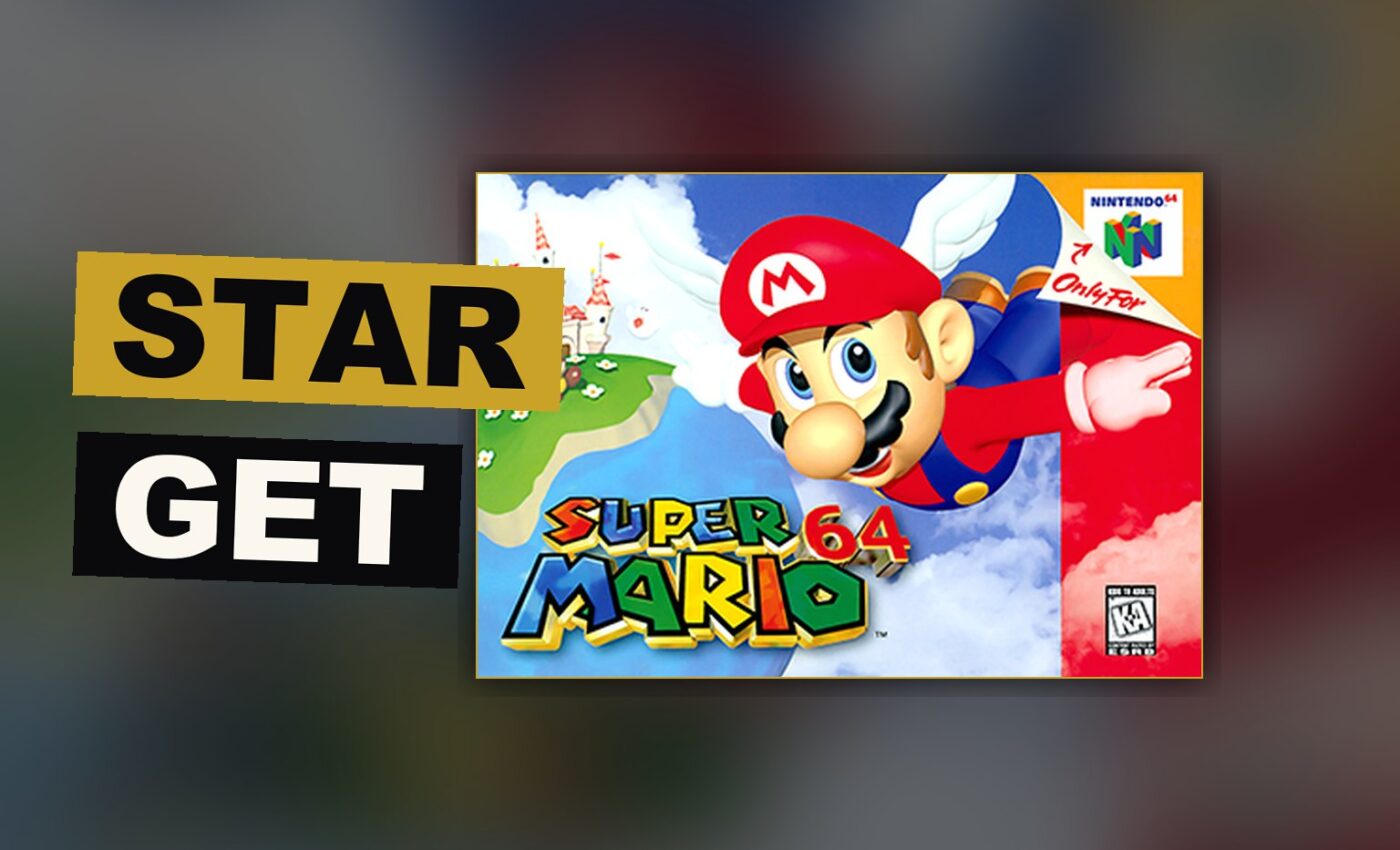
Super Mario 64 did not invent the 3D platformer so much as define what one could be, and three decades later that definition still holds. Nintendo’s 1996 launch title for the Nintendo 64 put Mario inside Princess Peach’s castle and handed players a camera, a jump button and 120 Power Stars to chase. The result is a game whose ambition, level design and control scheme outlasted the hardware it shipped on. It earns a 9.4 out of 10.
Release date, developer and sales figures
- Release: 1996 in Japan and North America; 1997 in PAL regions
- Developer and publisher: Nintendo
- Platform: Nintendo 64
- Director: Shigeru Miyamoto
- Composer: Koji Kondo
- Sound effects: Yoji Inagaki
- Copies sold: nearly 12 million by 2015
- Power Stars: 120 total
- Courses: 15, each with seven Power Stars
- Score: 9.4 of 10
Miyamoto’s team spent twenty months on production
The numbers behind Super Mario 64 are as striking as the game itself. Miyamoto conceived a 3D Super Mario game during the production of Star Fox in 1993. His team spent about one year on design and twenty months on production, starting with the virtual camera system before moving on to 3D character models and sprite movements.
That order of operations explains almost everything about how the game plays. The camera came first, and the camera is what made the rest possible. Koji Kondo composed the score. Yoji Inagaki recorded the sound effects. The game was released in Japan and North America in 1996 and in PAL regions in 1997.
It is the best-selling Nintendo 64 game, with nearly twelve million copies sold by 2015. That figure is a sales milestone, not a measure of quality, but it does show how many people met Mario in three dimensions for the first time here.
Princess Peach’s castle is the hub that holds it together
The hub world is Princess Peach’s Castle. It has three floors: the lobby, the main tower and a basement. Outside there is a moat and a courtyard. The player’s main objective is to find paintings, jump into them, and land in courses containing Power Stars.
Each of the fifteen courses holds seven Power Stars: six from named missions and one earned by collecting 100 coins in the level. Another fifteen are hidden as secrets and bonuses, bringing the total to 120. Collecting Stars unlocks more of the castle, which turns the hub into a progress bar you can walk around inside.
The courses are filled with enemies and with friendly creatures that help or ask favors. Bob-omb Buddies let Mario access cannons on request. Some Power Stars only appear after certain tasks, often hinted at by the course name. Those tasks include collecting one hundred yellow coins or eight red coins, defeating a boss, racing an opponent and solving puzzles.
The endless stairs are the best trick in the game
The final level is blocked by “endless stairs,” similar to the Penrose stairs concept. Mario can ascend them after collecting seventy Power Stars. Before that threshold, the music on the stairs resembles a Shepard scale, the auditory illusion that seems to rise forever without getting higher.
That is a remarkable piece of design. The staircase is not just a locked door with a different skin. It is a visual and musical joke that tells the player the same thing the game mechanics do: you are not ready, and you can hear why.
There are also many hidden mini-courses and other secrets inside the castle, some holding extra Power Stars required for full completion. Collect all 120 and Yoshi appears on the roof of Princess Peach’s Castle with a message from the developers, one hundred extra lives and an improved triple jump.
Bowser’s invasion gave the game a plot worth following
Princess Peach invites Mario to her castle for a cake she has baked for him. When he arrives, he finds that Bowser has invaded and imprisoned the princess and her servants using the power of the castle’s 120 Power Stars. The Stars are hidden in the paintings, which serve as portals to other worlds where Bowser’s minions guard them.
Mario explores the castle and enters those worlds, gaining access to more rooms as he recovers Stars. He unlocks three doors to different floors using keys obtained by defeating Bowser in hidden worlds. After getting at least 70 of the 120 Stars, he breaks the curse of the endless stairs blocking the entrance to Bowser’s final hiding place.
The setup is simple and it works because the castle is the story. Every locked door is Bowser’s doing. Every Star you bring back is a room you take back. The game never needs a cutscene to explain why you should keep going.
Wall jumps, backflips and flight still feel right
Super Mario 64 marked Mario’s debut in 3D, and the control scheme it introduced has appeared in every one of his 3D outings since. Wall jump, backflip and flight are all here. The player explores paintings around Princess Peach’s castle to collect Power Stars and stop Bowser.
The camera drew criticism at the time, and that criticism was fair. But the ambition, visuals, level design and gameplay drew praise, and that praise has held up better. Super Mario 64 is considered one of the greatest and most influential video games of all time, and numerous developers have cited it as an influence on 3D platform games.
Super Mario 64 against its 2020 re-release
| Feature | Super Mario 64 (1996) | Super Mario 64 in Super Mario 3D All-Stars (2020) |
|---|---|---|
| Platform | Nintendo 64 | Nintendo Switch |
| Base version | Original release | Shindou Pak Taiou Version |
| Textures | Original | Updated |
| Output resolution | Original | Higher |
| Modes | Single player | Single player |
| Perspective | Third person | Third person |
| Genres | Platform, Adventure | Platform, Adventure |
The 2020 port included in Super Mario 3D All-Stars was built on the Shindou Pak Taiou Version and its enhancements, with updated textures and a higher output resolution.
What actually matters here
The sales figure and the re-release are the noise. The design is the signal. Super Mario 64 built a hub world that doubles as a progress meter, a camera system that made 3D movement legible, and a control scheme that every later Mario 3D game still uses. The endless stairs and the Shepard scale are the clearest proof that the team understood how to make a player feel stuck without making them feel cheated.
The camera criticism from 1996 remains the one honest knock. It is also the problem the industry kept running into for years afterward, which is its own kind of compliment.
Super Mario 64 is not a museum piece. It is a working blueprint, and it still runs. 9.4 of 10.
Get the Notebook.
The day's best stories and every fresh verdict, in plain English, in your inbox by seven. One email a day, no more.