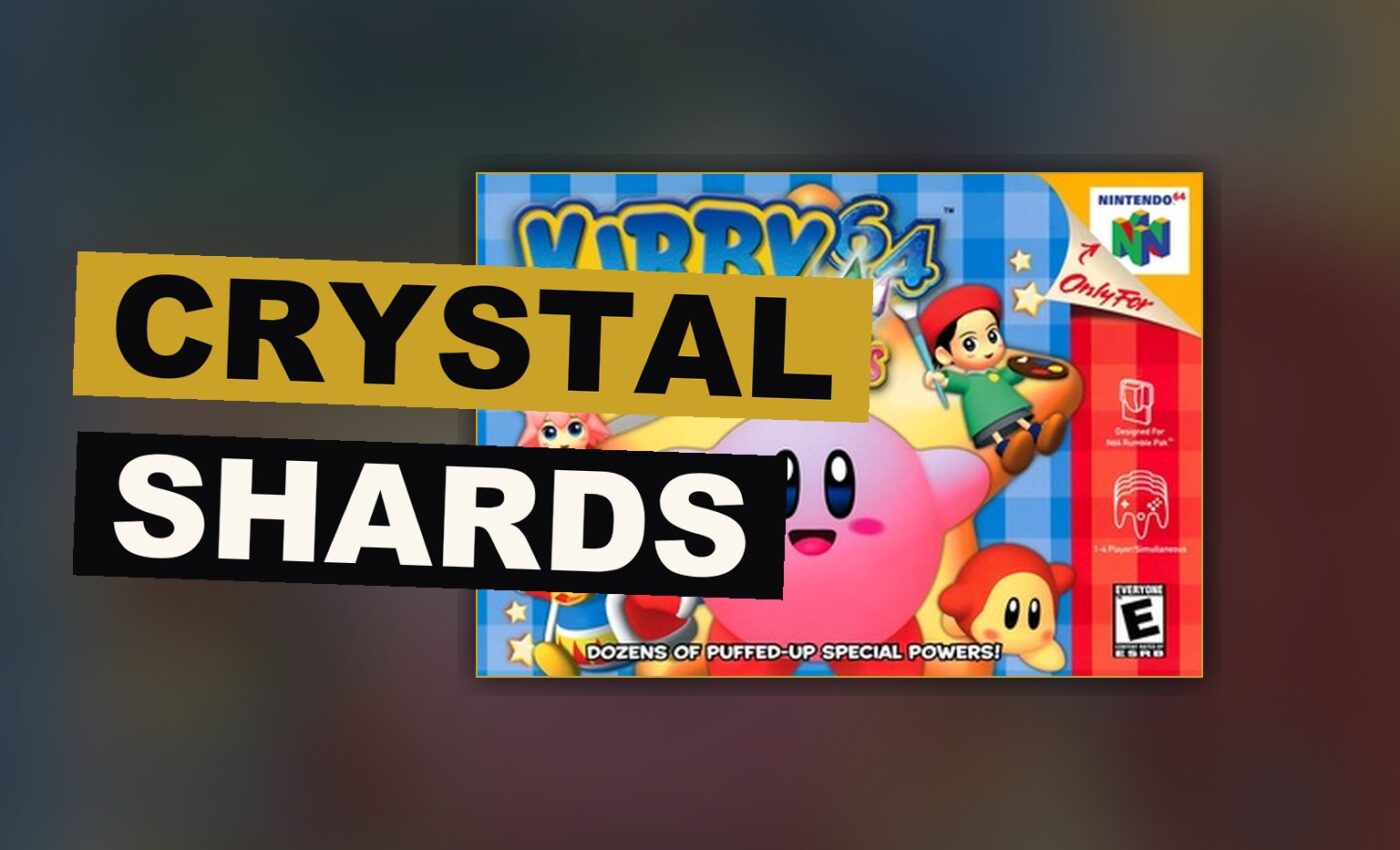
Kirby has spent most of his life on flat ground. That changes with Kirby 64: The Crystal Shards, the pink puffball’s debut on the Nintendo 64 and his first outing built with 3D computer graphics. HAL Laboratory developed it, Nintendo published it in 2000, and the result is a game that looks forward and plays backward — a 2.5D platformer that renders its worlds in three dimensions but keeps Kirby on a strict two-dimensional plane.
It works more often than it doesn’t. The game reassembles the series’ familiar loop — walk, inhale, copy, spit — and bolts on one genuinely new idea, Power Combos, which lets Kirby mix two copy abilities into something stronger. That single mechanic carries a lot of weight. So does the game’s brisk, low-stakes charm, even when the whole thing ends sooner than you’d like.
Ribbon Flees Ripple Star With the Crystal
The story opens on Ripple Star, a planet of kind and peaceful fairies. The planet is protected by a great Crystal that watches over it. That power draws Dark Matter, which wants the Crystal for its own evil agenda. Dark Matter attacks in a gigantic mass, blackening the sky and sending the fairies into a panic.
The queen of Ripple Star orders a fairy named Ribbon to carry the Crystal to safety. Ribbon tries to fly away with it but is stopped by three orbs Dark Matter sends after her. The Crystal shatters into 74 shards scattered across several planets, and Ribbon crashes onto Planet Popstar. Kirby finds one shard and gives it to her, and the two set out to find the rest.
That’s the setup, and it’s thinner than the game’s own summary suggests. The source material for Kirby 64: The Crystal Shards gives two shard counts — 74 in the storyline and 100 in the gameplay description — and the game itself sends Kirby across six planets to collect the pieces. Either way, the errand is an excuse. Dark Matter is the enemy. Ribbon is the companion. The crystal is the thing everyone wants.
Adeleine, King Dedede, and Waddle Dee Get Possessed
Kirby doesn’t travel alone. Along the way he enlists the help of artist Adeleine, King Dedede, and Dedede’s minion Waddle Dee. Each of them stumbles onto a crystal shard and ends up possessed by Dark Matter, which forces Kirby to battle each one to free them from its influence. It’s a clean structure: find a friend, fight a friend, get a friend back.
The worlds are rendered in 3D, but the action stays flat. Players control Kirby with the Nintendo 64 controller’s D-pad. He can walk or run, crouch, jump, and inhale enemies or objects to spit them out as bullets. He can fly for a limited time by inflating himself, though he can’t attack or use other abilities while airborne — he can only release a weak puff of air.
- Seven copy abilities, gained by eating certain enemies
- Power Combos, which mix two abilities into a stronger one
- Six planets to cross
- Three minigames in a multiplayer mode for up to four players
- Minecart and log flume levels piloted by Waddle Dee
- Levels where Kirby rides King Dedede’s back and clears obstacles with his hammer
The copy abilities are the series’ spine, and Kirby 64: The Crystal Shards handles them the way earlier Kirby games did. Eat the right enemy, take its property, use it. The twist is the mixing. Power Combos are the reason to keep eating things you’ve already eaten, and they’re the reason the game’s best moments feel like experiments rather than chores.
The D-Pad Switch a Year Before Release
Development began in September 1997. The game was intended for the N64’s 64DD add-on, but it became a standard N64 title after the add-on failed. HAL initially planned to use the N64 controller’s analog stick, then switched to the D-pad about a year before release.
That switch is the most consequential design choice in the game, and it’s not obviously the right one. A 2.5D platformer on a console with an analog stick could have moved with more nuance. Instead, Kirby 64: The Crystal Shards asks for eight directions and gets them. It plays like a Super Nintendo game wearing a polygon coat, which is either the point or the problem depending on what you wanted from the machine.
What you get is a game that never fights its own camera or its own controls. Kirby moves where you push him. The levels are legible. The enemies are readable. The difficulty, though, is close to nonexistent — a criticism the game’s reviews have carried since release, alongside praise for its colorful visuals and its classic style of gameplay.
Six Planets, Then Dark Star
The length complaint is the one that sticks. Kirby 64: The Crystal Shards is a short game, and its low difficulty means the shortness is not offset by challenge. You will not be stuck. You will not replay a boss until your hands learn it. You will move through six planets, collect the shards, defeat Miracle Matter, and reach the ending in a single stretch of evenings.
That ending is worth the trip. After Kirby and his friends collect every Crystal Shard and defeat Miracle Matter, Dark Matter flees Ripple Star and explodes. The victory is cut short when the Crystal detects a powerful presence of Dark Matter energy within the Fairy Queen and expels it, manifesting over the planet to create Dark Star. Kirby and his friends infiltrate Dark Star, and King Dedede launches them up to challenge 02. Kirby and Ribbon, armed with their Shard Gun, destroy 02 and the Dark Star.
It’s a real escalation, and it arrives late enough to feel earned. The game’s story does something the series rarely bothered with: it gives the final act a twist that reframes the whole errand. The Fairy Queen was compromised. The crystal knew. Kirby and Ribbon finish the job with a weapon built from the thing they spent the whole game collecting.
Power Combos Are the Best Idea Here
The visuals hold up better than the mechanics do. Kirby 64: The Crystal Shards is bright and readable, and its 3D rendering gives the series a sense of place that flat sprites couldn’t. Ripple Star, Popstar, and the six planets between them are distinct enough to remember.
Power Combos remain the strongest argument for the game. They turn the copy ability system into a small combinatorial toy, and they reward curiosity over efficiency. If you eat two enemies you’ve already eaten, you get something you haven’t seen. That’s a good loop, and it’s the one idea here that later Kirby games should have stolen more aggressively.
The multiplayer mode is thinner. Up to four players can compete in three minigames, and that’s the whole of it. No co-op campaign, no split-screen adventure worth the name. It’s a bonus, not a mode.
The Last Traditional Console Kirby Until 2011
Kirby 64: The Crystal Shards was the last traditional Kirby game for home consoles until Kirby’s Return to Dream Land in 2011. That gap is the most telling fact about it. Nintendo and HAL spent the next decade putting Kirby on handhelds and into experiments, and the N64 entry sat as the final word on what a console Kirby looked like for eleven years.
It got a second life anyway. The game was rereleased for the Virtual Console on the Wii in 2008, on the Wii U in 2015, and on the Nintendo Classics service in 2022. It was also included in the Wii compilation Kirby’s Dream Collection in 2012. A short game with a low difficulty curve keeps finding new audiences because it’s easy to pick up and pleasant to look at.
The Numbers
- Release year: 2000
- Developer: HAL Laboratory
- Publisher: Nintendo, Gradiente
- Platforms: Nintendo 64, Wii, Wii U
- Genre: Platform, Adventure
- Perspective: Side view
- Modes: Single player, Multiplayer, Split screen
- Crystal shards: 74 (storyline) or 100 (gameplay description)
- Planets: 6
- Copy abilities: 7
- Metacritic score: 7.7/10
What This Game Actually Proved
Kirby 64: The Crystal Shards is a good game with a short memory. It looks like a leap forward and plays like a step back, and the tension between those two facts is the whole review. The 3D rendering gives Kirby a world worth walking through, and the D-pad keeps him walking through it in straight lines. Power Combos are the one mechanic that feels like it belongs to this console and not the last one.
The low difficulty is not a small complaint. A platformer that never pushes back is a platformer you finish and forget, and Kirby 64: The Crystal Shards has been finished and forgotten by a lot of people. But it has also been rereleased three times, which suggests the forgetting never quite takes. The game is charming, brief, and easy to recommend to anyone who wants a Kirby game and doesn’t want to work for it.
What matters most is what it proved. A Kirby game could render in 3D and still feel like Kirby. That’s a smaller claim than the game’s marketing made at the time, and a more durable one. The series would spend years figuring out what to do with the console space it opened here. Kirby 64: The Crystal Shards didn’t answer that question. It just showed the door.
Get the Notebook.
The day's best stories and every fresh verdict, in plain English, in your inbox by seven. One email a day, no more.