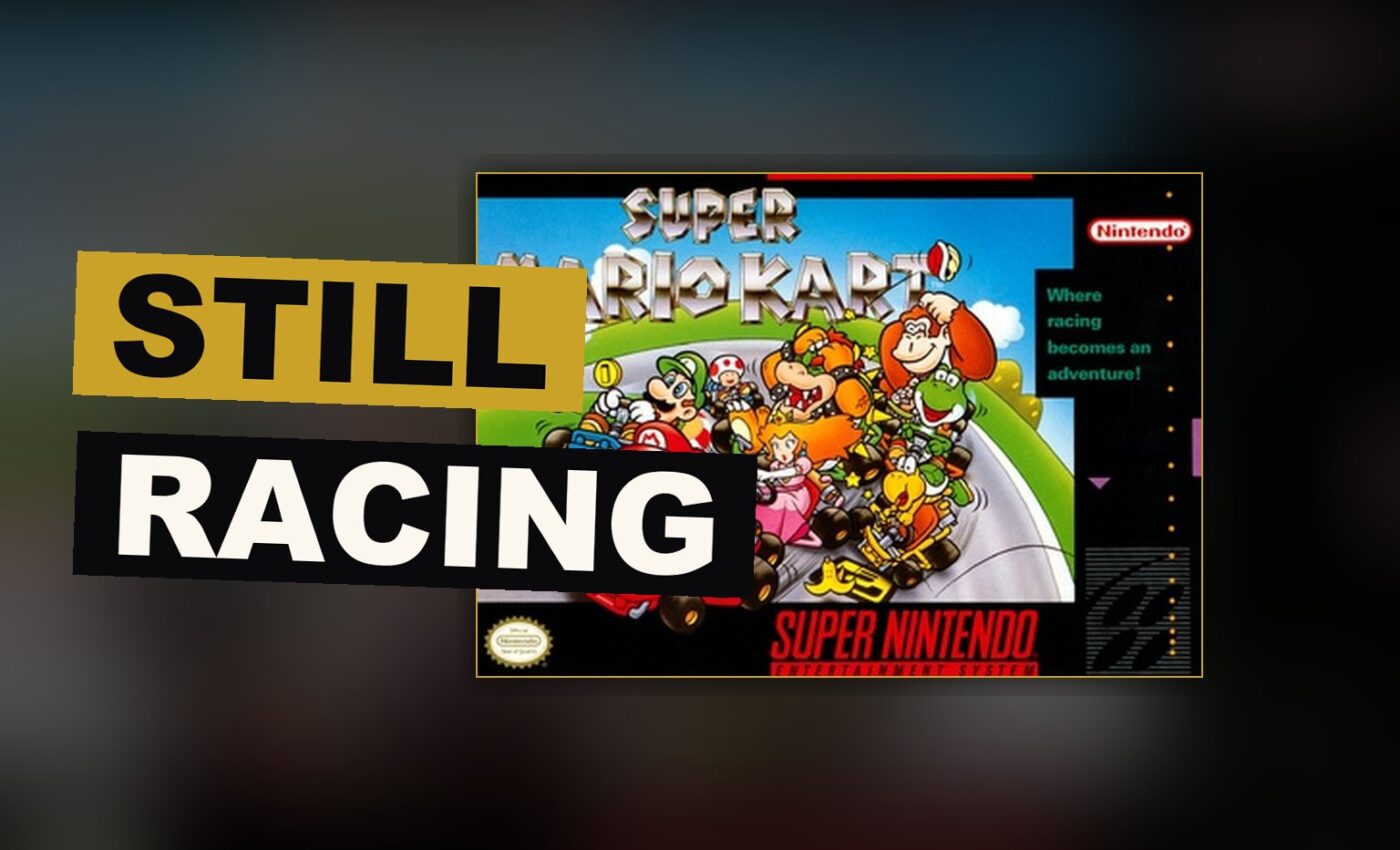
Super Mario Kart arrived in North America on September 1, 1992. It sold 8.76 million copies and became the fourth best-selling Super Nintendo Entertainment System game of all time. It is a landmark. It is also a rougher ride than its reputation admits.
Mario, Luigi and Six More Drivers
The roster is the smartest thing here. Super Mario Kart puts eight Mario series characters behind the wheel: Mario, Luigi, Princess Peach, Yoshi, Bowser, Donkey Kong Jr., Koopa Troopa and Toad. Each kart handles differently, with its own top speed, acceleration and handling. This was the first game to make Mario characters other than Mario and Luigi playable outside a platformer, and the spread of attributes still reads as good design. IGN called it a well-balanced “all-star cast,” and that holds up.
Not every pick survived. Donkey Kong Jr. and Koopa Troopa have only appeared intermittently after being replaced by Donkey Kong and Wario respectively in Mario Kart 64. The roster was a bet, and most of it paid.
The single-player structure is four cups, five tracks each, for 20 tracks across three difficulty levels: 50cc, 100cc and 150cc. Time Trial mode strips out the opponents and races the clock. Multiplayer splits two ways — two players can run the cups together or face off one-on-one in Match Race, and Battle Mode asks them to destroy the balloons around each other’s karts with power-ups.
Shells, Bananas and Lakitu’s Fishing Pole
The race itself runs from a viewpoint behind the kart. Lakitu hovers at the starting line with a traffic light on his fishing pole, and the race or battle begins when it turns green. Question-mark panels sit on the track and hand out power-ups. Shells and bananas hit other racers and send them spinning. The star makes a kart briefly invincible. Boost panels and short ramps let racers launch into the air, and hitting both at speed sends them higher.
Coins are the quiet mechanic that matters most. Lines of them sit on the track in competitive modes. Collecting them raises a kart’s top speed, and carrying them changes what happens on impact: instead of spinning out, a kart loses coins and keeps going. It is a small economy layered under the chaos, and it gives every lap a second objective.
The computer-controlled racers get their own character-specific items. Yoshi drops eggs that cost players coins and send them spinning. Donkey Kong Jr. throws bananas. These superpowers give each opponent a personality the player’s kart does not have, which is both a nice touch and an unfair one.
What Three Decades Have Done
Here is the honest problem. Super Mario Kart renders its characters as sprites drawn from 16 different angles, and the mode split is thin by modern standards: single player only in the traditional sense, with multiplayer capped at two. The kart handling that felt revolutionary now feels like the first draft of something better.
That is not a knock on the design. It is a knock on the assumption that the original is still the best place to start. Later entries in the series built on this foundation, and what Super Mario Kart still owns is the pure version of the idea — the coins, the shells, the boost panels, the eight karts with eight different feels. Nothing here is padding.
The re-releases tell you how Nintendo sees it. Super Mario Kart came to the Wii’s Virtual Console in 2009, the Wii U’s Virtual Console in 2013, and the New Nintendo 3DS’s Virtual Console in 2016. In 2017 it was bundled into the Super NES Classic Edition. That is a long run of ports, and it reads as a verdict: the original is the artifact.
Where the Cartridge Still Holds
Super Mario Kart earns its place in the canon on the strength of its roster and its coin economy, not on its racing feel. The eight characters with eight distinct karts set the template the series has followed since. The coins are the best idea in the game — a mechanic that rewards aggression and caution at once. The sprites and the two-player ceiling are the parts that have aged badly, and no amount of nostalgia moves them.
- Released: Japan August 27, 1992; North America September 1, 1992; Europe January 21, 1993
- Platform: Super Nintendo Entertainment System (SNES)
- Copies sold: 8.76 million worldwide
- SNES sales rank: fourth best-selling game
- Playable characters: 8
- Cups and tracks: 4 cups, 20 tracks, 5 per cup
- Difficulty levels: 50cc, 100cc, 150cc
- Metacritic score: 7.4/10
It is a foundational game, not a flawless one. The design instincts are sharper than the execution, and later entries improved on much of what dates here. Play it to see where the series came from. Do not play it expecting the series at its peak.
Get the Notebook.
The day's best stories and every fresh verdict, in plain English, in your inbox by seven. One email a day, no more.