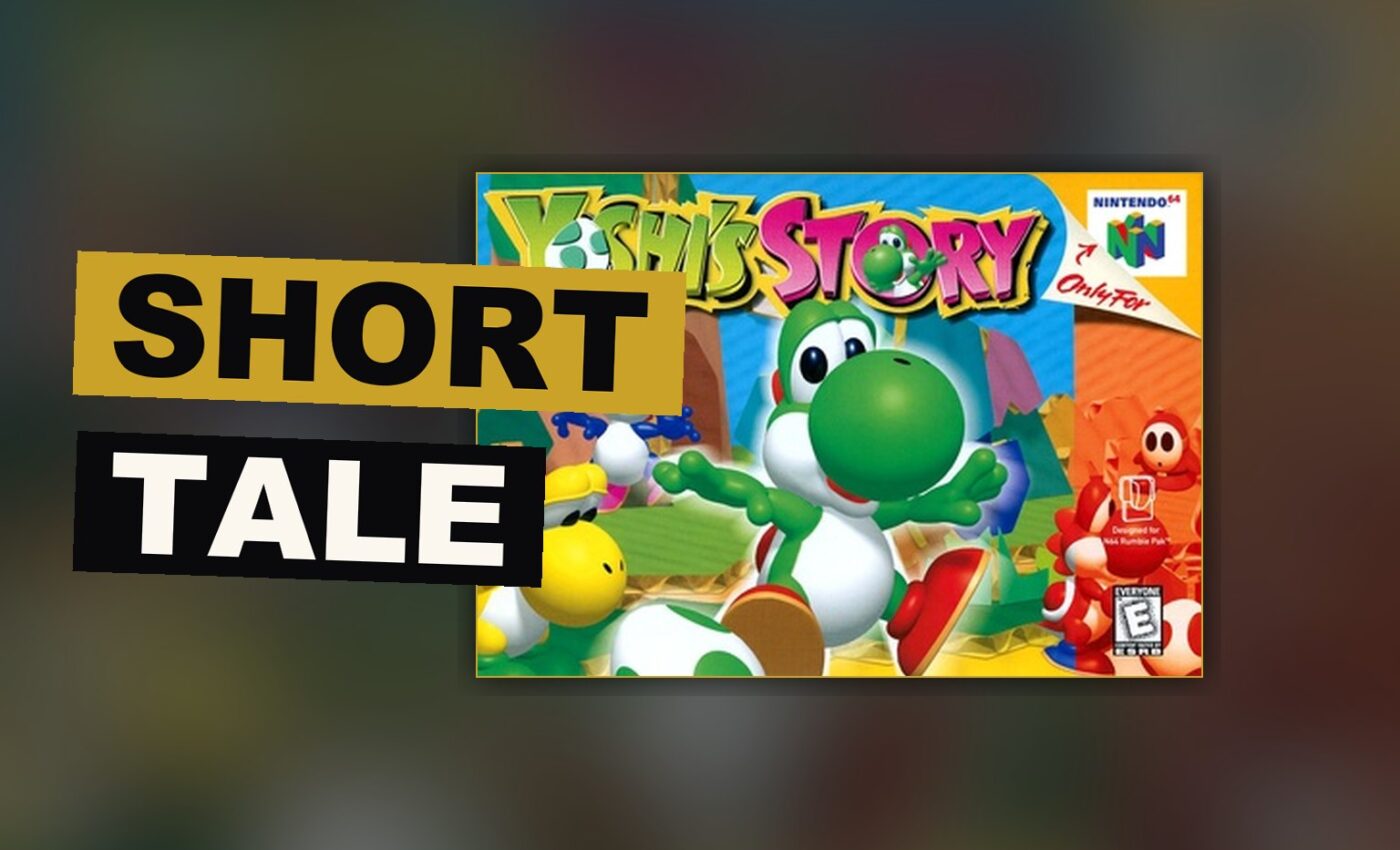
Nintendo’s Yoshi’s Story asks players to fill a fruit frame, not to survive a gauntlet. That single choice defines the 1997 Nintendo 64 platformer, and it is the reason the game divides people.
Baby Bowser and the Super Happy Tree
Baby Bowser has stolen the Super Happy Tree and cast a spell over Yoshi’s Island, turning the world into a pop-up storybook. Only six hatchlings escape, still sealed in their shells. They set out across six pages to take the tree back.
Hideki Konno and Takashi Tezuka led development at Nintendo EAD. Shigeru Miyamoto did not direct, though he contributed design ideas and served as supervisor. Kazumi Totaka composed the score and voiced Yoshi himself. The game shipped in Japan in December 1997 and worldwide the following year, later reaching the Wii, Wii U, and Nintendo Switch.
Thirty Pieces of Fruit
The goal on every course is to eat 30 pieces of fruit and fill the Fruit Frame. Fruit lies on the ground, floats in bubbles, and rides on enemies. The scoring rewards planning: eating one kind of fruit in a row pays more, and more still if it is a Favorite Fruit or the course’s Lucky Fruit.
Melons are worth the most, and each level hides exactly 30. That is the whole game in one sentence, and it is also the problem.
Story Mode and Trial Mode both open with the same ritual: pick a course, learn the Lucky Fruit, choose a Yoshi color. Trial Mode starts empty. Courses unlock only by clearing them in Story Mode. Each page holds four courses, sorted by difficulty, and the first page always shows all four. Later pages start with one. Special Hearts change that — three per course, and the hearts you collect decide how many courses open on the next page. Two hearts means courses 1, 2, and 3.
The structure is tidy. The stakes are not.
Cardboard, Fabric, and Wood
Yoshi’s Story looks like nothing else on the Nintendo 64. Its pre-rendered 3D worlds are built from cardboard, fabric, plastic, and wood, and the storybook frame holds them together. The art style and Totaka’s audio are the strongest things here.
Then there is the difficulty. The Yoshi moves by running, ducking, jumping, and ground moves, and the game rarely demands more than that. Get knocked out and a cutscene shows Kamek’s minions kidnapping that Yoshi, removing the character from play. It is a threat that almost never lands.
Ranked by what actually works:
- The art direction, which makes cardboard and fabric read as a real place.
- Kazumi Totaka’s score, and his turn as Yoshi’s voice.
- The fruit-scoring puzzle, which rewards patience over speed.
- The difficulty curve, which barely rises across six pages.
What the Puzzle Costs
Yoshi’s Story follows Yoshi’s Island from 1995 as the second main Yoshi game, and the comparison is not kind. Yoshi’s Island pushed players. Yoshi’s Story asks them to graze.
That is a real idea — a platformer about appetite and restraint rather than reflexes — and the melon count of 30 per level shows Nintendo meant it as a puzzle. But a puzzle with no pressure is a chore, and the six-page structure repeats its trick too often to surprise anyone past the second page. The vivid materials and the music carry the experience. The challenge does not.
This is a beautiful game that is too easy to respect. It earns its place as a curiosity worth playing once, not a platformer worth mastering.
6.5 of 10.
Get the Notebook.
The day's best stories and every fresh verdict, in plain English, in your inbox by seven. One email a day, no more.