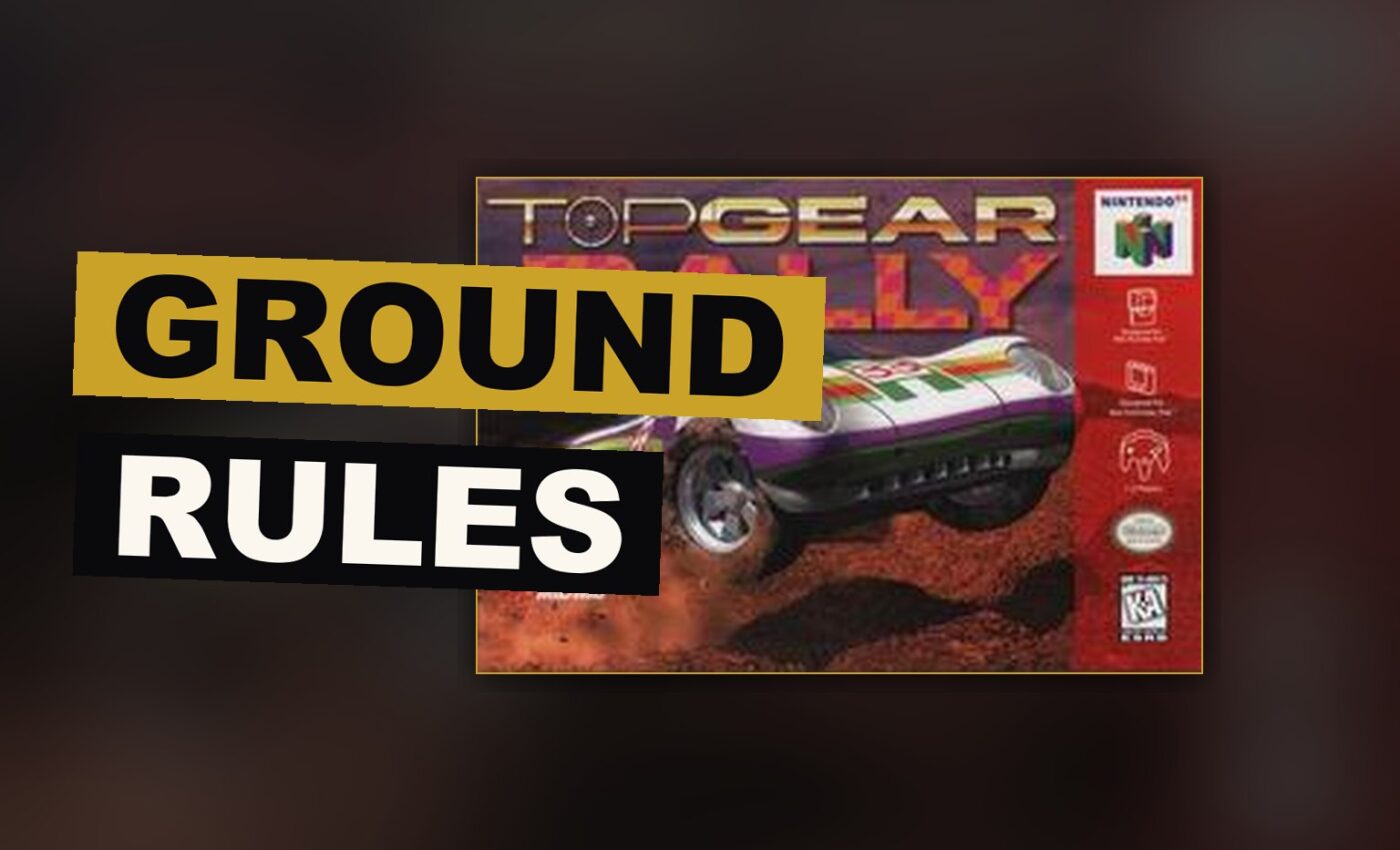
Top Gear Rally landed on the Nintendo 64 in 1997 with a split personality: it wants to be a simulation and an arcade racer at once, and it is far better at one of those than the other. Boss Game Studios built a game about dirt, weather, and the slow work of learning a car. Then it wrapped that game in a structure demanding six seasons of races against 19 computer opponents. The result rewards patience and punishes anyone chasing a quick thrill.
Six Seasons, Nineteen Cars, No Shortcuts
Championship mode is the spine of Top Gear Rally. A single player must complete six seasons, each made up of two to four races, and every race puts you against 19 AI-controlled cars. Points come from your finishing rank. Fall short of the required total and you do not advance.
That structure suits the game’s physics and hurts its pacing. Six seasons is a long commitment, and the early races are not hard enough to teach you why the later ones are. You learn the handling because the game gives you no choice.
New cars and tracks unlock as you progress. Nine cars and four tracks ship in the box, plus two bonus cars and a hidden track for players who finish the game and take first in every race of the final season. A mirror variant of each track unlocks too, flipping curves left-to-right and right-to-left.
Gravel, Fog, and a Hidden Shortcut
Top Gear Rally’s tracks mix road and off-road surfaces, and they are relatively open. Hidden shortcuts sit inside them for players willing to leave the racing line. Each track runs under five conditions: sunny, night, fog, rain, or snow.
Those conditions are not decoration. They change how a car behaves, and the game expects you to react. A gravel track in the rain is a different problem than the same track at noon.
The four gameplay modes are Championship, Arcade, Time Attack, and Practice. Multiplayer supports two players through split-screen. That is the whole of it, and it is thin.
Tuning That Matters, Damage That Doesn’t
Before a race you can paint your car, pick tire grips, adjust suspension stiffness and steering sensitivity, and choose a manual or automatic transmission. Each car has its own acceleration, top speed, drivetrain, and engine placement, and those factors change handling in ways you can feel.
Engine placement often decides how a car lands after a jump. Four-wheel drive cars hold more grip on gravel. These are real differences, not stat-sheet noise, and they make the tuning screen worth the time.
Then there is the damage system, the strangest decision in the game. Cars can be damaged. Their performance is not affected. You can wreck a car and keep racing at full speed, which drains the tension out of every corner you take badly.
A Workstation Demo That Became a Racer
Top Gear Rally started as a non-interactive demonstration. Boss built it on Silicon Graphics workstations, showing two- and four-wheel drive vehicles racing through different driving conditions. The game grew out of that demo, and it shows in the best way: the physics engine has a working suspension that reacts to rough terrain.
The cars are fictitious, but they were modeled after real vehicles. That combination gives the roster a familiar feel without licensing anyone’s badge.
The game received generally positive reviews from critics, who praised the technical aspects of its graphics and its fluid yet challenging gameplay.
Where the Sound Falls Apart
The audio is the weak point. Criticism landed on the game’s sound effects, and it is easy to hear why. A racer lives on engine note, tire scrub, and the click of a gear change. Top Gear Rally does not deliver those with any force.
The multiplayer mode drew the same kind of complaint. Split-screen for two players is a feature, not a mode, and it leaves the game feeling solitary even when someone is sitting next to you.
Four Tracks, Nine Cars, One Long Season
Here is the content math, laid out plainly.
| Feature | What Top Gear Rally offers |
|---|---|
| Tracks | Four, plus one hidden track |
| Cars | Nine, plus two bonus cars |
| Championship | Six seasons of two to four races |
| Opponents per race | 19 AI cars |
| Weather conditions | Sunny, night, fog, rain, snow |
| Multiplayer | Two players, split-screen |
| Modes | Championship, Arcade, Time Attack, Practice |
Four tracks is a small number, and the mirror variants do not add geography — they reverse what you already know. The hidden track and bonus cars are a reward for finishing first in every race of the last season, a steep price for content most players will never see.
The Suspension Is the Whole Story
The physics engine is what separates Top Gear Rally from the racers around it. A functioning suspension that reacts to challenging terrain is not a bullet point. It is the reason the tuning screen matters, the reason weather matters, and the reason a jump landing depends on where the engine sits.
That is the part worth protecting. Boss built a car model with weight and consequence, then built a game around it that sometimes forgets to use it. The damage system that changes nothing is the clearest example. The suspension tells you the car is real. The damage model tells you it isn’t.
What Holds Up and What Doesn’t
The handling is fluid and it is challenging, and those two things usually do not coexist. Top Gear Rally manages it because the challenge comes from the car, not from the track design or the AI. You fight the surface, the weather, and your own tuning choices.
The technical side of the graphics holds up as the game’s strongest visual argument. The weather conditions read clearly on screen, which matters when fog and night change how far you can see and how early you need to brake.
The customization is generous for 1997. Paint, tire grip, suspension stiffness, steering sensitivity, transmission type — the game hands you a lot of dials and trusts you to use them.
Our Score
Top Gear Rally is a good racing game with a thin shell around it. The physics engine and the tuning system are the reason to play. The Championship mode is the reason to stop. Six seasons against 19 opponents, with progress gated behind point totals, turns a game about feel into a game about grinding, and the four tracks do not have enough variety to carry that length.
The multiplayer is the bigger loss. Split-screen for two players is the minimum, not a feature, and the weak sound effects make the whole thing feel quieter and smaller than it should. A racer that nails suspension physics should sound like it is working hard. This one doesn’t.
In 1999 the game was ported to Microsoft Windows as Boss Rally, which suggests the underlying car model had a life beyond the Nintendo 64. That makes sense. The parts of Top Gear Rally that Boss got right are the parts that were hardest to build, and they are still the reason to pick it up.
Play it for the dirt, the fog, and the way a four-wheel drive car bites into gravel. Skip the six-season march unless you have the patience for it. The game’s best idea is under the chassis, and everything above it is thinner than it should be.
Get the Notebook.
The day's best stories and every fresh verdict, in plain English, in your inbox by seven. One email a day, no more.