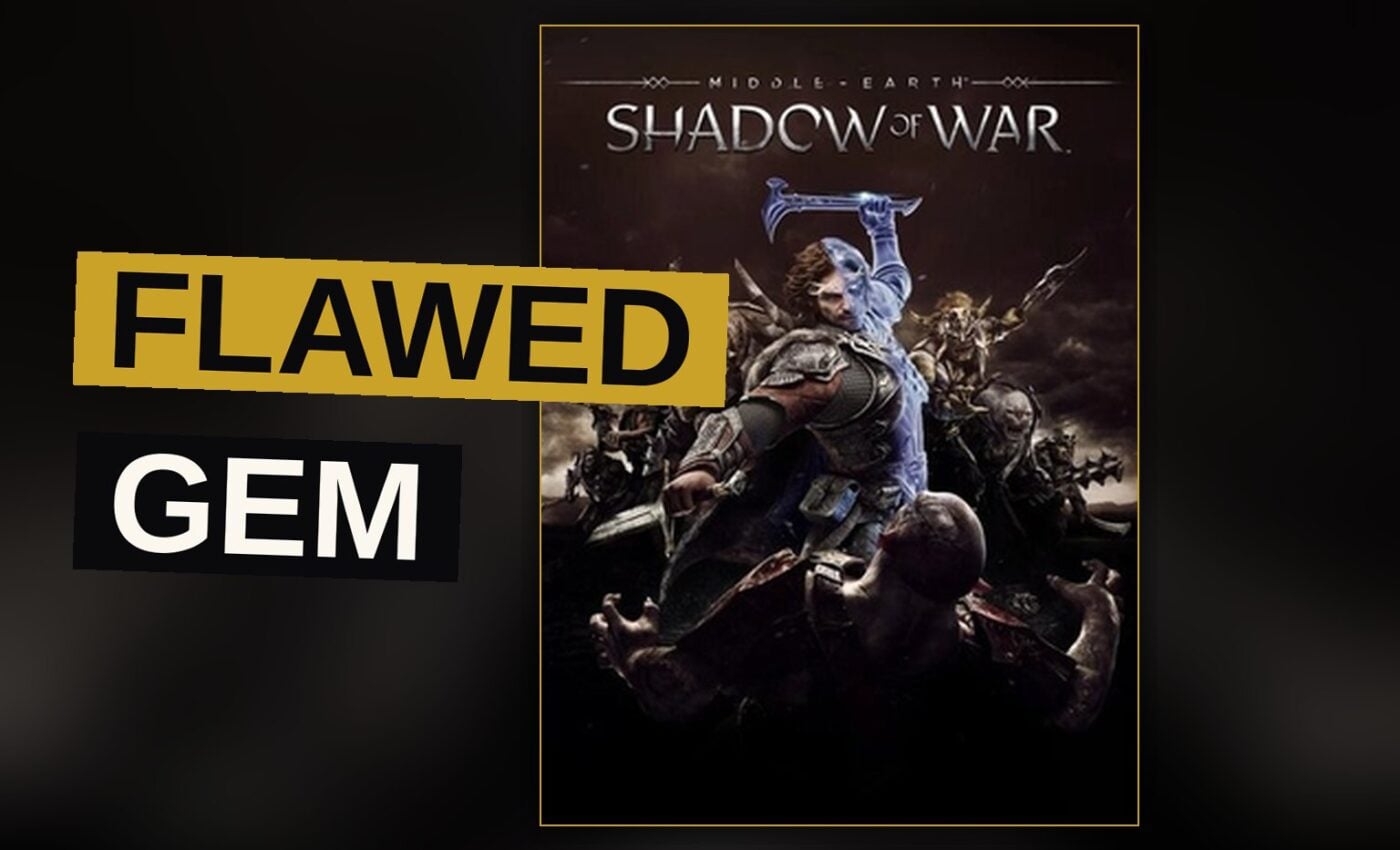
Middle-earth: Shadow of War is a bigger, brighter sequel that trusts its strangest idea — that orcs are people — and builds a whole war around it. Monolith Productions developed it, WB Games published it, and it landed in 2017 on PlayStation 4, PC and Xbox One.
Trailer, via Shadow of War.
Talion and Celebrimbor Forge a New Ring
The story picks up where 2014’s Middle-earth: Shadow of Mordor left off. Talion, the Gondorian ranger voiced by Troy Baker, still shares a body with the wraith of the elf lord Celebrimbor, voiced by Alastair Duncan. They travel to Mount Doom and forge a new Ring of Power, one free of Sauron’s corruption.
That decision drives everything after it. Shelob, voiced by Pollyanna McIntosh, takes Celebrimbor hostage and demands the Ring. Talion hands it over.
Shelob Sees the Future
Shelob claims they share an enemy in Sauron. She uses the Ring to see the future and points Talion toward Minas Ithil, the last Gondorian stronghold near Mordor. The city holds a Palantír, which lets whoever possesses it see anything they wish.
Talion wants to defend the Gondorians. Celebrimbor thinks the city is already lost and the Palantír is the only thing worth saving. That argument is the spine of the campaign.
General Castamir Opens the Gates
Talion meets the city’s defenders: General Castamir, his daughter Idril, and his lieutenant Baranor. Shelob’s visions hand him intelligence on the orc armies, including word that a human traitor walks among the defenders. Castamir turns out to be that traitor. He opens the gates and gives the Palantír to the Witch-king of Angmar.
Go behind enemy lines to forge your army, conquer Fortresses and dominate Mordor from within.
That betrayal lands because the game spends its time on the city before it falls.
Eastern Washington, Alaska and Iceland
The five regions are bigger and more colorful than Shadow of Mordor’s, and the team drew on the landscapes of eastern Washington, Alaska and Iceland for them. The light is different here. So is the mood, which allows more light-hearted moments than the first game did.
The Nemesis System Adapts to You
The nemesis system is still the reason to play. It procedurally generates orc characters to fight and recruit, and this time it tracks how you play and lets enemies adapt to your tactics. Orcs remember. They get promoted. They hold grudges.
Might, Parries and Unblockable Attacks
Combat runs on the same loop as before. Strikes build a might meter, and eight consecutive hits unlock a finisher that takes a large bite out of an enemy’s health. A symbol appears over an attacker’s head to signal a parry; unblockable attacks flash red and have to be dodged.
Celebrimbor supplies the rest — double-jumping, wraith vision to highlight nearby enemies, spirit arrows, a spectral glaive, health drain, and domination. Story quests hand out points for new skills, and each skill upgrades individually. Mirian, the currency dropped by defeated enemies, buys weapons, gear and followers in the market. The source names four of Talion’s five gear types — a sword, a dagger, a bow and armor — and cuts off before identifying the fifth.
What Shadow of War Gets Right
The order of what matters here is clear enough.
- The nemesis system’s adaptation, which turns your own habits into an opponent.
- The Talion-Celebrimbor split, which gives the campaign a real argument instead of a fetch quest.
- Minas Ithil, the one location the story bothers to make you care about.
The open world is the weakest of the three. Bigger regions and brighter color don’t fix a map that mostly funnels you toward the next fortress. The market and mirian economy sit awkwardly against a single-player game, though the source says nothing about whether they break it.
What holds up is the personal scale. An orc you spared in one region can return as a commander in another, and the game lets that mean something. Monolith built a war for Mordor and made the smallest grudge in it the most interesting thing on screen.
Middle-earth: Shadow of War is not a subtle game. It is a confident one, and its best idea — that the enemy army is a cast of characters — carries it past its weaker stretches. On PlayStation 4, PC and Xbox One, this is the sequel Shadow of Mordor earned.
Get the Notebook.
The day's best stories and every fresh verdict, in plain English, in your inbox by seven. One email a day, no more.