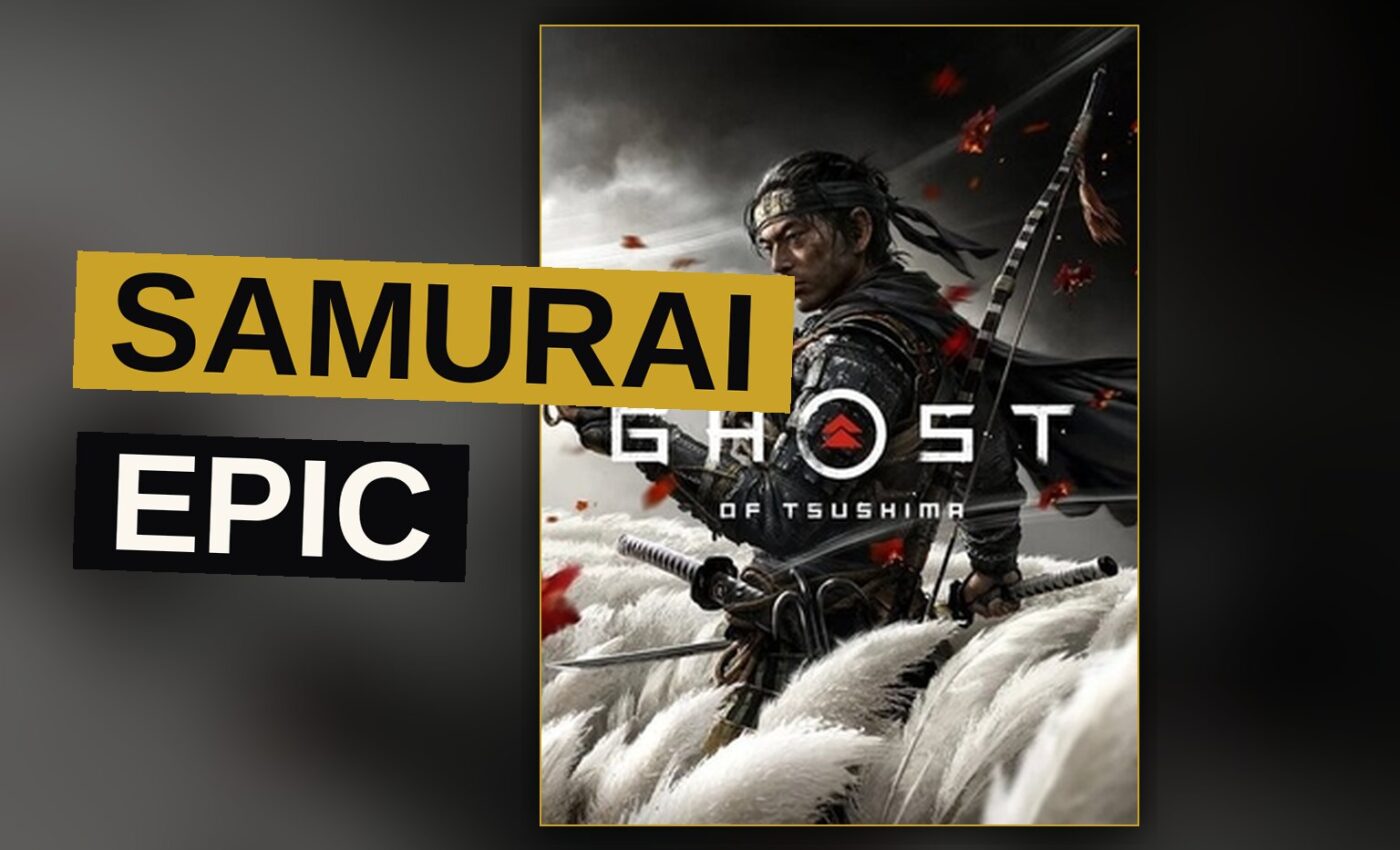
Ghost of Tsushima arrived in 2020 as Sucker Punch Productions’ clean break from the Infamous franchise, and it lands as the studio’s most assured game yet. Published by Sony Interactive Entertainment for PlayStation 4 and PlayStation 5, it is a third-person, single-player, open-world action adventure set in 1274, when the Mongol Empire invades the island of Tsushima. You play Jin Sakai, a samurai who has to decide whether the warrior code is worth dying for or worth abandoning. The game’s answer is the second one, and it commits to that answer for its entire run.
Trailer, via IGDBcom.
Jin Sakai and the Way of the Ghost
Jin is the head and sole remaining member of Clan Sakai, nephew and ward of Lord Shimura, the jitō of Tsushima. Daisuke Tsuji plays him in English, Kazuya Nakai in Japanese. When a Mongol fleet under General Khotun Khan lands at Komoda Beach, the five great families — Shimura, Sakai, Adachi, Nagao and Kikuchi — ride out to repel the invaders. The battle is a disaster. The samurai are cut down by superior Mongol weapons, Shimura is captured, and Jin is left severely wounded and for dead.
The scavenger Yuna finds him and revives him. She tells him the whole island has fallen. That is the setup, and it is lean enough to hold a long game together. Jin storms Castle Kaneda to rescue his uncle, loses to the Khan, and is thrown from the bridge. Only then does he accept that samurai tactics will not win this war. He learns guerrilla warfare from Yuna, recruits allies, and the islanders start calling him “The Ghost,” a samurai spirit risen against the Mongols.
Stances, Standoffs and the Ghost
Combat is the reason to play Ghost of Tsushima, and it is built on a stance system that keeps every fight from settling into one rhythm. Stone stance handles hostile swordsmen. Water stance handles shielded enemies. Wind stance handles spearmen. Moon stance handles brutes. You stagger an enemy or land a parry to break their defense, then attack to drain health.
A standoff is a direct confrontation with the katana that can end in a run of fatal strikes against several enemies at once. Bows fire multiple arrow types for distant threats. Stealth lets Jin evade and strike silently with his tanto, and chained assassination lets him take several enemies in a row. Ghost stance is the payoff: Jin becomes invincible and kills in a single hit for a limited time. You earn it by killing a number of enemies without taking damage, or by slaughtering a Mongol leader.
The arsenal of ghost weapons rounds this out. Firecrackers and wind chime bells make distractions. Smoke bombs disorient alerted foes. None of it feels like a menu of gimmicks. The game’s highest difficulty is a realistic mode where the player and enemies deal heavy damage, and every non-boss fight ends in one or two successful attacks.
Yuna, Taka, Ishikawa and the Rest
The supporting cast is deep, and the game gives most of them real work. Sumalee Montano plays Yuna, the thief who saves Jin and teaches him to fight dirty. Eddie Shin plays her blacksmith brother Taka, who builds the grappling hook Jin uses to scale Castle Kaneda’s walls. Lauren Tom plays Lady Masako Adachi, a warrior and widow. François Chau plays Sensei Sadanobu Ishikawa, a renowned kyūjutsu archer. James Hiroyuki Liao plays Kenji, a sake merchant and swindler.
Earl T. Kim plays the Buddhist warrior monk Norio, Karen Huie plays Clan Sakai’s elderly caretaker Yuriko, and Leonard Wu plays Ryuzo, Jin’s childhood friend and leader of the Straw Hat rōnin. Ryuzo is the one that stings. Destitute and starving, he and the Straw Hats betray Jin for a bounty. The game sets that up early and pays it off late.
Patrick Gallagher plays General Khotun Khan, cousin of Kublai Khan and grandson of Genghis Khan. He is a cunning antagonist rather than a shouting one, and the game is better for it. The Japanese cast includes Kazuya Nakai, Akio Ōtsuka, Yu Mizuno, Kappei Yamaguchi, Mabuki Ando, Shigeru Chiba and Tsutomu Isobe.
An Island Built for the Camera
Sucker Punch began work after Infamous First Light in 2014, wanting to move on from that franchise toward melee combat. The studio collaborated with Japan Studio and visited Tsushima Island twice to get the culture and history right. The influences are visible everywhere. Samurai cinema, particularly Akira Kurosawa’s films, shapes the framing. The comic series Usagi Yojimbo shapes the tone. Shadow of the Colossus shapes the landscape and the minimalistic art style. Locations were designed to be “the perfect photographer’s dream,” and that ambition holds up.
The open world can be crossed on foot or on horseback. It is a strong argument for the latter, though the game gives you reasons to stop.
Here is the ranking that matters most, the one thing this game does better than almost anything else in its genre:
- The stance system — four counters, one for each enemy type, and a fifth that makes you invincible.
- The standoff — a staredown that turns into a chain of kills.
- Ghost stance — the reward for playing clean, and the moment the game’s thesis lands.
- Stealth — the tanto, the chained assassination, the smoke bombs.
- The bow — multiple arrow types for threats you would rather not meet.
- The duels — boss fights against NPCs with their own tactics and attack animations.
That list is the game. The story is what carries you between those fights, and it is good enough to do that job without ever feeling like filler.
The Verdict on Ghost of Tsushima
Ghost of Tsushima does something rare: it makes a moral argument and then makes you play it. Jin’s choice between the warrior code and the practical, dishonorable way is not a cutscene. It is the stance system, the stealth, the ghost weapons. The game tells you honor will not save Tsushima, then hands you the tools to prove it.
The multiplayer mode, Ghost of Tsushima: Legends, arrived in October 2020 and was made available separately in September 2021. It is a solid addition, not the reason to buy the game.
Where does this sit against the rest of the open-world field? High. The combat has more texture than most games in the genre manage across a whole trilogy, and the art direction gives the island a specific identity rather than a generic one. The realistic difficulty mode is the sharpest thing here, because it forces every fight to matter and punishes the sloppy parry.
The weak points are real but minor. The mission structure leans on liberating villages and disrupting Mongol activities, and that loop repeats. Some players will find the open world’s checklist familiar. Neither flaw is enough to sink it.
This is Sucker Punch’s best game, and it is one of the best games of 2020. It earns its length.
Get the Notebook.
The day's best stories and every fresh verdict, in plain English, in your inbox by seven. One email a day, no more.