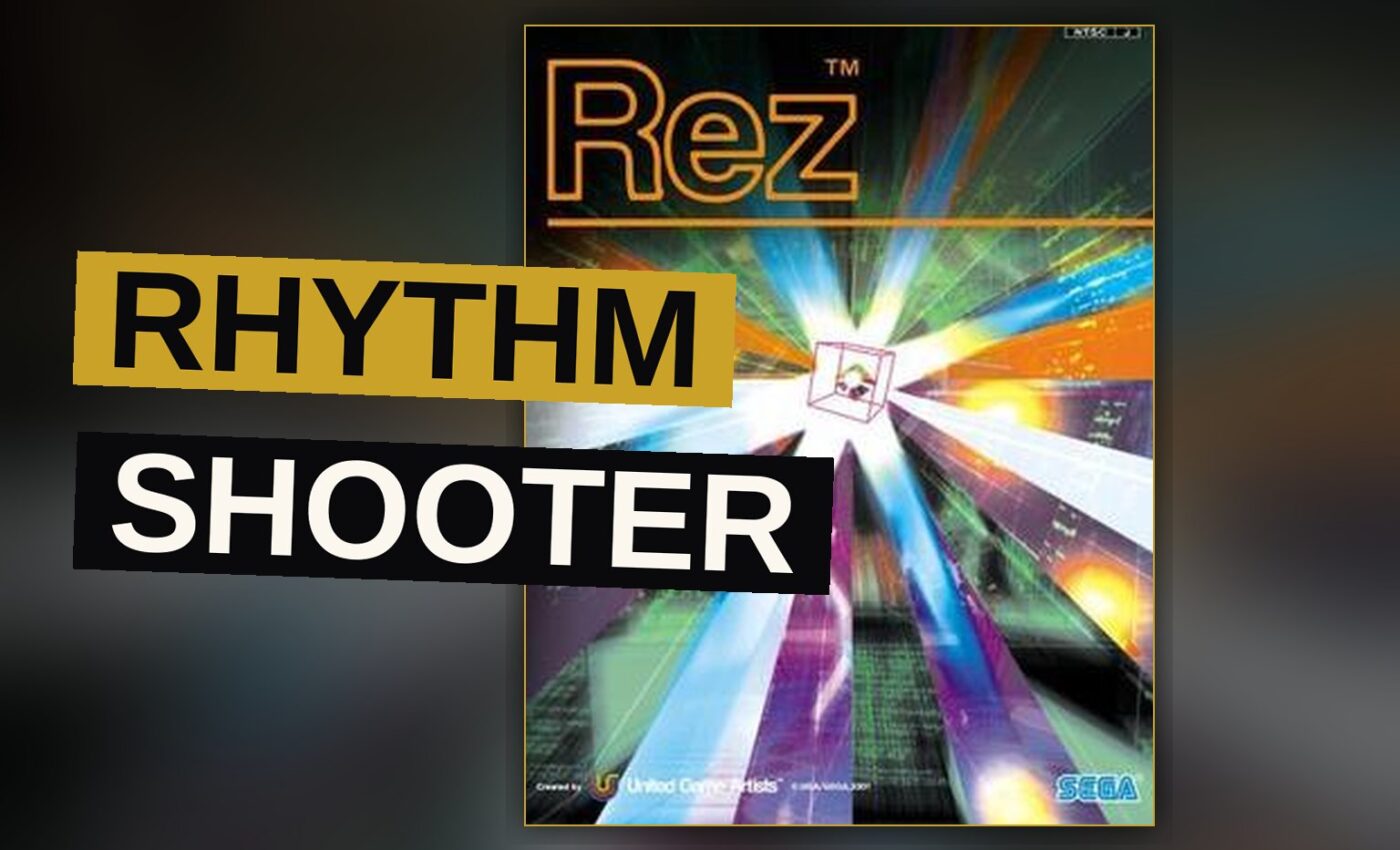
Rez launched on the Dreamcast and PlayStation 2 with almost nothing to explain itself. There is no dialogue, no narrator, and barely any text. You are a hacker virus diving into a network, and the game asks you to feel your way through the rest.
Developed by United Game Artists and published by Sega, Rez arrived in Japan in 2001 and reached the United States and Europe in 2002. It was ported to Xbox 360 as Rez HD in 2008, then expanded into Rez Infinite, released across platforms from 2016 to 2023. Twenty-five years on, the original still holds up as one of the medium’s cleanest arguments that a game can be about a feeling rather than a plot.
Eden, Project-K, and a Hacker Called Swayzak
The setup is spare and effective. Earth is overpopulated and cracking under crime. A global network called Project-K is built to manage the chaos, run by a self-aware AI named Eden. Drowning in information and infected by a virus, Eden questions her own existence and shuts herself down.
You play that virus, a hacker unofficially named Swayzak. Your job is to travel deeper into Project-K, destroy the anti-viruses and firewalls in your way, and wake Eden up. The story is told through visuals alone, with thematic nods to the journey of life and technological singularity. It never overexplains, and it is better for it.
Five Areas, Ten Layers, One Lock-On
Rez fuses rail-shooter mechanics, in the vein of Panzer Dragoon, with the music game. You ride the rails, aim a lock-on missile launcher at up to eight targets, and fire. Every hit syncs to the background track, adding musical layers as you go.
Destroying data nodes raises the layer level, up to a maximum of 10. Each bump changes the music, the layout, and the enemies. There are five Areas, though only four are open at the start.
| Element | Detail |
|---|---|
| Default form | Level 01 |
| Lowest form | Level 00 |
| Layer level cap | 10 |
| Lock-on targets | Up to 8 |
| Overdrive Nodes | Up to 4 |
| Areas | 5 |
Getting hit drops you a form. At Level 00, one more hit ends the run. Progress Nodes raise you back up, and Overdrive Nodes fill a meter that triggers screen-clearing attacks. Bosses close each Area and scale in difficulty based on how many enemies you killed in the layers before.
Why the Synesthesia Still Lands
The design concept pulled from rave culture and classic rail shooters, with wire frame graphics inspired by Wassily Kandinsky’s paintings. Tetsuya Mizuguchi conceived the game in 1994 and 1995, drawing on European disco. Production began in 1999, after United Game Artists finished Space Channel 5. Keiichi Sugiyama supervised music that featured Japanese and European collaborators, and those tracks influenced the level designs.
That priority is the whole game. Most shooters treat music as backing; Rez treats it as the terrain. Controller vibration feeds each shot back into your hands, chasing a synesthesia the game mostly achieves.
It is not flawless. Five Areas is a short run, and the enemy-free exploration mode and score attack only arrive after you have cleared the main path. The layer system punishes a bad stretch hard, and the devolution mechanic can feel less like a lesson than a stall.
None of that dulls the achievement. Rez is a shooter with no dialogue that says more about life and machines than most games manage with hours of it. The visuals and the soundtrack carry the meaning, and the mechanics carry the theme.
Get the Notebook.
The day's best stories and every fresh verdict, in plain English, in your inbox by seven. One email a day, no more.