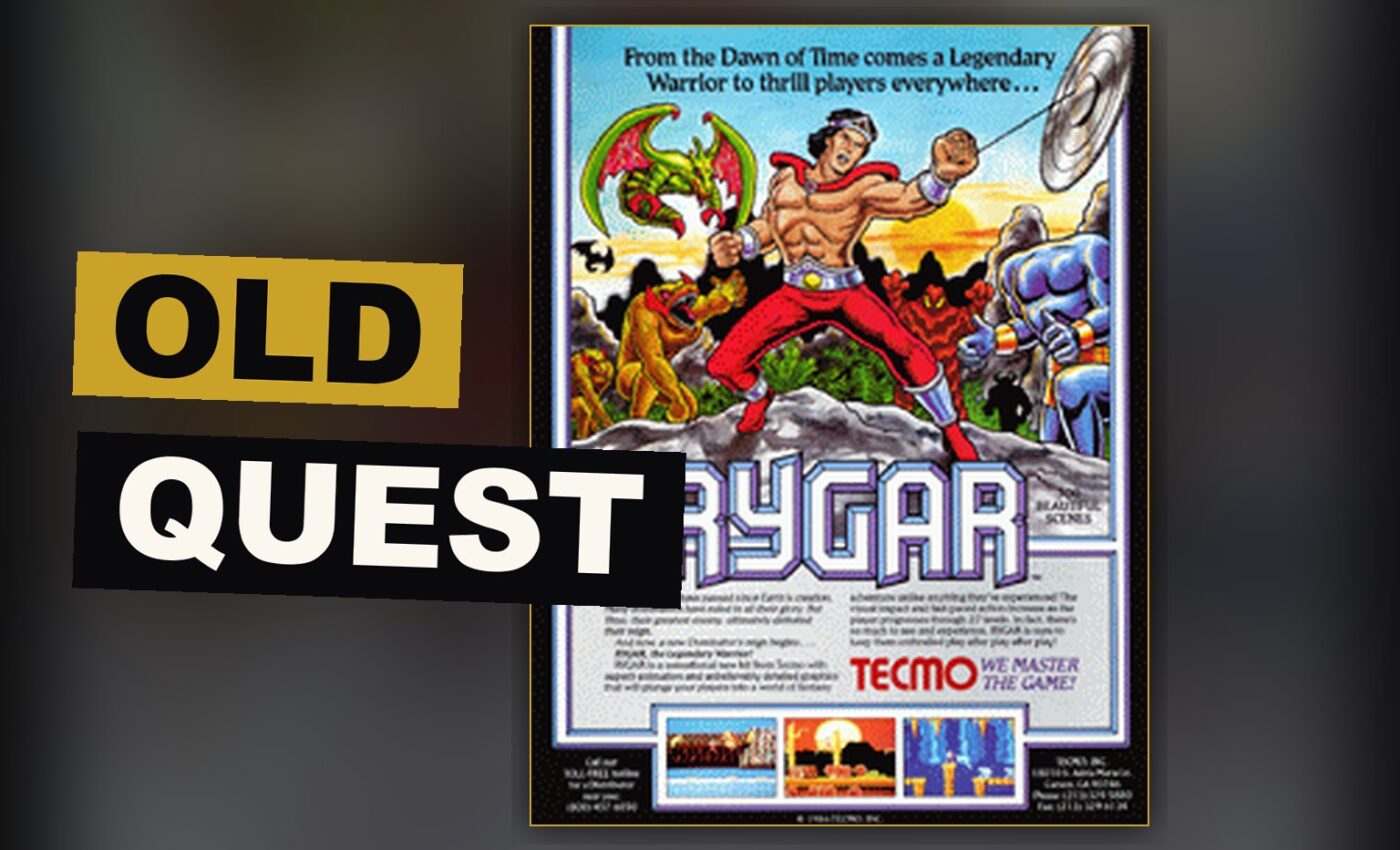
Tecmo’s Rygar hit arcades in 1986 with a weapon nobody had seen before. The Diskarmor is a razor-sharp shield on a long chain, thrown like a yo-yo and reeled back to the hero’s hand. That single idea carries the game further than its thin story ever could.
The Legendary Warrior and the Diskarmor
Rygar is a side-scrolling platformer. The player moves left to right, jumping, ducking, attacking and climbing ropes. The Diskarmor offers a standard front-facing attack, a curved overhead swing, and an airborne strike. Rygar can also briefly stun enemies by jumping on their heads.
There is no health bar. One touch from an enemy or a projectile kills Rygar outright, and so does a fall from a platform. That rule makes every screen a small negotiation.
Ligar Waits in the Throne Room
The arcade original barely bothers with plot. An opening crawl sets the scene: “4.5 billion years have passed since Earth’s creation. Many dominators have ruled in all their glory, but time was their greatest enemy and it defeated their reign. And now a new dominator’s reign begins…”
That new dominator is Ligar, a monster with the body of a large human male and the head of a lion. He can jump great distances. At the end, Rygar fights him in a large throne room, and after the win a crowd arrives to celebrate. The closing text reads: “peace has again come to the world. A new resurrected threat may agian [sic] challenge you.”
One Character, Two Names
In the Japanese arcade game, the hero is unnamed — only “Legendary Warrior.” The final boss was named ライガー, which can be written in Roman letters as either “Rygar” or “Ligar,” because the syllables “Ry” and “Li” come from the same Japanese character. When the game was translated into English, the villain kept the name Ligar and the hero was mistakenly called Rygar. The naming confusion is baked into the game’s identity.
A Port That Built the Map
The NES version arrived in 1987, and it is the one that matters. Nintendo even released the NES version in arcades that year. Where the arcade original had almost no story, the console port expanded it: Ligar has taken over the land of Argool, and Rygar is a dead warrior risen from his grave. Clues and limited dialogue come from large, sage-like men found in stone green temples.
| Version | Year | Notes |
|---|---|---|
| Arcade | 1986 | Original, minimal plot |
| NES | 1987 | Expanded story, RPG elements |
| Commodore 64 | 1987 | Poorly received |
| ZX Spectrum | 1987 | Poorly received |
| Amstrad CPC | 1987 | Poorly received |
| Master System | 1988 | Different ending text |
| Atari Lynx | 1990 | Expanded story |
Why the NES Version Still Holds Up
The NES port folds RPG elements into a standard platformer, and that combination is why it has since been recognized as an important early example of the Metroidvania sub-genre. The Commodore, Spectrum and Amstrad ports were poorly received, particularly for their graphics. The NES version is the one worth your time.
The power-up system deserves credit too. Sun Power swaps the circular attack for a straight overhead strike. Crown Power kills multiple enemies in one hit. Cross Power grants temporary invincibility. Tiger Power lets Rygar kill by jumping. Star Power extends the Diskarmor’s range. None of them are permanent — they vanish when Rygar dies.
What the Difficulty Actually Does
The one-hit death rule is the whole design. It sounds cruel, and it is, but it forces the player to learn enemy patterns instead of tanking hits. The fire monster that appears when a level’s timer runs out is a blunt solution to stalling, but it keeps the pace honest.
Rygar is not a perfect game. The arcade original is a sketch, and the weaker home ports are a warning about lazy conversion. But the NES version took a strange weapon and a stranger premise and built something durable around them.
Get the Notebook.
The day's best stories and every fresh verdict, in plain English, in your inbox by seven. One email a day, no more.