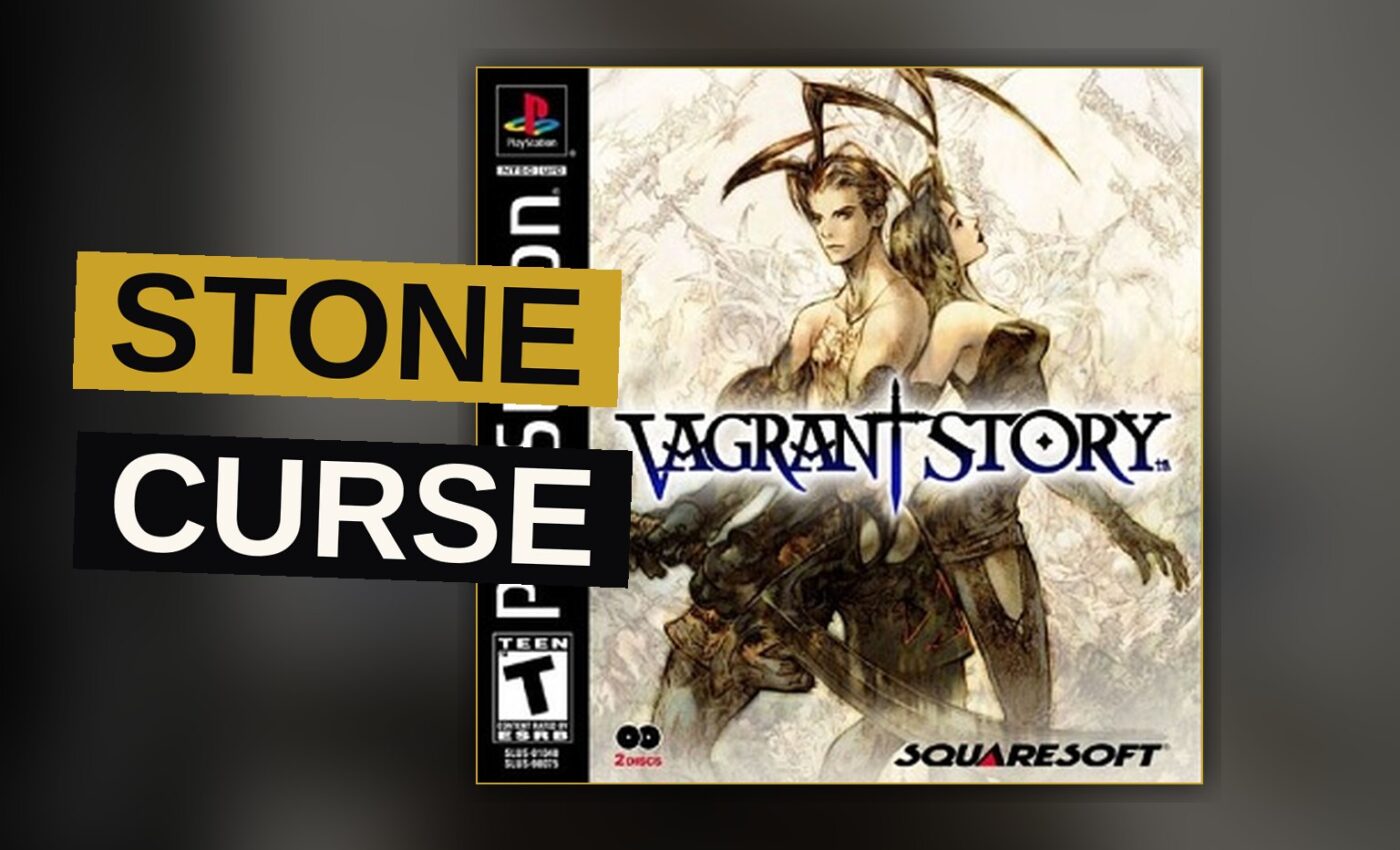
Vagrant Story arrived on the original PlayStation in 2000, and it did almost nothing the way a role-playing game was supposed to. Square’s team, led by Yasumi Matsuno, built a dungeon crawler with no shops, no party, and no small talk. You are Ashley Riot, a Riskbreaker — an elite agent of the Valendia Knights of the Peace — sent into the ruined city of Leá Monde to hunt a cult leader named Sydney Losstarot. That is the whole of it. No inns, no merchants, no companions to trade barbs with. What is left is a game about a man, a weapon, and a city that wants him dead.
A Riskbreaker Walks Into Leá Monde
The setup is tighter than most RPGs manage across three discs. Sydney, leader of the religious cult Müllenkamp, has laid siege to Duke Bardorba’s manor in search of a key. Ashley is dispatched to find the link between the cult leader and the duke, a senior member of the Valendian Parliament. Then the prologue drops its hook: Ashley is blamed for murdering Bardorba, and the game winds back one week to show how he got there. It is a clean frame, and Matsuno — credited as director, producer, designer, and writer — uses it to keep the pressure on.
The kingdom of Valendia is engulfed in civil war. Leá Monde sits on an island ringed by reefs, a town with more than two millennia behind it. Its walls, the game notes, have been the “witness of many battles” and are “stronger than the mightiest forts of Valendia.” An earthquake struck 25 years before the story, destroying the city and leaving the ground unstable. That instability is the point. You are crawling through a corpse.
No Shops, No Friends, Just the Forge
This is where Vagrant Story separates itself from every console RPG of its era. There are no shops and no player interaction with other characters. Strip those out and the game has to fill the space with systems, and it does — weapon creation and modification become the spine of the whole experience. You do not buy a better sword. You build one, break it down, and rebuild it again.
Combat runs on a pausable real-time system, similar to Square’s Parasite Eve from 1998. Tap attack and a spherical grid appears around Ashley; individual body parts inside that sphere can be targeted. Chain Abilities let you string attacks into large combos by pressing buttons in timely succession, which makes fighting feel closer to a rhythm game than a menu. Defensive Abilities cut or reflect damage and shrug off status ailments. Break Arts trade Ashley’s hit points for extra damage — a gamble the game lets you take whenever you like.
Exploration carries its own weight. Ashley runs, jumps, and pushes crates and cubes to get around, so platforming and block puzzles sit alongside the fighting. Clear a block puzzle room and a time-attack mode called “Evolve, or Die!!” kicks in, ranking you on how fast you cross it. It is optional and can be switched off from the menu. The restraint is welcome.
Leá Monde Is the Best Character Here
The city does the work a supporting cast would normally do. The Grand Cathedral and the Temple of Kiltia anchor the center. The west and east districts flank them, still in fairly good shape, ringed by the massive, fortress-like City Walls. Below ground: an abandoned mineshaft and limestone quarry, the shadowy labyrinths of an “Undercity,” and the dark Iron Maiden dungeon. The maze-like Snowfly Forest, named for the snowflies found inside, covers part of the city. The Graylands host the prologue. Valnain holds the VKP headquarters.
Matsuno and Akihiko Yoshida — the pair behind Final Fantasy Tactics — designed it, and the scenery draws on the real landscapes of southwest France, including Saint-Émilion. That grounding shows. Leá Monde reads as a place with weather and history rather than a backdrop, and the third-person camera lets you study it. You can also switch into a first-person view for a 360° look using the START button or the right analog stick. It is a small thing. It matters when the architecture is this good.
The story keeps its own company. Ashley is coming to terms with the recent death of his wife and child, and the game does not soften that into a side quest. His path back to some sense of humanity runs through the destruction of a great many monsters and the exploration of dark, dangerous dungeons. That contrast — grief and grinding — is the actual texture of Vagrant Story, and it holds up better than the plot mechanics around it.
The Friction Is the Feature
Not everything lands. The weapon system rewards patience that the pacing does not always earn, and a game with no shops and no conversations can feel airless across a long session. The block puzzles are filler between better ideas. The time-attack mode is a curiosity bolted onto rooms you have already solved.
None of that sinks it. Vagrant Story is a console action RPG that refuses the genre’s comforts and bets everything on craft — on systems deep enough to justify the silence, and on a ruined city rendered with real care. It earned critical acclaim on release, with some publications calling it one of the greatest games of all time, and the re-release through PlayStation Network for the PlayStation 3, PlayStation Portable and PlayStation Vita consoles has kept it reachable. The absence of shops is not a missing feature. It is the design.
What matters most, looking back, is the confidence. Matsuno’s team took the Final Fantasy Tactics engine of ideas and pointed it somewhere colder. The result is a game that trusts you to build your own weapon, read your own map, and sit with a protagonist who has nothing left but the job. That trust is rare now and was rare then.
The Hard Numbers
- Release: 2000
- Developer/Publisher: Square (later re-released by Square Enix)
- Platforms: PlayStation; re-released via PlayStation Network for PlayStation 3, PlayStation Portable, PlayStation Vita
- Director/Producer/Designer/Writer: Yasumi Matsuno
- Designers: Yasumi Matsuno and Akihiko Yoshida
- Genre: Action role-playing game
- Mode: Single player
- Perspective: Third person (first-person 360° view optional)
- Score: 9.2 of 10
Vagrant Story is not a game you settle into. It is a game you work at, and it pays that work back in atmosphere, systems, and a city that feels excavated rather than drawn. Twenty-five years of rubble, two millennia of history, one assassin with a homemade blade. That is the pitch, and it still holds.
Get the Notebook.
The day's best stories and every fresh verdict, in plain English, in your inbox by seven. One email a day, no more.